


Our second video episode has seen some hardware upgrades and it shows :)
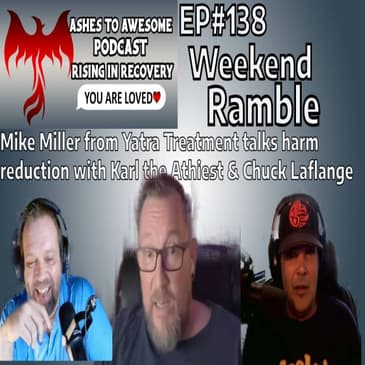
Mike from the Yatra Treatment Center joins KTA and I in an open conversation about harm reduction, and of course we talk about the one episode I managed to publish last week in the midst of a hardware meltdown. It's great to have KTA back, and I am looking forward to as full roster next week. Stay tuned for some format change announcements in the very near future.
Remember if you are listening on Spotify, you can watch the video version there as well. If you are listening on any other platform, you can watch the video version on YouTube by clicking HERE, or searching "ashestoawesomepodcast" in YouTube.
Click HERE for links to Chucks new daily 5 min podcast , "Morning Cup of Kindness", all of our socials where we have posted some great short form content to help inspire, and THE NEW ASHES TO AWESOME APP.
Thank you so much for listening. If you are listening on the Spotify platform, you are able to share your thoughts about an individual episode in the interactive element that Spotify offers. Doing this tickles the fancy of the algorithm and really helps us to spread the message.
Also please visit our Facebook page here, and like, share, or comment on any of the posts. Your feedback there is sincerely appreciated, and taken quite seriously.
Lastly, most of our alumni guests from the podcast are members of our Facebook group. If you would like to get to know any of them, or have questions, or perhaps would like to invite them onto another show, this is a great place to interact. You can join that group here .
Ours sponsors, that make spreading the message possible:
Dent Kits - WEBSITE
Together We Can Recovery Society WEBSITE
Revolution Recovery - WEBSITE
Yatra Trauma Therapy Center -WEBSITE
Nate D Foundation = WEBSITE
Chuck (00:00.654)
I can't do that anymore on video.
mike miller (00:03.297)
Oh yeah.
Chuck (00:06.282)
Hey, listeners, welcome to another episode of The Weeknd Rumble. I am Chuck Liefvein, your host, and with me today in Virtual Studio is my co-host, Carl the Atheist. How you doing, KTA?
Karl (00:16.802)
Doing great, Chuck.
Chuck (00:18.242)
Good stuff, good stuff. And a returning and special guest is Mike Miller from the Yatra Treatment Center out in Phuket, Thailand. Welcome back, Mike, how are you?
mike miller (00:28.051)
Good job. Nice to be back.
Chuck (00:29.07)
Good, good, good. Ah, yeah, nice to have you, that's for certain. So the last week, week and a half really, I guess now, we've had, you know, there hasn't been much out in the way of Ash is awesome and I had some really serious tech issues. We seem to have sorted that out now. So we're trying to get back into a regular release schedule. That said, there's some changes to be had. And the first one, I guess, to talk about would be the format of the weekend ramble. So...
Up until now, for anybody that hasn't been paying attention, we go back and we look at the week previous and kind of critique the week, if you will. And we do it in great detail with a panelist of three or four of us on here. And I've decided now to kind of change that up a little bit where we will definitely go back and critique the week, just not in as much detail and as much length. We're going to start bringing in guests who are professionals as much as we can or at least have some very lived experience.
and talk about recovery and some of the issues surrounding it, aka, or not aka, such as harm reduction, which we're going to do today. I think we're going to talk about that. Before we get into that though, I would like to discuss the one episode that we did get out last week and that was Kaleidoscope Wednesday with Ryan Bathgate. This was an interesting week for him. The week previous he'd had a very rough week in the way of
his personal life, he kind of fell into a funk if you want to call it that. And then this week he'd come back from it. And so we got to talk about the process in that for him and what that meant. Carl, if you want to make some mentions on that real quick.
Karl (02:07.64)
Oh, the one thing I like is the daddy daughter date. I have those with my daughter. We haven't had one in some time, but you know, when they get up to 19, 20 years old, they don't want to go to movies with dad as often. So, you know, it's definitely a good way to get reconnected with your children is to spend some one-on-one time with them without the other parents and without the other siblings.
Chuck (02:11.367)
Right, of course you would.
Yeah.
Chuck (02:22.734)
Hehehehehehehehehehehehehehehehehehehehehehehehehehehehehehehehehehehehehehehehehehehehehehehehehehehehehehehehehehehehehehehehehehehehehehehehehehehehehehehehehehehehehehehehehehehehehehehehehehehehehehehehehehehehehehehehehehehehehehehehehehehehehehehehehehehehehehehehehehehehehehehehehehehehehehehehehehehehehehehehehehehehehehehehehehehehehehehehehehehehehehehehehehehehehehehehehehehehehehehehehehehehehehehehehehehehehehehehehehehehehehehehehehehehehehehehehehehehehehehehehehehehehehehehehehehehehehehehehehehehehehehehehehehehehehehehehehehehehehehehehehehehehehehehehehehehehehehehehehehehehehehehehehehehehehehehehehehehehehehehehehehehehehehehehehehehehehehehehehehehehehehehehehehehehehehehehehehehehehehehehehehehehehehehehehehehehehehehehehehehehehehehehehehehehehehehehehehehehehehehehehehehehehehehehehehehehehehehehehehehehehehehehehehehehehehehehehehehehehehehehehehehehe
No, no, no way.
Karl (02:37.504)
and just enjoy their company and get to know who they are as a person. It doesn't matter what age they are, whether they're a 4-year-old or a 20-year-old. You think you know your kids, but when you get them alone, you really start to understand them more as a person as opposed to your offspring.
mike miller (02:51.586)
Thank you.
mike miller (02:54.948)
Thanks.
Chuck (03:01.23)
enough. Okay.
Karl (03:01.892)
Yeah, so I really liked that he did that.
Chuck (03:04.994)
you find some inspiration there to maybe knock one of those daddy daughter dates off when you get a chance.
Karl (03:13.792)
Yeah, absolutely. She's out of town right now as she usually is. But yeah, when she gets back, hopefully she gets back before Stampede's over. Maybe we'll hit up the final weekend.
Chuck (03:27.214)
There you go. There you go. Stampede week. It's my first time, you know, first stampede week back in Calgary. No urge whatsoever to go. No. For me personally, I don't think it plays well into living a sober life. So, while stampede rarely does, but especially this fresh and this sobriety, it's not an environment I think I want to go spend a lot of time.
mike miller (03:38.403)
Thank you.
mike miller (03:43.874)
Thank you.
Karl (03:47.612)
I started smoking again at the Stampede beer gardens. 18 months without smoking a cigarette, found myself in the beer gardens at the Stampede and full time smoker again. So yeah, it's definitely, definitely avoid.
Chuck (03:50.51)
Hehehehehehehehehehehehehehehehehehehehehehehehehehehehehehehehehehehehehehehehehehehehehehehehehehehehehehehehehehehehehehehehehehehehehehehehehehehehehehehehehehehehehehehehehehehehehehehehehehehehehehehehehehehehehehehehehehehehehehehehehehehehehehehehehehehehehehehehehehehehehehehehehehehehehehehehehehehehehehehehehehehehehehehehehehehehehehehehehehehehehehehehehehehehehehehehehehehehehehehehehehehehehehehehehehehehehehehehehehehehehehehehehehehehehehehehehehehehehehehehehehehehehehehehehehehehehehehehehehehehehehehehehehehehehehehehehehehehehehehehehehehehehehehehehehehehehehehehehehehehehehehehehehehehehehehehehehehehehehehehehehehehehehehehehehehehehehehehehehehehehehehehehehehehehehehehehehehehehehehehehehehehehehehehehehehehehehehehehehehehehehehehehehehehehehehehehehehehehehehehehehehehehehehehehehehehehehehehehehehehehehehehehehehehehehehehehehehehehehehehehehehehehe
Chuck (03:59.485)
There you go, goddamn stampede, right? Yeah, yeah. Did you ever make it to a stampede, Mike, when you were in Canada?
mike miller (04:01.866)
Thank you.
mike miller (04:06.534)
I did, I was in my past life, just before I got clean, I had a little production company and I was hired on as a filmer for a skateboard tour through Western Canada and we went through Calgary and ended up there for the Stampede week and as I was not clean yet, it's a bit of a blur. I remember the skate park.
Chuck (04:20.288)
Uh oh.
Chuck (04:30.638)
Ha ha ha ha ha ha ha ha ha ha ha ha ha ha ha ha ha ha ha ha ha ha ha ha ha ha ha ha ha ha ha ha ha ha ha ha ha ha ha ha ha ha ha ha ha ha ha ha ha ha ha ha ha ha ha ha ha ha ha ha ha ha ha ha ha ha ha ha ha ha ha ha ha ha ha ha ha ha ha ha ha ha ha ha ha ha ha ha ha ha ha ha ha ha ha ha ha ha ha ha ha ha ha ha ha ha ha ha ha ha ha ha ha ha ha ha ha ha ha ha ha ha ha ha ha ha ha ha ha ha ha ha ha ha ha ha ha ha ha ha ha ha ha ha ha ha ha ha ha ha ha ha ha ha ha ha ha ha ha ha ha ha ha ha ha ha ha ha ha ha ha ha ha ha ha ha ha ha ha ha ha ha ha ha ha ha ha ha ha ha ha ha ha ha ha ha ha ha ha ha ha ha ha ha ha ha ha ha ha ha ha ha ha ha ha ha ha ha ha ha ha ha ha
mike miller (04:30.762)
but I don't remember much else. I remember a lot of cowboys and cowboy-esque sort of people, which, you know, as a, yeah. Yeah. But, you know, it was not exactly my element as a kid who grew up in the punk rock, skateboarding addiction sort of world. It was a bit sort of like a fish out of water, but, you know, nothing untoward happened. Just wasn't really sort of my comfort zone, if we'll put it that way.
Chuck (04:36.959)
Yeah, I was going to say cowboy-esque. Yeah, yeah, it's not really cowboys per se. Yeah, yeah, yeah.
Chuck (04:59.958)
I think if I was going to call Stampede something different, 10 days of Untoward would be pretty much accurate. As far as my behavior went in my Stampede days, Jesus, we had some fun, but ooh, right? Carl was there for a lot of those days, actually. I'm just...
mike miller (05:05.428)
Yeah.
Karl (05:15.916)
I remember the one year we went every single day. We'd go for the, we'd go early to get the stamp so then we could go, go to work and then get in free admission at the end of the day. Let's sit on Scotchman's Hill and watch the fireworks. Yeah.
Chuck (05:19.883)
Right? Yeah.
Chuck (05:30.409)
I do miss that. I'd like to get out there actually at some point during maybe next weekend when you're in, you know, when you're not working. We can go hit that up or something. Maybe that'd be kind of cool. I don't think you can get to our spot anymore, but you know.
Karl (05:41.172)
No, it's all fenced off. You're not supposed to be there. No.
Chuck (05:42.986)
Yeah, we weren't supposed to be there either, but whatever. We were 20, so it never stopped us from doing anything.
mike miller (05:45.459)
Hehehe
Karl (05:48.752)
There were pieces of fireworks landing on us.
Chuck (05:53.758)
Literally, actually. We were so close, Mike, that they were landing on us. Remember, your cousin had one up on the wall there for quite some time that had fallen on us. Anywho. Back to the Ryan thing. Anything else you want to cover on that one? There is quite a bit to cover on that. I just don't want to pick it apart too much.
Karl (06:00.056)
Yeah, landed on the blanket.
mike miller (06:05.786)
Nice.
Karl (06:15.98)
There was, you know, the one thing I really wanted to touch on was the question from Rob in Edmonton. I mean, well, I have the question written out, so I'll read it to you. What if there are real consequences attached to a thought of a possible outcome that is out of your control, but still dominates your thoughts? It's a waste of energy, but so worrisome that it can consume someone and, and in turn,
Chuck (06:22.066)
Okay, yep. Refresh my memory.
Karl (06:45.492)
make worse decisions and it piles up and eats a person alive. I feel like I already know the answer to a degree, but how does somebody light the fire under their ass? I think my biggest takeaway that Ryan said is, and he always says this, is the future is unwritten. One of the things that I excel at is not getting upset about things that have already happened because you can't change what's happened.
Chuck (06:55.906)
Okay.
Karl (07:15.076)
it's already been done. But the one thing I think I really need to improve on is to quit worrying about the future because it hasn't been written. It's easy to forget the past and move on with that, but you always have that anxiety and anxiety is fear and fear is lack of information. So if you can wrap your head around that, it will alleviate a lot of those
Karl (07:45.797)
Like that worry that's consuming you. Yeah, I like that he brought up the effort, commitment, environment, and perception. The four things that you can control, right? What are you doing effort-wise? How are you setting up the unwritten future to be written in a way that you can influence it? And I really like that one because that's something that I took out of a leadership course once was, you know.
Chuck (07:48.286)
Anxiety.
Karl (08:12.696)
leadership is the art of influencing human behavior to accomplish a mission in the manner desired by that leader. And I think if you can influence your path, I mean, you can't influence the future so much, but you can influence what you're perceiving, what effort you have, what commitment you have to changing it and the environment that you're putting yourself in. I think that you're gonna be a lot more successful. Thank you.
Chuck (08:39.906)
Well said. Well said. Yeah. One of his big ones is the anxiety into excitement. You know, we kind of covered that a couple of weeks ago, but I love, I love that attitude and how you can, how you can really can, right? Cause it is, it's about the, an unwritten future.
Karl (08:55.641)
Mm-hmm.
mike miller (08:56.648)
All right.
Chuck (08:57.634)
All right. I think all in, he did a really good job at that. And listeners go back and take a listen. Episodes 135 and 137 are the two, that's how much work I didn't get done, right? Geez. In between there should be six more numbers in between. He did a great job of A, being vulnerable the week before, in a live way or on the show. And then kind of explaining how to come back from that on the next one.
real life case. Mike, I see you sitting over there nodding your head in that. Of course, you didn't listen to the episode. I asked you literally 12 hours ago if you wanted to come onto the show. I could completely understand. Is there anything you want to speak to that? Is it a general mindset or a frame of mind?
mike miller (09:39.283)
Yeah.
mike miller (09:45.602)
Um, sure. Well, I, I don't disagree with any of that stuff. Um, about, you know, I come from a place of, um, cognitive behavioral therapy when it comes to like the perceptions and the anxiety and everything. And, um, you know, it's a real way to check your thinking and then get into more effective behaviors, et cetera. Um, I was taught really early in my recovery, plan your work and work your plan and kind of like control what you can, um, you know, so
make your plan and work towards it. And you can only influence what you can influence. You can't, there's a lot of stuff you can't control worrying about it. You know, easy to say worrying about it doesn't, isn't very worthwhile. And it's a bit of a waste of time, like, but how do I stop that from doing it? And so cognitive behavioral therapy to sort of challenge my thinking, dispute it, get into more effective behaviors. And those behaviors include things like regulating the nervous system. So some breathing, some mindfulness, that kind of stuff that can help.
alleviate the physiological symptoms of anxiety, like where you get that heart rate racing and all that. So yeah, I think it's good. One of the things, just speaking really quickly, even though, yeah, fair enough, I didn't watch or listen to the episode, but that daddy daughter date, I'm a guy who didn't get the father son stuff, right? And...
Chuck (10:55.85)
hahahaha
Chuck (11:01.251)
Yeah.
Chuck (11:10.006)
Yep.
mike miller (11:11.31)
And it played a big role in me ending up where I ended up as far as like, you know, attachment disorders, um, you know, having, having difficulty with relationships and confidence and feeling lovable and all of that kind of stuff. And like forming beliefs about myself and, um, having insecure attachment and anxious, anxious attachment in relationships. So, you know, I'd like to say that. Him doing that is, is a lot bigger than like a day out, you know what I mean? Like this is like influencing. Um.
his daughter's future in having her father present. So that's a pretty massive thing. And I think it's admirable and I'm glad he's doing it. It's good for both, it's good for him as well, right? But huge for her, even though, yeah.
Chuck (11:51.402)
Of course it is, yeah. Yeah. Well said, well said. Excuse me. Okay, so moving on. Harm reduction, and I think like a real hot topic right now is the mandated treatment kind of mentality. And I don't know how well in the loop you are on that and what's happening on this side of the pond, but there's some big things happening, especially in Alberta right now, right? So are you up to date on that stuff, Mike?
mike miller (12:20.97)
A little bit. I mean, I've had a little bit of conversations with it. I have a friend of mine that works, has a sort of addiction services, does interventions and treatment placement and stuff in British Columbia. And we talk about all things sort of treatment and addiction and recovery related pretty frequently. And so we've, we've touched base on it. So, I mean, and I am never short of opinions. So, yeah.
Chuck (12:39.175)
Yep.
mike miller (12:48.294)
I try to keep them as informed as I possibly can, but, you know, it's something when I got clean, I got clean in a 12 step place. I started working in a 12 step place. And, you know, it was like abstinence was the way to go. And that's what I needed in my life. Absolutely. Right. And, you know, maintain that abstinence till today. And when I started going to school and started learning, and they were bringing up stuff, you know, so this might be around 2005. And they're talking about harm reduction, like I had.
Chuck (12:48.395)
hahahaha
mike miller (13:17.886)
a real hard time kind of wrapping my head around it and thinking it was like enabling and all the kind of stuff that goes with it. And now it's evolved, you know, like with the mandated treatment and everything is like a whole other aspect that wasn't around back then. And yeah, so I've had some struggles around the harm reduction stuff, but I think my thinking's probably evolved a bit around it as well.
Chuck (13:43.614)
Okay, okay. Carl, I'm sure you can remember when you showed me that news story about manned data treatment. No, no. Okay, okay. I think.
Karl (13:51.088)
Still not a fan.
Karl (13:57.801)
I understand it. And as long as it's used in the same way that...
Karl (14:08.92)
being committed works for people that, you know, maybe schizophrenic or bipolar and are really in trouble of creating harm either to themselves or their immediate surroundings. And now, like I understand, okay, addiction is harm, right? Like you are harming your body with these drugs and that. And there is always the potential for death, you know, even if you don't.
you know, if you're getting heroin, I mean, there's always been heroin overdoses, you know, there's, you know, it doesn't have to be spiked with fentanyl for that to happen. But I think like, like real harm is, you know, the guy that's getting wired and walking down the street with a machete. Maybe it is time for him to be forced into treatment. But then, you know, I haven't I haven't read a lot about what that looks like.
mike miller (15:02.163)
Thanks for watching.
Karl (15:08.064)
Is that just going to be them putting him in detox for, you know, six weeks and then saying, there you go. Now you're not hurting anyone. Have a nice day. Is there going to be continuing care? Are there going to be halfway houses before treatment? You know, you can't just go detox see in six weeks or nine weeks. And, you know, by the way, you know, if you don't stay sober, you got to go back and start this whole process again. Um, I would really have to see more about what their plan is.
I am happy with how the UCP is putting more money into treatment centers. And they are getting rid of some harm reduction services. But
Chuck (15:49.738)
such as, I'm not kidding, I'm not on the loop on this, so help me out.
Karl (15:52.696)
Well, they've closed down some safe injection sites and they've turned them into mobile safe injection sites. So it's like an old city bus now, right? So that, you know, it can basically pull up in an area near tent town, right under the bridge there. And they can have people inject safely there as opposed to putting them into communities where everyone's that, you know.
Chuck (16:01.229)
Okay.
Karl (16:21.128)
Oh yes, we want to see these safe injection sites. Oh, but I don't want it down the street from my house.
Chuck (16:26.37)
That's not my backyard mentality, right? Yeah, yeah.
Karl (16:28.296)
Yeah, right. So they have closed a few of those, I believe. I hope I'm not miss speaking on this. If I am somebody hit us up in the comments. Let me know how wrong I am. But they are putting more into treatment than harm reduction. Now, hopefully, they're looking for a balance for that. But again, nobody has all the answers. Nobody has figured this out yet. So
the fact that they're taking steps, I guess, and different steps.
Chuck (16:58.93)
and different steps, right? We're not just gonna repeat what British Columbia has done in Alberta and hope that it works out differently for us. You know, we've seen that didn't work the way that everybody wanted it to, so we're gonna do something different. I like that personally. I wanna touch on a specific, now that you said it, Carl, the safe injection sites. Mike, what are your opinions on that theme, that idea?
Karl (17:06.006)
Right.
Karl (17:11.308)
Yeah, so.
mike miller (17:20.629)
Well, the name is like, traditionally, they've been called supervised injection sites because injecting isn't safe, right? You know, like Carl said, like you can overdose from heroin, you can overdose from coke, meth, whatever you name it, right? You don't need fentanyl in it. But you know, there's a lot of statistics out there. So I think part of the thing about this is like, harm reduction is
Chuck (17:26.982)
Okay. Yeah.
mike miller (17:45.954)
much more than supervised injection sites, like giving out like crack kits and that kind of stuff. Like it's like helping people get to appointments, it's foot baths, it's socks, it's like warm clothes, it's like all kinds of different things. But the thing that gets really sort of like brought up and sort of gets driven through fear, like it gets really amplified, like oh it's safe injection sites and it's this and that.
Like if you have a supervised or if you have a safe injection site, the kid from the suburbs is going to go out. Now I can go and shoot dope. And like that, there's no evidence that stuff happens. Right. Um, and also like, I know people personally in my life that if they weren't at a supervised injection site would be dead. Like they've been revived there. They're the supervised injection sites have zero deaths. You know what I mean? Like it's people are using anyway. Right. But then
Chuck (18:23.103)
Yeah.
Chuck (18:36.566)
Right? Yeah. That's, that's significant now. Right? Yeah.
mike miller (18:41.394)
So what kind of drives the fear about it is it's still attached to the moral model of addiction, which is that addicts are bad people, weak willed, immoral sinners that need to be punished and all that stuff. Not what they claim to be following, which is the medical model, which would be like, well, they're unwell and we need to provide them treatment. Now treatment is also a continuum too. And treatment isn't just residential treatment. There's outpatient, there's intensive outpatient, there's like
therapy, there's all kinds of different things. There's 12 step, there's other mutual self-help groups like refuge recovery. You know, treatment should be given to higher levels of treatment should go to people that have more severe symptoms, right? So, you know, I can't remember if we were talking about this before, but a couple of weeks ago, two of my friends that were big in kind of the punk rock scene in Vancouver and British Columbia, both died.
Chuck (19:26.186)
Yeah.
mike miller (19:39.626)
on the same day, not together. They had both had varying sort of degrees of abstinence and all that kind of stuff. Like, they weren't suitable for being leveraged into treatment, like mandated to treatment, because they weren't like down on your luck, you know, out running around committing crimes and doing all that. They were people that were struggling, kind of had their shit together at different times. And then they both went and sort of relapsed. And they both died. Now, if they had a safe supply,
they would both be alive, most likely, right? But then you get into safe supply and then it gets into that moral thing of like, well, now we're giving drugs to drug addicts and that's a terrible idea. But every government run liquor store is safe supply. And it's just, why don't we have a moral objection to that when actually the harm done to society, to families, to our healthcare costs through alcohol.
Chuck (20:25.378)
Touche, touche, yeah.
Chuck (20:37.19)
Oh, yeah, it's without a doubt.
mike miller (20:37.41)
dwarfs illicit drug use. So what's happened is, like the sort of majority of people that can sit morally thinking that they're above the fray of addiction, they like alcohol. So they're like, no, that's a cool one. And we're going to supply that safely. Why don't they just make those people go back to bathtub gin and say, if we're not going to do safe supply at all, we're not going to do it. For me, like...
It's such a complex problem and people try to come up with really simple answers like, give everyone drugs, too simple. Don't give anyone drugs, too simple. Make everyone go to treatment, too simple. Like not everyone needs rehab. And from someone who's worked in the treatment industry, in inpatient, outpatient, medical monitoring with addictions, doctors, occupational health, all kinds of stuff for the last 20 years almost, people getting leveraged into treatment.
isn't always successful and actually a lot of times they're not motivated like the guy that Carl's talking about like you know you kind of get them sectioned if you will committed into treatment like you think that guy's going in and be like oh let me give it my all and like I'm really going to come get the best out of this like well maybe some people do but they don't all and it depends on what kind of residential treatment are they providing are they providing evidence-based stuff that includes pharmacological interventions and actual therapy or are they
Chuck (21:45.814)
Hell no, hell no, right?
mike miller (22:02.218)
getting you sitting down and doing stuff that you can get in the community for free, like 12 step stuff, which is fine, but why would the government pay thousands of dollars to house someone to do 12 step stuff when they could literally just rent them an apartment for hundreds of dollars and send them to meetings? So, to me, it has to be evidence-based. It has to be, like, if you're gonna spend this money to leverage people into treatment, make it work. You know what I mean? Like, like.
Chuck (22:08.616)
Yeah.
Chuck (22:18.295)
Yeah.
Chuck (22:26.806)
Yeah.
mike miller (22:28.266)
People cry about where the money goes, oh, we gave them all this money for cocaine to drug addicts and all that shit. And fair enough, you know what I mean? That's not out of line to have that sort of attitude about it. But then we go, oh, well, we'll spend thousands of dollars. I know there's like recovery houses in the Vancouver area that charged the same price that I charge, that we charge at our trauma center. And we're like on the ocean in Thailand with a steam room and a lap pool. And you know, like it's a...
pretty luxurious place. And yeah, and they're, you know, and you know, we obviously not everyone can come to our place and I get that. We have a certain market, but these people are sharing rooms and getting like macaroni and cheese for lunch and the government is paying for that treatment. And so I just think like, you know, if you're gonna invest in it.
Chuck (22:59.168)
Damn near concierge service, right?
mike miller (23:22.694)
invent like do it evidence based. But the thing about evidence based is that some of what drives this whole treatment thing is the sort of lobbying arm of abstinence based treatment, recovery houses and that kind of stuff. And they're like, yeah, if you if I can convince the government that they should hire me to do this stuff, like I'm like laughing. But but if I do that, I should be able to provide evidence that it actually works.
Chuck (23:46.194)
Yeah, right.
mike miller (23:50.526)
And I'm not talking five to 10%. I should be able to provide evidence that this does better than treatment. Yeah. Better than no treatment, better than treatment as usual. It should be an improvement on what's happening. And I don't know that that's what's happening. I'm, you know, I have my ideas about that, but I don't have stats in front of me or anything. I just think that like, if, if you're going to come out. Punching like swinging at one of these models, then your model better.
Chuck (23:55.426)
Better than half, but yeah.
mike miller (24:18.186)
be able to be deconstructed and stand up to some scrutiny. And you better be able to like question it and it shouldn't just be like, well, that way sucks. So we should do this way. It's like, but does, is your way better? Like show us that it is or it isn't. Cause you know, I worked in lots of recovery places where people would come in, do complete treatment episodes of a month or two months. And then they just go get loaded. Like that's not an uncommon thing. And that's like thousands of dollars. And it's like, was that a worthwhile investment? Then there's people like me, the government.
Chuck (24:39.658)
Yeah, right, right. Yep.
mike miller (24:48.234)
Government of British Columbia paid for me to get clean. And I've been clean for 20 years and contributing member of society since. So like they got their money's worth with me, but does that balance it? I don't know. Like, I just don't know.
Chuck (24:59.782)
So that kind of, I think it's something that we've talked about in a few episodes over the course of the show. There is no one size fits all period and we can all agree to that. I think mandated treatment and here I am, I generally typically I try not to inject my opinions into the conversations because I'm supposed to be Switzerland, right? But I think mandated treatment has a place so long as it's done, you know, and with a lot of protocol and you know, it's speaking to what KTA was saying, you know, it's not just a cop saying, okay, you're in,
mike miller (25:08.538)
Mm.
Chuck (25:28.214)
That's it, you're in for mandated treatment, right? There has to be medical professionals involved in making that decision and sectioning them or committing them or whatever the term you wanna use is for that. I think if you could do that, then maybe you've got something to work with there. And for me personally, when that news story first came out that Carl showed me, I was guns blazing. But it was made because news is news, and they need to invoke emotion if they wanna keep their jobs.
it was presented in such a way that I honestly believe that was, oh, cops are going to just be able to say, okay, you're going to treatment center. You know, and of course, Lisa being Lisa, and you know, who's not here today. So this is our first weekend away from the weekend ramble since she started. So she was the one that kind of said, no, it's not like that. It's more compared to like a case of a schizophrenic or something like that, you know, that's at risk. So I think.
mike miller (26:10.21)
Wow.
Chuck (26:22.366)
opinions kind of need to be reserved so we see exactly what they are doing. But she certainly opened my mind to the idea a lot more with that. Right. So I think that was a good thing.
Karl (26:29.84)
The biggest problem I would have with that is just allowing RCMP or city police to make the determination on whether or not it has to be a healthcare professional that makes that decision or the family if that person is a minor. In Alberta, it's 18. If you're a 17-year-old and you're...
mike miller (26:30.646)
Ahem.
Chuck (26:38.37)
which it can't be a thing, right? It just can't be, period. Right?
Chuck (26:48.351)
Mm-hmm.
Karl (26:55.924)
nodding out in your bedroom and your parents are afraid that you're going to cause harm to either the other children in the house or the parents themselves or yourself, then maybe they should be able to say, okay, this is happening now. This isn't an option. And with assistance of a healthcare provider as well that can make that determination to say, you know what, you are right. This is something that we need to do to save this person's life.
but just having an angry cop that's arrested the same guy 10 times and he's high, but he's not really causing anybody harm other than maybe some disturbing the peace or some petty theft or stuff like that. And then the cop just say, I don't want to deal with this guy. Let's put him in for, it's like, and I realized not all cops are like that. And I'm probably the wrong person to talk about it because I'm not a big fan of the way policing is done. But
Chuck (27:48.044)
Hahaha
Karl (27:55.3)
I think it all really boils down to the lack of services that are provided to people prior to the addiction, which brings us to healthcare. They call it healthcare, but it's not healthcare, it's body care. They're taking care of your body. You cut your finger, they'll stitch it back together. You break your leg, they'll set your leg. You have a mental disorder, that's $160 an hour on your own dime.
Why, why isn't healthcare, why doesn't that include your brain? Why doesn't it include, you know, right now they're making steps federally to, you know, include dental into healthcare, which is amazing. Like of course it should be right. Cause dental health is huge. Uh, you know, it, uh, dental health as, as Chuck knows, right? Like we didn't do video when Chuck didn't have his teeth. Now he went through dent kits. He got his teeth. He's happier. He's.
He's more out there. So, you know, like taking care of your body self-care is going to you know, is going to make you Not a better citizen That's the wrong terminology. I don't know the proper wording for it, but I'm sure everybody gets my Yeah, like you're gonna be happier. You're gonna be more productive. You're gonna be you know, you're gonna come out of your shell more and I think if
Chuck (29:11.426)
Happier, happier for sure, right?
mike miller (29:13.59)
Please.
Karl (29:21.024)
if we offer these mental health services to people when they are in middle school, you know, maybe they can, you know, before they get to that point in, you know, junior high or high school where they're starting to experiment with drugs and that maybe, you know, if we get rid of those underlying, you know, I'm not the best at speaking about this, but it's something that something Lisa said.
Chuck (29:44.19)
Mike, I think this is right in your lane. But before we get to that, Carl, I'm gonna interrupt you. Before we get to that, you just reminded me that we do have to take a commercial break. So I'm gonna do that real quick. And when we come back, we'll get into this more, okay?
Karl (29:49.59)
Okay.
Karl (29:56.09)
Perfect.
Chuck (30:04.194)
And awkward silence. Okay, there we are, okay. Okay.
mike miller (30:07.259)
I just don't know if I should talk or not.
Chuck (30:44.462)
You're gonna see why you reminded me to make that commercial happen there, Carl.
Karl (30:47.452)
Excellent. And before you throw it over to Mike, I just wanted to say, it's one of the things that I really picked up on that Lisa said, and I'm probably going back four or five weeks now, and it was when she was talking to a friend of hers, I believe, about the addictions. And she said, you know, these people didn't make any choices that are different than you did. You know, like when we were in our 20s, we went...
You know, we went to the bar and everybody did a rail in the bathroom. But then all of us. Yeah, go ahead.
Chuck (31:16.142)
Do you want me to do you one better here, Carl? Listen to this.
Chuck (32:20.266)
That would be the quote you're talking about, Carl? Yeah.
Karl (32:23.872)
That is the exact quote. Yeah, exactly. Yeah. I'm glad you had that queued up because I didn't want to ruin it.
Chuck (32:32.592)
Right? Like I do that to Ryan all the time, right? He'll say something just profound. I'll be like, but did you hear what Ryan said about the thing and the stuff and the what have you? I mean, yeah, like that, right? It was so right. It was.
Karl (32:43.68)
Yeah, it's exactly that, right? They all made the same choices, but some people, you know, were predisposed to it, whether through mental health or, uh, through their, uh, family situation.
mike miller (32:54.323)
Thanks for watching.
Chuck (32:55.554)
trying to dip it in the ass before that, right? Before we get to that point, right? Yeah, yeah, true story. Mike, your thoughts?
Karl (32:57.4)
Yeah, middle school is a great, great place to start.
mike miller (33:04.57)
Oh man, I got a lot of thoughts.
Chuck (33:07.062)
I know you do. Yeah. I'm starting to figure out Mike, I'm going to have, I'm going to have to be better at breaking you up a little bit, like I am with Ryan. So that's, I'm, but we're learning. We're learning. Right. Okay. Go ahead.
mike miller (33:12.596)
Yeah, sorry. Yeah. Yeah, I like what she said. I mean, again, what she's saying is like people, again, see things through the moral model where it's like, oh, you know, you did the thing because there's something wrong with you and I did it and there's nothing wrong with me. So I'm fine. You know, like it's a way to place yourself above them and other people, you know, but I think that like.
You can't separate physical, mental, emotional. Like it's all part and parcel. Like I know this. If I feel sick, my thinking starts to become a bit more negative. Then my emotions are a bit more negative. Like I don't feel as good. Like you can't, you can't separate all of that stuff. So when we go, oh, well, we're gonna fix your cut finger, as Carl said, but we're not going to teach you any kind of coping skills. And you know, this is where it gets a little like, sorry, I'm a lefty bleeding heart.
liberal therapist. Capitalism is designed to grind people up. It's not to take care of any of our health. You know what I mean? Like if you don't get a return on your investment, then the system doesn't see you as being worthwhile, if that's mental health, etc. Now, what we do know is that when you invest in people's mental health, you do get a return on the investment as society because A, you stop being a drag on society. You're not being policed. You're not in probation. You're not in court.
You're not in the psych ward, you're not in that kind of stuff. Um, and, and you're not doing crime and do, you know, if you get well, right. I mean, particularly if we're talking about addiction, but at no point is that ever, there's no preventative stuff. Like, you know, I went to school and what did I learn? I learned how to, you know, go and be a worker. I didn't learn how to have relationships or how to set boundaries or, you know, anything, one of, one of my trainers talks about, um, he says addiction. This is his quote.
Chuck (34:34.796)
Yeah.
mike miller (35:03.898)
it's a substitute behavior for attachment deprivation. And so if we can look at it, that it's, or like Matte says, don't ask why the addiction, ask why the pain. Like if we know that that's what's driving it, people who work in this field know that that's what's driving it. Why aren't we doing anything preventative around the pain before people get into the addiction? Because many, many people can use drugs.
Chuck (35:28.672)
Mm-hmm.
mike miller (35:33.158)
and not wind up how I wound up. You know, kind of like what Lisa's saying, right? Like her ex-boyfriend, you know, he experimented and used and partied, but he didn't end up as a full-on addict. You know, the difference between him and me might have to do with our upbringing and the fact that as I started going kind of off the rails, every adult that I came in contact with was about punishing me and controlling me and putting me in a little room or whatever, but nobody was like,
Hey kid, you're going off the rails. Like instead of putting on probation, maybe we'll like give you some counseling sessions, or maybe we will like talk to you about what's going on in your life beyond your behavioral issues at school where you're acting out, right? And they, and they just don't do it.
Chuck (36:17.898)
Nope, nope, fair enough, eh?
Karl (36:19.904)
Well, they have school counselors, but they're there to help you determine what job you're going to be. They're not there to actually, you know, see what's... Yeah, yeah. So, I mean, that's more of a career counselor than it is a counselor. And I think we need more people there to, you know, if you see a kid acting out, you know, they go see the counselor and it's not to determine what college you want to go to. And it's not to determine...
mike miller (36:26.706)
Yeah. Council you.
mike miller (36:37.378)
for sure.
Karl (36:49.46)
where you want to end up in life. It's to determine what is wrong, right? It'll make them better students in turn, will make them better workers. And for the capitalist conservatives out there, they become taxpayers. That is government revenue. That is your goal, right? Like you want more money, make people healthy and happy. They're gonna work harder for the things that they want to achieve, which in turn is gonna provide income to the government. So, I mean, they're...
mike miller (36:53.91)
Yes.
mike miller (37:02.356)
For sure.
Chuck (37:15.118)
Lisa spoke to this a few episodes ago as well, the one to six ratio, right, if you remember this. Every dollar that's put into treatment is seen back six times in society, right? So the math is good, right? And apparently this study's been repeated multiple places across the world and the results are consistent. Again, I hate to bastardize something that she said that she said so eloquently at the time, but very true, very true. Or if that is true, I should say,
that it's something we need to really seriously look at. And we don't because of four year election cycles and you know, nobody's saying, and optics, it really comes down to optics, right? Nobody wants to be the politician that gets shunned for saying something that, you know, be it true or not, doesn't sound like what the people wanna hear.
mike miller (38:01.398)
Well, I would be very interested in what the definition of treatment is in that, because like I say, treatment is a continuum, right? And, um, it can, you know, you can, if you intervene early, it'll take a lot less investment than having to house someone long-term in the, you know, I went to treatment for six months in a sober house for four months after that. And, you know, as Devin is, is prone to talking about like what the government paid for me was not very much to those places, but it was still like thousands of dollars, whereas
Chuck (38:14.538)
Yep.
Chuck (38:28.127)
No.
mike miller (38:31.486)
when I was in school, you know, I'm an honor roll student. And next thing you know, I'm like skipping classes and showing up drunk and high and all the kind of shit that we do. And when I got talked to by an adult, it was to give me shit and suspend me and send me home. It wasn't to say, hey man, like this is a pretty big shift away from like honors algebra to like coming in smelling like weed and skipping class. Like what, where is that disconnect? Like what is happening?
Nobody ever did that. It could have been preventative. Sure. Yeah.
Chuck (39:01.63)
Yeah, right. So much better to ask what's happening than what happened. You know, right? You know, yeah, yeah. What's this, an ounce of treatment is a pound, or an ounce of prevention is a, how's it go? Somebody help me out here. Yes, there we go, there we go, thank you. Yeah, yeah, I figured you'd both be better at that than I. Anyway.
mike miller (39:13.046)
Poundacure. Poundacure, yeah.
Karl (39:20.048)
Yeah. And what, you want to spend $10,000 on providing treatment to somebody, or do you want to collect $10,000 in income tax from their paycheck? I mean, come on, just get your shit together, people.
Chuck (39:29.61)
Yeah. Great. True story.
Chuck (39:36.085)
It sure feels that way sometimes, right? Go ahead, Mike.
mike miller (39:36.511)
Well, but the thing that you can't get away from in that is the moral model. And like, you know, like people just look down on drug addicts and think like, I don't want my tax dollars going to those people, you know, to that stuff. And you know, they want to punish people. And well, exactly. Right. But that but the politicians don't fire that up as the thing to get people like super angry and
Chuck (39:51.107)
Yeah, you don't think they are when they go to jail? No, right? Right? Yeah. Yep.
mike miller (40:02.706)
and get to the polls and vote for them and everything. They don't go, hey, do you know that actually treatment would allow us to do less policing and if we paid for them to get clean, you wouldn't have them in the courts and probation and jails and et cetera, et cetera. Or in the emergency room where you go in and complain about your healthcare because you're waiting and it's because there's such a drag on it. And some of it is because these people that aren't well end up.
Karl (40:18.956)
The emergency room waiting room. Yeah.
mike miller (40:32.118)
harming themselves in some way, you know, through, you know, misadventure or whatever it is, um, and end up in emergency rooms or, or whether it's psychiatric needs or whatever, like that could ease every aspect of our legal and, and medical system. But people go, yeah, but I don't want my money to go into that. And it's, well, but they're, but they're fired up about it. You know, like that's the whole thing. They get, they get wound up and pointed at.
Chuck (40:53.758)
Yeah, it's crazy, right? It's crazy. You know, perception is...
mike miller (41:02.142)
You know, the people, the sort of predator class of rich people love nothing more than pointing working class people at the underprivileged people or people that are struggling. Right. And so like, you know, like, Oh, those are the problem down there. You're like, well, your tax breaks for your company are equal to like 200 treatment beds, you know, like it's, it's not really, but they don't want you to know that shit, right.
Chuck (41:28.094)
Yeah, yeah. Ooh, now we're getting into some delicate territory. Yeah, we're going on the capitalist thing here. Ooh, right? It's different. For clarity, I am a right-wing guy, so, right? I mean, I like to think that I'm a little more open-minded, say, than a lot of people on my side of the aisle, right? But, you know.
mike miller (41:31.302)
Sorry, told you. Hey man.
Yeah, it's all right.
Karl (41:49.14)
I think we're the new conservative check. It's the ones that want to be, you know, we want our money to be spent responsibly and we want our values, whether that be, you know, your religious values or your personal values, we want those to be foremost in our life. And we want to take care of our families and we want people to, you know, live and let live. But at the same time,
Chuck (41:52.77)
Fair enough, right?
mike miller (41:53.474)
Cool.
Karl (42:20.312)
we're not about handouts. And I don't think providing treatment to somebody is a handout. I think that's a hand up. Yeah, exactly. And.
mike miller (42:27.436)
Hand up.
Chuck (42:27.618)
No. Yeah, right. I would argue that prison is a handout. Right, you know what I mean? In those circumstances anyway, right?
Karl (42:33.216)
Absolutely it is. It's a scapegoat. We're just going to hide these people away for a few years. Now they're not our problem. And then when they get out, they're usually a bigger issue.
mike miller (42:46.626)
Sure. Well, it's not rehabilitating anyone. And you know, like I'm, I'm definitely not a conservative, much more liberal, but I'm also a business owner. And I think that you can do that ethically. And I think that I want, I also want my tax dollars spent in ways that help people that need it more than help people who already have it. You know what I mean? Like that's just, if everyone pays their fair share and you help the, you know, it's that whole thing like.
Chuck (43:08.075)
Yeah.
mike miller (43:12.614)
A measure of a society is how it treats its least fortunate people, right? And I think that, um, if, if we're all good, then we're all good. Right? Like it's just a better way to live. If we take care of those people who live in tent cities, then guess what? I don't have to look at a tent city. Everyone wins.
Chuck (43:16.888)
Yes.
Chuck (43:20.714)
Yeah. I like that. I do.
Karl (43:29.359)
Exactly.
Chuck (43:29.925)
Yes. Right.
mike miller (43:30.782)
Like I don't understand how that's like a big sticking point for people, you know?
Chuck (43:37.102)
I do want to take a quick break for a PSA. And we'll be right back after this. I don't actually have a PSA queued up, so I'm gonna have to edit that in after the fact. Right? Edit, edit, edit. If I say that, then I can search for it in the conversation later, and then it makes it really easy, so. Right? Yeah, yeah, right. Right. You know what? Carl taught me that I had no idea of the action.
mike miller (43:50.36)
I don't know what I can talk about.
Karl (43:54.746)
edit
mike miller (43:57.398)
Now, on video I do this.
Karl (43:58.188)
You gotta say it like Super Mario Brothers.
Chuck (44:06.03)
thing, you know, that the whatever, right? I can't do this one. Yeah, that thing that it was for the sound and the visual, right? Which of course, you know, yeah, I had no idea. That was like, yeah, total news to me, right? Yeah, right. Which I'm going to have to do when I get start getting multiple cameras in here for this. I'm going to have to start doing the clap thing, right?
mike miller (44:07.99)
The clapperboard.
mike miller (44:12.586)
Yeah, it syncs it up. Yeah.
Karl (44:15.94)
This way, I give her a big.
mike miller (44:18.294)
Yeah.
mike miller (44:24.007)
Yeah, then you need a multi cam editor. I, when I would do skateboarding videos, you know, you're filming people doing trick after trick after trick after trick, and you don't want to go through hours of footage. So every time someone landed one, you'd wait about 10 seconds to get them rolling away, and then just put your hand over the camera. And then you're like, oh, I saw the hand. That means the trick was landed, you know.
Chuck (44:40.397)
Yeah.
Yeah, right, yeah, rather than sitting and waiting for it. I like that, yeah, okay. Okay, so well.
mike miller (44:50.626)
There you go. It'll make it easier for you.
Chuck (44:51.062)
We're back from the break. All right. All right. So. On to next year. We're at the 45 minute break, our line. So we're getting there. This is see this harm reduction. We could realistically we could do the weekend ramble on harm reduction every single week because there's so much to cover and so much and different opinions different and all the things. And I think it's probably going to become definitely a reoccurring theme. Well I know it is.
Chuck (45:22.594)
Help you out here, guys. All right.
mike miller (45:24.31)
Well, for me, I want to say one thing. I have opinions and I've worked in this field for a long time, but I don't by any stretch of the imagination think that I have the answer. What I do know is that, as Carl said, one size fits all is never gonna work. It just isn't. And so when we're talking about leveraging people into treatment or whatever, it should, if you were gonna get, what would it be, like a lung transplant, right?
Chuck (45:28.087)
Mm-hmm.
mike miller (45:52.906)
So you get assessed by a doctor and they go, yeah, man, like you need a lung transplant. And then you would, before you went in for the actual operation, they would say, have you been smoking lately? And if you said yes, they'd be like, you're not eligible anymore, like you're out. Because we're not going to waste a healthy lung, not that you're not worth a lung, but we're not gonna just basically throw on away when there's tons of people that need it. So.
When we're leveraging people into treatment, I think it has to be assessed like, look, if we put you in treatment, what are you gonna do there? Like, are we just gonna put you there and you're gonna be resistant, you're gonna disrupt the community so other people trying to recover also have a harder time. It's, you know, there's a bit of a saying in treatment, 10% of the clients give you 90% of the work, right? Like you get the compliant clients and the people that come in, and then you get the resistant and defiant ones. And to me,
Chuck (46:27.356)
Yeah.
Chuck (46:42.371)
I'm sorry. Yeah.
mike miller (46:47.626)
That's based in trauma. Like the reason that they're doing it is because they don't feel safe and they don't feel safe to do all the stuff that's in treatment. But then they get punished for having those symptoms instead of having those symptoms actually treated through the lens of trauma. So you need to find the right thing.
Chuck (47:01.194)
You just said something Mike that I wanna unpack for a second. And it's really, not that I mean to cut off your point, I think you're making a very good point. However, this is something specific to you. You just said that's based in trauma to you, that's based in trauma. Do you find because of your work that everything is based in trauma? And I don't mean to minimize what you're saying at all. I mean, do you find that you managed to pull that out of situations or that you see what other people might not because of your work? That's maybe a better way to put that.
mike miller (47:07.315)
Oh, that's fine.
mike miller (47:21.251)
Um, no, no.
mike miller (47:29.546)
Well, it's more like it's the conclusion that I came to after working in treatment for a long time. So there was always, there's almost always someone in a group therapy situation who would be called something like a passenger where they don't really wade into discussions. They don't offer up parts of themselves for discussion. They don't get vulnerable. And then a lot of times what happens is the counseling teams will be like, that person's not invested in treatment. They're defiant, they're resistant, they're this.
Chuck (47:35.668)
Okay.
mike miller (47:58.366)
And I would suggest that what I know about clients, and I just have had this reaffirmed from clients, is that they don't feel safe enough in a group full of people they don't know to just really get vulnerable and let their guard down because their whole life they've had to be guarded against that kind of stuff. Most people, like this is again, the moral model versus, like I don't meet people in treatment who are bad people. Like I don't, you know.
I ask people when they come in and I say like, you feel bad about how you acted in their addiction? Like everybody goes, oh yeah, man, shame, guilt, remorse. Like I acted terribly. It's like, okay, well then clearly you're not a bad person. And then why aren't you engaging? Well, it's because you don't feel safe enough. And then when you don't feel safe enough, you then have compensatory behaviors, which are things like shutting down, using anger to push people away, like whatever it might be. And it looks behaviorally like they're disruptive, but they're just not in the right room.
with the right people at the right time. It's, you know, it's that, again, treatment does the same thing, one science fits all. They'll say, oh, we do individualized treatment plans, and then you go in and everyone's in group at this time, and everyone does this at this time, which is a great way to kind of maximize clinical hours. If I sit in a room with 10 people in group, you're getting 10 clinical hours out of me in one hour of my time, right? So each client feels like they got an hour of treatment, but they don't, right?
Chuck (49:24.191)
Mm-hmm.
mike miller (49:24.43)
And I'm not saying group therapy is bad, not saying that. It's just not appropriate for everyone. Just like none of this is appropriate for everyone. My center isn't appropriate for everyone. You know, it's like you really need to assess and get people to the right place to meet the needs and the level of care that is appropriate for them.
Karl (49:43.532)
You need to meet people where they are.
mike miller (49:46.002)
For sure. It should all be client centered. Like if it's, if it's client centered, we should ask someone that we're going to mandate into treatment. Do you even want to be clean? Because you can't make someone be clean that doesn't want to be clean. Like you can put them in treatment and house them for a month or two months or however long it is. And then they're just going to go out and use it. It's like, okay, did we, and what the rationale will be a lot of times is what we planted the seed. It's like they know that people stop using drugs. Like they know that that's not like,
Chuck (49:46.114)
Yeah, yeah, right, you know, yeah, yeah.
Chuck (50:14.976)
Hahaha
mike miller (50:16.018)
What you're doing is you're recharging them to go out and go on another run. And I'm not suggesting that you just let them keep going, but instead of like, you know, you use motivational interviewing. Well, if you're not into getting clean, how can we help you to become interested in doing something to get us like from, you know, train wreck 10 out of 10 to like train wreck eight out of 10, you know what I mean? Like, how do we get you motivated to be a little bit healthier than you are right now and make some changes that.
And then you get them into treatment eventually. It happens in supervised injection sites where people, that's their first introduction to sometimes like addictions workers and social workers and that kind of stuff. And eventually they go like, hey man, can you help me get into treatment? When they...
Chuck (50:58.654)
And here's the one thing about harm reduction, Mike. At least, in the very, very least, no matter what your mindset is about it all, is you're putting people in touch with people that care. Right? At least that, there's a connection there. Right? Yeah. And yes, right? There's a connection happening at any point in any sort of harm reduction, there's a connection happening, and we can all agree about how important connection is in its relation to addiction, or not, or helping with addiction.
mike miller (51:08.682)
Yeah, well, and you can't help them if they're dead.
mike miller (51:22.902)
Well, if people think about it, if anyone who doesn't have a relationship with addiction thinks about any time in their life when they've thought something like this, oh, you know, like I got a bit of weight on here, I should probably change my diet and start exercising. Like the next day, do they just like 180 flip everything around? Probably not, right? First thing is like, yeah, well, you get, you know, it's like the stages of change thing, right? Like you start becoming.
Chuck (51:41.911)
Oh, there's a progression, right? Yeah.
mike miller (51:51.03)
contemplative where you're like, yeah, maybe I could probably do that. And then, and then, you know, you, you start moving more towards change through the different stages and eventually. Yeah. Or maybe like, you take like the Coca-Cola out and you put in like Coke Zero, or you take the, all the pre-packaged food out and you put something else in and then, yeah, then maybe I start going for walks and to get, and then after the walks, maybe then I'm in the gym and it can be a progression until the point where you're like a machine that's like.
Chuck (51:58.174)
looking at a gym or looking at your diet and yeah, right. Eventually you get there.
mike miller (52:20.542)
you know, doing 100k runs and eating all raw food or whatever it is. Um, but it, but, but you don't. Yeah. But you, but you don't go, you don't go from the sofa, scarfing back pizzas and drinking two liters of Coke to that guy. You know what I mean? Like that's just not a realistic, but that's what we're asking people to do in addiction, right?
Chuck (52:27.04)
And then he said, 100 K while in runs. So they all laughed and laughed. All right.
Chuck (52:38.878)
No, you certainly don't. You certainly don't.
Chuck (52:44.273)
Yeah. One last thing that I do want to talk about.
And it's a sensitive one for me today, but the connection thing. So I lost another friend a few days ago, I should say. I found out about it yesterday morning, two overdose. The thing is, I come across this news once every week or two. And I'm not happy to say that I've become pretty accepting of it. And I won't use the word apathy, but maybe leaning in that direction.
This particular friend, I was.
Chuck (53:27.294)
I was cruel to him.
Chuck (53:31.95)
I'm sorry.
I was mean to him the last three times I saw him. And at the time I felt it was justified. It doesn't matter though, it doesn't. And when I say that monologue, and I'll say it at the end of this episode as well, and let people know that their love to use the words that are loved, it's so important.
Chuck (53:57.81)
It is so important to do that and to let people know that you care. Because it just... That's... For me, the lack of love or perceived lack of love or not feeling lovable was the boot on my neck for my last, arguably, two years in active addiction. And...
if we can just do better, you know, at that connecting and just letting people know and there's a couple points I'm making here I guess but in this day and age with fentanyl on the scene people die more suddenly more often than ever before and you will never get to take those words back right so choose them carefully right choose them very carefully
Karl (54:47.053)
Well said.
mike miller (54:47.722)
sorry to hear about your friend. And I think it's, you know, I can very much relate to like not the apathy thing, but it's almost like I'm not surprised by, I'm not shocked anymore when anyone that's using drugs, I find out that they pass away, which you get a bit sort of like you build up a callous on your heart towards it because it's just happened so much and it's really sad. And I'm not even in Canada. You know, we talked about this the last time I was on. I don't experience a lot of it here, but all my friends back home,
I, you know, I through social media, I hear about it. But, you know, the other thing I would say, yeah. The other thing I would say, Chuck, is it's really easy to beat yourself up at, you know, looking at things in retrospect. But, you know, as far as like put that in this context of harm reduction is like the caring words and the love and all that, that's harm reduction. You know what I mean? Like it doesn't have to be a supervised injection site. It's like that person is like, oh, maybe there's like something. Someone gives a shit, right?
Chuck (55:19.71)
You spoke about two of them today, right? Yeah.
Chuck (55:37.454)
Yeah, it is. Yep.
Chuck (55:45.418)
Yeah, right.
mike miller (55:45.618)
So it doesn't have to be these formalized like drug delivery systems for it to be harm reduction. It's like we can act compassionately towards people. Like I said, it can be foot baths or a sandwich or whatever it might be, and it can just be kind words, right? So, you know, it's, I think what it speaks to is addiction comes with a lot of really shit behaviors that can be incredibly frustrating.
And then, you know, sometimes that can lead into us getting sick and tired of it and all that. And I get that. Like we can get compassion fatigue, right? It's like, I've had enough of the shit behaviors. And, and, you know, I think that getting it away from that, because again, that's back sort of into the moral model stuff and getting it into the like, rephrasing it in my head, like, you're not a bad person. You're trying to get good. You're an unwell person trying to get well kind of thing. Right.
Yeah, it's really sad. I'm really sad to hear about your friend and I can see that it really hits you home or hits home for you. Sorry. And, uh, yeah, I wish that could end.
Chuck (56:48.802)
Thank you. Yeah, me too, me too. Carl, you were gonna say something there?
Karl (56:57.984)
Um, that's the love model that he was talking about. It's that connection. It's that being kind. It's, uh, you know, addressing immediate risks associated with the certain behavior. Um, and
fostering trust, improving engagement with that person, and in turn, hopefully increasing the likelihood that they'll seek treatment. As Mike said earlier, you can't force somebody to wanna be clean, but maybe you can at least increase the likelihood that they'll want to. And just by making that connection with people and just loving them.
I mean, that's what it comes down to.
mike miller (57:49.818)
And I think that what happens is, in my experience, it's so much more impactful for the person that you're doing it to. And I'll give you a quick little anecdote. I knew a guy that struggled with in and out and in and out of addiction. And he told me this story. I didn't remember it. I ran into him in downtown Vancouver and he was really loaded and he asked me for money. And I said, I'm not gonna give you money, but I'll buy you McDonald's.
And he tells me, he goes, everyone else would just like give me the money to get the McDonald's and go away or buy the McDonald's and then just leave. And he said, you sat with me while I ate it. And I said, I had no idea that I did that. Like I didn't remember it. But to him, it was this really impactful thing where it's like I treated him like any other human being because if one of you guys was hungry and I was like, hey Chuck, how you doing? You're like, oh, I'm hungry. I'm like, oh, let's get McDonald's. I would sit with you while you ate that meal. You know what I mean? Like just out of like.
connection to you and respect and courtesy but with addiction we don't do that shit we go like oh get out of here you know i think i'm being some like
Chuck (58:52.772)
The more kind of us actually give something and then walk away. But what you're saying, that's profound. And if you're listening, think about that. Really think about that and what that connection could mean to an individual.
mike miller (58:55.968)
Yeah.
mike miller (59:01.43)
Yeah.
and I'm not trying to set myself up as being super kind or anything like that. I'm just like, cause I didn't remember it. Like, and to this day, I don't remember that. Yeah.
Karl (59:05.069)
It's...
Chuck (59:11.559)
I love how you said that I didn't remember it. To qualify, there's some humility there. I'm like, that's admirable. Oh, go ahead, Carl. Yeah.
Karl (59:18.224)
When I...
mike miller (59:18.244)
But I do think that's the thing, right? Is that it's an important thing for him.
Karl (59:23.32)
I was just going to say that I believe it's kind of like, I believe it was your mom, right? Norma, when she was down in San Francisco or something, she was talking about that extra sandwiches or something. And she went down to give sandwiches to these guys, but she didn't just say, here's a sandwich and then bugger off. She stopped, gave him the sandwich and talked to him. And you know, that connection, who knows where that guy is now.
Chuck (59:45.666)
had the conversation.
Karl (59:51.672)
But maybe that little bit of conversation and the food probably did more for him than just, you know, throwing a sandwich at him and running to your cap.
Chuck (01:00:01.97)
most certainly more than a couple of bucks right because we all know where that goes right yeah well said
Karl (01:00:05.812)
Yeah, I mean, and, you know, I've, I've done that. Like I've been downtown on the C train and, you know, people have asked me and I've gone into the seven 11 or the max or whatever it was, and, and bought them, you know, a sandwich, and then I gave him the sandwich and I got on the train and I left. But I've also, you know, had homeless or unhoused underhoused people come up and ask me for money and say, you know,
Hey, do you get two bucks? I'm trying to get beer. And I've given them the two bucks because I mean, at least they were honest with me. You know, they're not like, Hey, do you have a couple bucks? I'm trying to get my daughter onto a bus to go see your mother. I mean, I know you're not. I know you're not right. But, you know, if you're honest with me, you know, actually, just recently, within the last, I'd say six months, I stopped at the liquor store on my way home one day, was grabbing a case of beer.
Chuck (01:00:49.814)
We've heard all the stories, literally every version of that story, right? Yeah, yeah.
Karl (01:01:04.352)
There was a guy that, you know, he looked a little disheveled and he was with a woman and they were panhandling. He said he wanted to, needed a couple bucks to get some beer. And you know, I just bought him an eight pack. And then I also, because he was indigenous, I also gave him some sweet grass and some sage and told him to, you know, have a smudge and let him know the creator loves him and, you know, wished him well.
Um, asked if he needed anything else, if he needed food or anything. And, uh, he said he was hungry. So I gave him whatever was left in my lunchbox because I always bring more food than I need. And yeah, I imagine they went to a park, drank their beer, ate their food and passed out under the stars and you know, I hope they're doing well. Um, I haven't seen them around town since. So yeah, who knows.
Chuck (01:01:52.494)
Who knows?
mike miller (01:01:53.814)
What you did was you relieved some of their pain for that day anyway, right? Like, you know, it's, yeah.
Karl (01:01:57.896)
And that's what it was about. Cause I could see it in their faces, you know, like I work nights, right? So I make it to the liquor store. If I want a case of beer, like it closes at 2 a.m. and I get back to air, like 10 to two. So, you know, it was late and, you know, it wasn't that warm out, but you know, it was more than just here's the beer. There was a conversation.
mike miller (01:02:02.931)
It's huge.
Karl (01:02:21.284)
there was, you know, I gave them some medicine for some smudging in that because they were indigenous and I hope they appreciated that. Uh, they, they seem to, when I gave them the sage and the sweetgrass, he was like beside himself that I had it, right? Because I don't, I don't present very indigenous. Um, but, uh, yeah, I mean, it's, it's about making that connection and hopefully, you know, hopefully they knew that there is somebody out there that does feel for them, feels their pain and.
and understood that, you know, I'm not going to tell him to piss off. He's standing outside of a liquor store five minutes before close. You know, he's a couple bucks short. I bet you the guy in the store probably would have let him go with a, you know, short a few bucks even. So.
Chuck (01:03:01.399)
Mm-hmm.
All right. Well, guys, like I said, we could go on about this for ages. We're not going to go, there's always next weekend. And Mike, I want to thank you for coming on the show. It's time for daily gratitudes. And guess who they're brought to you by Mike.
mike miller (01:03:14.434)
closer.
mike miller (01:03:19.506)
No idea.
Chuck (01:03:24.006)
And go. And they're coming, I promise.
mike miller (01:03:31.013)
I didn't know what the cue was.
Chuck (01:03:33.398)
That was the cue is they're supposed to be playing right now and they're not and I don't know why. Yeah, so edit, edit. God damn it.
mike miller (01:03:36.766)
Yeah. Oh, OK.
Karl (01:03:40.736)
Edited it
Chuck (01:03:44.846)
Why isn't it playing? God damn it. Well, Daily Gratitudes are brought to you by Yachter Treatment Center in Phuket, Thailand. Let's see if I can do this from scratch. Daily Gratitudes are brought to you by Yachter Treatment Center in Phuket, Thailand. They are a business run by, nope, they're a clinic run by clinicians, not a business run by businessmen. And they know that where trauma is a smoke, nope, they know where addiction is a smoke, trauma is fire. Learn more at yachtercenters.com.
mike miller (01:04:11.343)
Thanks for watching!
Chuck (01:04:14.198)
That's Y-A-T-R-A-C-E-N-T-R-E dot com. There we go. Okay. We're probably gonna edit in the right version of that. Maybe I'll leave it be. We'll see. Absolutely, absolutely right. And Mike, I can't thank you enough for your sponsorship. So, Karl, you got a couple for me? Daily Gratitudes it is.
mike miller (01:04:21.122)
That's good, well done.
mike miller (01:04:26.886)
it's all right, it gives it that touch of humanity, right?
Karl (01:04:40.63)
I am grateful for my family.
my entire family, not just my personal family. I say, you know, my moms, my dads, grandparents that are surviving, aunts, uncles, cousins, everyone. Everyone, I love you all.
Chuck (01:05:02.798)
He's got a huge family, Mike, huge family. He really does.
Karl (01:05:04.925)
Huge family.
mike miller (01:05:07.474)
noticed by the mom's dads, like the plurals.
Chuck (01:05:10.066)
Yeah. There's some fantastic people there. Yeah, there really is. I've known a lot of them over the years, so. Well, except that one, no, I'm just kidding. I'm kidding.
Karl (01:05:12.1)
Yeah, it's like that. They're all fantastic in their own way.
mike miller (01:05:16.274)
It's amazing.
Karl (01:05:23.084)
I am also grateful for Chuck. Even though he's had so many issues with his laptop dying and having to buy a new computer, and he's still persevering. He's upset that he missed four episodes last week, but you know what? He got two out under those conditions. If you've ever had a laptop shut down on you because the video card overheats, you know that you're not coming back from that.
mike miller (01:05:32.759)
Thank you.
mike miller (01:05:45.012)
Hmm.
Karl (01:05:52.868)
but he's persevered. He's got episodes coming out anyways. So, you know, stay tuned people. We're, you know, we're trying our best out here. We're low budget, but I think we're high quality content. So, and my final gratitude is going to be for Mike for joining us this week. You know, it's great putting a face to the name. I really enjoyed your episode. I love what you do out in Phuket and yeah. Keep.
Keep doing what you do man.
Chuck (01:06:23.618)
Awesome. Mike, you got a couple for us?
mike miller (01:06:23.97)
Beautiful. Thank you. Yeah, first off, grateful to be associated with the podcast and to be asked back as a guest. You know, I know I can just go on and on. So it's nice to have someone that can kind of tolerate that, I guess. Give me a platform for my rambling. It's called the ramble, you know. But no, it's...
Chuck (01:06:50.472)
Oh shit, Touche. It's okay, okay.
mike miller (01:06:53.746)
right up my alley. No, but it is an honor to be part of it. And just, you know, if anyone can get the message, or if we can just give someone something to think about or talk about, like that's cool to me to be a part of that. And this might sound counterintuitive. I'm kind of glad that your laptop went down. Because it gave you a few days of not like 16 hours a day, six days a week, like, you know, like, so you can do some self care stuff, right? Because like, we need you sitting in that seat. So, you know, like I say, it might sound
counterintuitive because the material didn't come out, the content didn't come out. But you know, you got to take care of you too and give yourself some time to kind of live your life. And yeah, anyway, so for what that's worth. And then my last one is I'm super grateful for my wife and everything that she brings to our relationship. You know, we are married and we work together and her.
willingness to kind of work on like personal growth and professional growth and like everything she gives to our clients and everything she gives to our staff and everything she puts up with and gives to me, it's inspiring every day. And she just got, we just got approved for a visa for her. So we're coming to Canada in August and it'll be her first time because she's Thai and she's never been to Canada. So we're going to go and see some whales and some snow and.
Chuck (01:08:13.877)
Oh.
Chuck (01:08:17.008)
Yeah.
mike miller (01:08:21.694)
Like all kinds of stuff that we don't get to do here. So.
Chuck (01:08:23.814)
In August? Okay, how long have you been gone from Canada, Mike? Snowy in August?
mike miller (01:08:29.402)
Oh, we'll go to the glacier.
Chuck (01:08:31.47)
Oh, okay, okay. My bad, my bad, my bad. Yeah, yeah. Heh heh.
mike miller (01:08:33.182)
Yeah, I mean, yeah. We're going to come to Banff, so maybe we'll stop by. Yeah.
Karl (01:08:33.378)
Or Calgary. Sometimes we get snow in August, that's true.
Chuck (01:08:39.978)
Are you really? Well, let's definitely have a conversation about that. I'm sure I could get somebody, Carl, to help me get out to Banff and make a visit. So, you know, anyway.
mike miller (01:08:49.825)
Well now that Carl and I are like dear friends, then that can probably... ..
Chuck (01:08:53.67)
You are alumni now together in this, right? So yeah, absolutely.
Karl (01:08:59.14)
Chuck just wants to use my pass to get into the park. Ha ha ha.
mike miller (01:08:59.232)
Yeah, cool.
Chuck (01:09:02.189)
hahahahahahahahahahahahahahahahahahahahahahahahahahahahahahahahahahahahahahahahahahahahahahahahahahahahahahahahahahahahahahahahahahahahahahahahahahahahahahahahahahahahahahahahahahahahahahahahahahahahahahahahahahahahahahahahahahahahahahahahahahahahahahahahahahahahahahahahahahahahahahahahahahahahahahahahahahahahahahahahahahahahahahahahahahahahahahahahahahahahahahahahahahahahahahahahahahahahahahahahahahahahahahahahahahahahahahahahahahahahahahahahahahahahahahahahahahahahahahahahahahahahahahahahahahahahahahahahahahahahahahahahahahahahahahahahahahahahahahahahahahahahahahahahahahahahahahahahahahahahahahahahahahahahahahahahahahahahahahahahahahahahahahahahahahahahahahahahahahahahahahahahahahahahahahahahahahahahahahahahahahahahahahahahahahahahahahahahahahahahahahahahahahahahahahahahahahahahahahahahahahahahahahahahahahahahahahahahahahahahahahahahahahahahahahahahahahahahahahahahahahahahahah
mike miller (01:09:02.602)
Hehehehe
Chuck (01:09:06.486)
Yeah. Anyway, guys, and for myself, I'm very grateful for both of you for coming on. You know, happy to have you back, Carl, to be honest with you. It's I've missed you for the last 82 weeks or whatever that you've been gone for. And or 60, whatever. That's me compromising. Right. And so anyway, and of course, Mike, you are you're a great guest and you're welcome back on the show anytime. Don't doubt that you will be invited back. I will. I won't take for granted that you accept.
Karl (01:09:18.692)
Three, three weeks.
mike miller (01:09:35.262)
You can, I will.
Chuck (01:09:37.594)
It's wonderful. And the final gratitude goes out as always to you, the listeners. You guys, you're killing it out there for us. You're doing great things. I know it's summer and not as many of you are tuning in as you would on the on season, if we're going to call it that. So those of you that still are, I do appreciate it very, very much. And keep liking, keep sharing. If you're on Spotify, hey, now you can watch us on video or you can listen to the audio.
Karl (01:09:38.776)
Just pick a better shirt next time, Mike.
mike miller (01:09:43.65)
Thank you.
Chuck (01:10:04.542)
If you're not listening on Spotify, you can watch a video on YouTube and listen to us on all the normal platforms. And if you're in Spotify, throw a comment out there, whatever you got to do. We do appreciate every single time that you do those things. And of course, if you're on Apple, the likes or the reviews and ratings help us as well. Every time you do any of these things, you are helping me get a little bit closer to living my best life. My best life is to make a living spreading the message. The message is this. If you are in active addiction right now, today could be the day.
Today could be the day, but just start that lifelong yatra. Reach out to a friend, reach out to a family member, call into detox, go to a meeting, do whatever the hell it is you need to do to get that journey started, because it is so much better than the alternative.
And if you are the loved one of somebody who's suffering an addiction, you've just taken the time to listen to our ramble. If you just take one more minute of your day to text that person, let them know they're loved. Use the words.
mike miller (01:10:59.871)
You are loved.
Chuck (01:11:01.602)
That little glimmer of hope just might be the thing.

Shattered Stigma
Yatra

Morning Cup