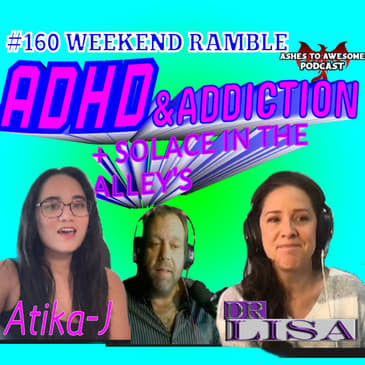


Dr. Lisa, Atika-J and I talk about ADHD and it's relation to addiction, but also my personal struggle, and how its made relapse that much hard to avoid. Also we go look at Atika-J's mini docu-series "Solace in the Alleys" We talk about Lisa's considerable fund raising efforts for Mike Walks Again www.soberfriendssociety.org
Solace in the Alley's
https://www.instagram.com/solaceinthealleys
If you have a nonprofit or fundraiser that you would like to advertise for free and spread a five-minute dose of kindness to the world while doing it, you can on the latest Chuck LaFLange Production, Morning Cup of Kindness. Details HERE
Remember if you are listening on Spotify, you can watch the video version there as well. If you are listening on any other platform, you can watch the video version on YouTube by clicking HERE, or searching "ashestoawesomepodcast" in YouTube.
VIST WWW.A2APODCAST.COM FOR ALL THE THINGS, INCLUDING CHUCKS NEW E-BOOK, "TURN SORRY INTO THANK YOU"
Thank you so much for listening. If you are listening on the Spotify platform, you are able to share your thoughts about an individual episode in the interactive element that Spotify offers. Doing this tickles the fancy of the algorithm and really helps us to spread the message. Also please visit our Facebook page here, and like, share, or comment on any of the posts. Your feedback there is sincerely appreciated, and taken quite seriously. Lastly, most of our alumni guests from the podcast are members of our Facebook group. If you would like to get to know any of them, or have questions, or perhaps would like to invite them onto another show, this is a great place to interact. You can join that group here . Ours sponsors, that make spreading the message possible:
Dent Kits - WEBSITE
Together We Can Recovery Society
WEBSITE Revolution Recovery - WEBSITE
Yatra Trauma Therapy Center -WEBSITE
Nate D Foundation = WEBSITE
Chuck (00:44.732)
Hello listeners, welcome to another episode of the Weekend Rumble on the Ashes to Austin podcast. I'm your host, Chuck LaFlandre and joining me in studio today is of course my weekend co-host Dr. Lisa. How are you doing today, Lisa?
Lisa (00:55.983)
I'm Great Chuck, how are you?
Chuck (00:57.988)
I'm really good, I'm really good, thank you. And again for I think our third appearance now, Attica, how you doing today? Attica J, I should say.
Atika (01:06.026)
Hey, yeah, I'm doing good. Just sipping my coffee. And how are you, Chuck?
Chuck (01:13.288)
I'm doing really good today. I'm doing really good. I seem to have all the techie stuff dialed in for once. It's been, well, it's always a wrestle with tech with me. So, right. Actually, our other co-host there on Wednesdays, Ryan Baskate, messaged me a few times this week trying to get his own stuff uploaded and figured it out and a whole new appreciation for what I do around here. Right. So I kind of got a kick out of that. But oh, yeah, yeah.
Lisa (01:36.279)
I know he was telling me a bit about that actually. Yeah.
Chuck (01:40.981)
Yeah, a couple minutes of it's enough to make you just want to drive off the edge, right? So yeah Anyway There's a couple things I want to talk about today But right off the bat Mike from the sober friends society out in the Erdry Lisa you went out on the walk with him. We were just talking about that pre recording. How was that for you?
Lisa (01:58.846)
It was intense. Knowing what they were doing, so it was Mike, a friend of his Brody, and so they walked from Edmonton to Airdrie. I think it took them 12 days. They were walking about 30 kilometers a day, and they did it to fundraise for the Sober Friends Society, so that Mike is founder of that, and then also the Mood Disorder Society of Canada. So yeah, I thought it was a huge undertaking.
Chuck (02:23.781)
Okay.
Lisa (02:28.266)
just hearing about it, but then myself, another psychiatrist I work with, a nurse that I work with and her partner went and joined him, him and Brody for one day. So we walked with them from Sylvan Lake in Alberta to Penhold, which was I think 29.8 kilometers. And it almost killed me. And I was saying to you earlier, right? Like I work out regularly, but walking 30 kilometers is no joke.
Chuck (02:45.17)
Okay.
Chuck (02:48.924)
haha
Chuck (02:58.544)
No kidding, eh? No kidding.
Lisa (02:58.566)
Um, it was crazy. Like I've got, you know, it's a week later, I've still got blisters on my feet. Um, you know, I couldn't walk for about two days afterwards. Uh, right. Well, we were all joking that we were going to be fighting over the wheelchairs, you know, to like wheel ourselves around at work. Like, um.
Atika (03:08.642)
Oh my god...
Chuck (03:09.undefined)
know what's good to be working in the hospital then. Getting orderly, reeling around for the day or you know.
Atika (03:18.213)
Hehehe
Chuck (03:21.782)
Get out of the way, step and a half. This is for me. I can see it now.
Lisa (03:25.082)
I mean, these guys did it every day for 12 days, you know. I will say though that, you know, when the walk started, it was, it took us seven hours. We were stopping sort of about every hour. But yeah, when it started out, there was a lot of conversation and it was great to get to know Mike and get to know Brody. And it was, you know, it was just, it was fun. But obviously seven hours, you know, you have points there where everyone's just kind of trudging along.
Chuck (03:33.746)
Okay.
Lisa (03:55.038)
And it was funny because I remember, you know, my brother is ex-military. And I remember he would tell me about rucksack marches they would do with like 80 kilos on their back. And I remember saying to him, like, how, like, how do you do it? And he was like, it's just one foot in front of the other. And I had moments where I was like one foot in front of the other. You know, and I did find myself thinking about, you know, the purpose of the walk and thinking about people who are dealing with addiction or dealing with mental health struggles.
Atika (04:05.108)
Aww.
Chuck (04:14.225)
Hahaha
Lisa (04:25.918)
You know, and the fact like they don't have a convoy car to sweep them away when they decide to quit. You know, there's no off-ramp. And I did find myself kind of just thinking about that when I was finding it really physically challenging. So yeah, it was incredible.
Chuck (04:42.708)
Okay, okay. That's excellent. And I guess the one element we never even mentioned was the five pound ball and chain, right? That he's carrying with him the whole time. So I'm assuming he's carrying it. He's not dragging the thing because that would just be like torture, right? But yeah.
Lisa (04:50.354)
Yeah.
Lisa (04:55.426)
So yeah, so he's got, you know, he's got the ankle strap and then carries the ball in his hand. And the last about six kilometers I took his and the other psychiatrist took Brody's. And again, like, you know, when I, when I work out five pounds is like, that's a really light weight. So you don't think much of it. Well, let me tell you, when you're, when you're on like your 25th
Atika (05:00.436)
I like them.
Chuck (05:09.098)
Oh.
Chuck (05:14.75)
Hahaha. Yeah, yeah. Hahaha.
Atika (05:18.315)
Hehehehe
Chuck (05:22.407)
Yep.
Lisa (05:24.546)
Um, yeah.
Chuck (05:25.168)
Yeah. Right.
Atika (05:25.311)
It's like 80 kilos just like every other...
Lisa (05:28.694)
it definitely made a difference. And same with the other psychiatrist who was carrying the other one. She was like, I can't believe that the difference that this five pounds makes. But yeah, and it was just really symbolic to take that from Mike and to carry it for him, for those 5K.
Chuck (05:39.684)
No kidding, no kidding.
Chuck (05:46.072)
No kidding. No kidding. I think the whole thing really is just what you said about not being able to take the off ramp, you know, just like somebody who's suffering and, you know, with mental health. And I think that's pretty, well, it's definitely admirable. I'm going to put it out there. You'll probably be a little bashful about it, but you were ahead in the fundraiser, ahead of him even at one point, right? How much do you guys manage to raise over there at the PLC?
Lisa (06:09.163)
Yeah, yeah.
Um, I think between, you know, so myself, the other psychiatrist, the nurse and her partner who joined, I think that between us, we raised just under 6,000 or $5,500 or something.
Chuck (06:24.82)
Oh wow, okay, that's considerably higher than the last time I checked. Okay, that's amazing. That is amazing. Yeah.
Lisa (06:28.714)
Yeah, I mean, I myself was, I think I was at 3000 something, I can't remember. But the group of us that kind of went together and joined him that day, you know, between us, it was, you know, it was over 5000. And so he had a goal for the fundraiser itself to make 10 grand. And I think last I checked, he was at 10,250 or so.
Chuck (06:36.076)
Okay.
Chuck (06:48.948)
10, yeah, yeah.
Chuck (06:53.85)
Okay.
Lisa (06:54.694)
I know he had a personal goal to fundraise on his own $5,000, and he is still short, about $1,500. And I know he's keeping the fundraiser open for about another two weeks. So yeah.
Chuck (07:02.618)
Okay.
Chuck (07:07.844)
Okay. And soberfriendsociety.org, I think, but if I'm wrong, either way, whether I'm wrong or not, I'll put it in their show notes again for this episode so you guys can, if anybody wants to help out, they can certainly do that. That's an admirable cause and certainly putting up for it to say the least, right? That's a long ways to go. So yeah.
Lisa (07:19.603)
Yeah.
Lisa (07:25.586)
Yeah, it's intense. But it was good. Very impressive, yeah.
Chuck (07:27.784)
Yeah, yeah. That's awesome. Yeah, yeah. So I've gone back and forth today quite a bit actually. Well, in the last 12 hours. Of course, we're here to talk with Attica about her fundraising, or not her fundraiser, her nonprofit, the J-Health. Or.
Atika (07:46.35)
care initiative.
Chuck (07:48.06)
J-Health Initiative, that's it, sorry. And specifically, the work you've done with Solace in the Alley, which is absolutely, it was mind-blowing. And the other thing I wanted to talk about was ADHD, and just now as we're talking now, I do wanna touch base on that first, because I think that once we get into the Solace in the Alley, that's gonna be the rest of the episode, because I'm really excited about that. So I apologize, Attica, I know I said I was gonna do it the other way around, but we just got to talking about mental health.
Atika (08:13.902)
Oh, no, that's fine. Yeah, we should, we should. Yeah, yeah, yeah.
Chuck (08:14.744)
So here we are, right? Yeah, right, yeah, yeah. Seems to be a nice segue into that. The reason that I bring it up, and a little bit of vulnerability to the listeners and to the supporters here, for myself, I'm undiagnosed, but I don't think there's any doubt, and I think, Lisa, you could probably back that up without an official diagnosis, right?
Yeah, I've got some pretty wicked ADHD, right? Looking at my monitors right now, I can tell you like what the hell was I thinking getting two monitors, right? That's a lot more room for a lot more shit to happen. And you watch these reels on TikTok and it's a big topic now, right? It's all over TikTok and Instagram and everywhere else. And a lot of it's kind of funny, right? And it is, it's kind of funny to watch somebody like me.
Lisa (08:46.609)
Mwah.
Lisa (08:49.867)
Hahaha
Chuck (09:06.544)
When I was a drug dealer in the winter, I looked like a monkey doing the dance because I'd be doing this all the time with all the pockets in my winter jackets and you know, trying to get it out. So there is a humorous element to it. There's also a really serious side to it though. I never would have imagined. I was self-medicating for so long that I didn't even know I had it until Carl the ACS wife is the one that kind of said, well yeah, obviously you do. You were self-medicating and that's why you're so scatterbrained now. Oh, okay.
Lisa (09:21.538)
Mm-hmm. Yeah.
Chuck (09:37.712)
I think back to that conversation, and as somebody who suffered an addiction, I almost wish she never had that. I wish, well, a lot of days I wish that I didn't know that. Whew.
Lisa (09:50.164)
How come?
Chuck (09:53.212)
because the low hanging fruit, the easy solved my problem is 40 bucks in a phone call, right? So, you know, you and I had talked about, sorry.
Lisa (10:00.944)
Mm-hmm.
Lisa (10:08.041)
Okay.
Chuck (10:13.028)
You know, I'd reach out to you again, some help with some medication, because whatever, I've got some health care, like number issues and all that jazz.
Lisa (10:16.514)
Mm-hmm.
Chuck (10:21.148)
The steps to me getting medicated is a list. I have to enlist other people. I have to, like, it's a big fucking deal. Excuse my language, I'm not supposed to swear anymore. To medicate myself is 40 bucks in phone call. So had I not, if I didn't know that, right, it'd be like, oh, I just got, you know, whatever, right? I'd have this option, but now it's like, I can, you know, fuck relapse, it's looking really good right now. I am fortunate in that I have a support network of
Lisa (10:25.571)
Mm-hmm.
Lisa (10:35.563)
Yeah.
Atika (10:37.09)
I agree.
Lisa (10:41.438)
Mm-hmm.
Lisa (10:47.837)
Mm-hmm.
Chuck (10:52.092)
many people, arguably thousands of people, right? If you want to look at it that way. And I'd be letting down a whole ton of people. So I'm able to stay focused and stay the course. And believe it or not, all of this, tears or not, it's not about me, right? What I think about is the people without the support, right? And without the knowledge and without, you know, like I've got a vast network of people, people that love me and support me.
Lisa (10:57.274)
Mm-hmm.
Lisa (11:06.287)
Mm-hmm.
Lisa (11:14.134)
Yeah.
Chuck (11:20.232)
What do you do if you're out there, if you're in the alleys and you've got this? And how the hell are you supposed to stay clean? Because I can tell you, had I went and got a job in a warehouse instead of starting this podcast, there's no way in hell I'm clean today. There's no way. There's no way I could have made it. I know that, right? So I just, Lisa, this is really it, right? This is in your court, right? If you wanna speak to this or anything you can say to it.
Lisa (11:45.606)
Yeah. I mean, I think one thing, you know, and not necessarily that you need this, but something that you just said kind of triggered what a thought for me is, because you said, you know, the easy solution is $40 on a phone call, right? And there's this technique that you can use in therapy, like a downward arrow technique, where you carry your thoughts to the end.
Right? So it's yeah, it's a phone, it's $40 in a phone call. And then what? And then what? And then what? And then what? Right? So just for people listening, right? It's like, if you find yourself having that thought that it is just $40 in a phone call, carry the thought all the way, carry it to the stairwell. Do you know what I mean? Carry it to the alley. Particularly if you're somebody who is in recovery. Just, you know,
Chuck (12:17.52)
Oh, it's fast forwarding the tapes is what we call that in recovery. Yeah.
Chuck (12:31.896)
Yeah.
Lisa (12:39.986)
If the thought stops at $40 in a phone call, it sounds like a great solution. You know, if you carry that thought and you keep going, okay, and then what happens after the phone call and the $40 and then what happens and you carry it, carry it, carry it. That to me is where you can kind of catch yourself from not grabbing the $40 and making the phone call, right? But yeah, I mean, I do agree with you as well, Chuck, though, that, you know, we've talked about this before, but...
Chuck (12:44.808)
Yeah.
Chuck (13:00.496)
Yeah, yeah, right, right.
Atika (13:01.006)
Thank you.
Lisa (13:10.162)
And even that fundraiser recently in Mission, right? Allowing people that 24 hours to experience homelessness and to realize it's not just we'll get a job, you know? And I see this all the time. Like the hospital that I work at is, I would say within, like in Calgary, it's in the area of the city that probably has the greater population of those who are living, you know, just lower socioeconomic.
Atika (13:20.459)
on.
Chuck (13:21.337)
Yeah.
Lisa (13:38.49)
individuals. And so we see a lot of people come into the hospital who have no ID, who have no health care. They're entitled to ID and health care. You know, they've lived in Calgary for years, but they don't have it. It's not activated. I had a guy recently who hadn't had ID in 10 years. And I said to him, I was like, you know, how
Chuck (13:38.609)
Yeah.
Lisa (14:03.506)
Did you ever try to find a place to rent a room? Did you try? And he was like, yeah, I couldn't do anything. I had no ID. You can't get a place to stay. You can't get a job. And then on top of it, we have a team of people in the hospital who will help individuals get all these things in place. And it's hard. I have this incredible social worker who will spend hours sitting on phone calls, who will make multiple trips to the registry.
Chuck (14:23.508)
Yeah it is.
Lisa (14:32.598)
who has to go into computer systems from other provinces to try to track down birth certificates to get somebody ID. So yeah, how people do it without support is...
Chuck (14:49.893)
It's unbelievable. Right? Yeah. And the other thing I want to speak to, the kind of humorous side of it, the absent-minded, whatever, folks, that's not it, right? That's the funny shit, for sure. But let me tell you, right? There's some, like, it sucks, right? It's unwanted chaos all the time, right? And if you can try and
Lisa (14:52.367)
It's a huge barrier.
Atika (14:54.907)
It's a huge barrier.
Lisa (15:13.606)
Mm hmm. Yeah.
Chuck (15:17.132)
A good friend of the show, I can say her name, Lena, has been on in the past and listens quite regularly and kind of helps out with all sorts of things on the back end. She's got two sons and a husband who are ADD. And yesterday she says to me, we're talking about, you know, I kind of, I don't know if ADD, and Lisa, you can answer this, if it comes in bouts or in waves, but it seems for me that that's what it is. Like last week was really bad for me.
Lisa (15:46.539)
Mm-hmm.
Chuck (15:46.664)
And I found myself over committing to a bunch of stuff and then taking on new projects. And it was like, holy shit, man. And so I was saying to her, well, no, I haven't gotten to this because, buh-buh-buh-buh-buh-buh-buh-buh. And she said, well, why don't you just not take on that stuff while you're doing that stuff? I'm like, aw, you've got all that ADHD around you and you're still saying things like that, right? So, right.
But it's true, it's just messed up. Does it come in waves? Is that a thing? Is that?
Lisa (16:14.097)
Yeah.
Lisa (16:18.006)
So I don't know if I would describe it as coming in waves, but I think that depending on a lot of other circumstances, the symptoms can be exacerbated, right? So if you're stressed out, if you're tired, if you're overwhelmed, if you've got a lot on your plate, if you're, you know, there are things that will make it seem worse, right? And so in that way, like, I guess it can sort of, sort of seem like it's waxing and waning.
Chuck (16:29.287)
Okay.
Chuck (16:40.698)
Okay.
Lisa (16:47.29)
somewhat. Yeah, yeah.
Chuck (16:48.292)
Okay, yeah. That stands up with what was happening in my week last week for sure, right? There's a lot going on, so yeah.
Lisa (16:55.442)
And even, you know, some people, you know, and again, there's evidence to support this and evidence that contradicts it. But if you look at kids with ADHD, right, some people feel that if those kids are eating a certain way, you know, again, that their symptoms will be worse. You know, you give a kid with ADHD sugar and that can sort of exacerbate it. Some people.
Chuck (17:15.834)
But that's a stimulant, so that seems like it stands up though, right? It's just... I think, right? Yeah, right?
Lisa (17:19.482)
Yeah, yeah. And even, you know, they're, yeah, right. And then there are people too, who think that things like food does. Now again, I don't think that the scientific evidence really stands behind that from what I know. But again, things like diet, sleep, you know, exhaustion, overwhelm, just too much happening, those things can, you know, make it present, I guess, more intensely. But I mean, like five
Atika (17:21.334)
an opera.
Chuck (17:46.585)
Okay.
Lisa (17:48.438)
percent of people have ADHD. Like it's, you know, that's not a small number, right? And it's boys more than girls. It's like a two to one ratio, right? So there are more boys who have it. Now, the interesting thing is that there's, there's three types of ADHD, right? There's inattentive, there's hyperactive, and there's combined, meaning you kind of have both.
Chuck (17:53.308)
No it's not. No. Right.
Chuck (18:00.908)
Oh really? Okay, yeah.
Chuck (18:15.59)
Okay.
Lisa (18:16.258)
girls more often are inattentive and boys are more often combined or hyperactive. So it's interesting because they say that there are more boys with ADHD, but we also know that girls with ADHD often don't get diagnosed because they're inattentive. So you'll have a girl who just is quiet sitting in the back of the classroom in La Land, has no idea what's going on, but she's not bothering anybody. And so...
Chuck (18:22.67)
Okay.
Chuck (18:43.928)
Where's the boy? Right? So it's a behavioral issue, and then of course it's gonna get attention, right? So, right, right.
Atika (18:45.378)
That's me.
Lisa (18:45.502)
the boys climbing the curtains, right?
Lisa (18:52.094)
Exactly. And so, you know, I don't, it's interesting because, you know, they say it's more boys than girls, but we also know girls are often not diagnosed despite having it. And so is it really more boys than girls or, you know, who knows, but that's kind of, that's what the stats are on it. So.
Chuck (19:04.084)
I wonder, yeah, right, yeah, that makes sense. That makes sense. It's a funny, because you said the classroom. My stepson, when I was married at the time, was eight or nine years old. And his teacher's solution to his hyperactivity was to put a cardboard shroud around his desk and not let him out for recess. If you can imagine.
Atika (19:30.047)
Oh, God.
Chuck (19:31.376)
It's this very, very small town, Saskatchewan, and not that long ago, 2018. So relatively, not long ago, this is something you would think back to the 50s, not something in the 2000s. Well, I can tell you that school got to learn who I was real quick. It's like I wasn't even a, what? Get in the car, we're going to the school. And yeah, that was their very first dose of me, and did they ever get a big dose of me? Yeah, I was just, what?
Lisa (19:37.6)
Wow.
Atika (19:38.476)
job.
Lisa (19:50.145)
Yeah.
Lisa (19:54.678)
Yeah. Wow.
Chuck (20:01.768)
How'd you think that was going to play out? I can tell you, he brought all those behavioural issues home. First of all, because that energy didn't... How about send him out for extra recess, go run the laps? Right?
Lisa (20:07.036)
Yeah.
I know.
Lisa (20:13.894)
Exactly. Yeah, it's sad. I mean, I feel like, you know, modern classrooms, I mean, a lot of people say modern classrooms aren't really set up, you know, appropriately for childhood learning, independent of ADHD, right? I think that's why you have programs like Montessori and it's like, you know, let kids explore, let them learn by exploring, let them move around, let them go to the bathroom if they need to not have to sit there with their hand up waiting to go.
Atika (20:14.526)
Yeah, that'll do it.
Chuck (20:27.473)
Yeah, yeah.
Lisa (20:41.274)
So, but yeah, I mean, yeah, putting a cardboard box around him. I imagine that didn't work out real well for anybody.
Chuck (20:45.348)
I was, no, no it didn't, no it didn't, no, no. And at the end of the day, I gotta tell you, it was one day, right? There wasn't a day two of that shit, to say the least, right? So anyway, thank you. I really did wanna touch base on that, and I don't think it's a conversation that's over either. Because it's close to me and I'm the host, I get to decide, right? But, so I think maybe that we can have some more conversations about that. Go ahead.
Atika (20:46.845)
Yeah.
Nooooooooooooooooooooooooooooooooooooooooooooooooooooooooooooooooooooooooooooooooooooooooooooooooooooooooooooooooooooooooooooooooooooooooooooooooooooooooooooooooooooooooooooooooooooooooooooooooooooooooooooooooooooooooooooooooooooooooooooooooooooooooooooooooooooooooooooooooooooooooooooooooooooooooooooooooooooooooooooooooooooooooooooooooooooooooooooooooooooooooooooooooooooooooooooooooooooooooooooooooooooooooooooooooooooooooooooooooooooooooooooooooooooooooooooooooooooooooooooooooooooooooooooooooooooooooooooooooooooooooooooooooooooooooooooooooooooooooooooooooooooooooooooooooooooooooooooooooooooooooooooooooooooooooooooooooooooooooooooooooooooooooooooooooooooooooooooooooooooooooooooooooooooooooooooooooooooooooooooooooooooooooooooooooooooooooooooooooooooooooooooooooooooooooooooooooooooooooooooooooooooooooooooooooooooooooooooooooooooooooooooooooooooooooooooooooooooooooooooooooooooooooo
Lisa (20:56.315)
Yeah, yeah.
Lisa (21:07.77)
Yeah, and I think one other thing, and I mean, I've said it on the show before, but I'll say it again, because, you know, I mean, ultimately, you know, with Ash is to Awesome, you know, we talk a lot about addiction and about people in recovery. And so I think it's important to just connect the dots between ADHD and addiction. And untreated ADHD is a risk factor for later developing addiction struggles.
Chuck (21:28.72)
Yeah. Yes.
Chuck (21:37.456)
without a doubt.
Lisa (21:39.347)
And again, that's in part related to, you know, in some cases, as you've described Chuck, you know, people are trying to self medicate, right? And they'll try something and are like, okay, this makes me feel more normal. This makes me feel more calm. I'm going to do more of this.
Chuck (21:49.952)
with no understanding as to why. I had no idea that that's what was going on all those years. Right. So that's, yeah.
Lisa (21:54.21)
Exactly. Right. And then it's also that kids with ADHD, they're not good at planning and thinking in advance and considering consequences. There's a lot of impulsivity, right? It's hyperactive impulsive. And so there's this huge impulsivity. And so they do things and then after they're like, oh, my gosh, I shouldn't have done that. Or, oh, my gosh, that wasn't a good idea. But in the moment, they're not thinking about it.
But I do remember, and again, I'm not a child and adolescent psychiatrist. You know, it's an extra year of training and fellowship to specialize in child and adolescent, but we do have to spend six months doing child and adolescent work during our residency training. And one of the things that really stood out to me was seeing kids with ADHD and parents being really averse to medicating their ADHD.
And then you have to remember, these were not kids with mild ADHD. I'm not saying every child with any symptom of ADHD needs to be put on a stimulant, but I was working in a hospital setting. So these are kids who were like, you know, being sent to the hospital for psychiatric assessment and the ultimate solution was, okay, like we think the answer here is ADHD. So these were kids where this was causing a lot of functional impairment, causing a lot of distress. Also untreated ADHD leads to anxiety.
and untreated anxiety is also going to put people at risk of turning to substances. And parents were really afraid. They were like, you know, if you put my child on a stimulant, you're going to turn them into a drug addict. And the evidence shows that treating ADHD is protective against substance use disorder, not the other way around, right?
Chuck (23:19.528)
Damn straight.
Atika (23:30.603)
Okay.
Chuck (23:36.688)
Yeah, yeah, yeah.
Lisa (23:40.658)
So I just think it's important because I feel like that was a conversation that I had many, many times. And I think it just made me realize that that's, I think, a very broad fear for parents is, you know, you can't put them on stimulants. And, you know, again, a lot of parents, too, will think back to when they were kids and their mind goes to Ritalin. Now, Ritalin is still used, but I would say it's used a lot less than it was when we were kids.
Chuck (23:51.888)
Yeah.
Lisa (24:08.462)
Now in place of that, we tend to use stimulants that are longer acting. And if you think about, you know, drugs that are the most addictive, right, through the quick on, quick off, that's the stuff people get hooked on. It's not the long acting. And so similarly, you know, stimulants for ADHD that are used most often now are very long acting. You know, they work for 8 to 14 hours, depending on the one that you choose. But it's protective to treat your kids ADHD.
Chuck (24:18.97)
Oh yeah.
Lisa (24:37.758)
You know, to me, it's not just protective against substance use disorder, against anxiety, but it's protective for their self-esteem. You know, whether you're the inattentive kid sitting in the classroom and then the teacher says, hey, Chuck, you know, what's the answer to the question I just said? And the inattentive kid is like, oh, like, I have no idea what she's even been talking about for the last hour. And now I'm being, right? Yeah.
Chuck (25:00.134)
That's me through and through.
Atika (25:01.527)
That's so me. That's so me.
Lisa (25:05.234)
And then that kid is getting called out in front of their entire classroom and they're humiliated, you know? Or it's also for the hyperactive impulsive kid. They're in trouble all the time. And then what happens is they start to go, well, you know what? Everyone thinks I'm the bad kid. I may as well just be the bad kid. I'm just gonna own the identity that everyone is giving me. None of those things are healthy and none of those things have good prognosis. And again, it's treatable.
Chuck (25:05.649)
Absolutely, yeah.
Lisa (25:34.206)
like it's treatable, you know? So yeah, it's like, if you think your kid has ADHD, the biggest gift you can give them is to have them properly assessed, obviously, but then to have, you know, to treat their ADHD. And there's behavioral stuff as well, you know? So it's not just the medication. And a lot of the behavioral work is more for the parents and the kid. It's teaching you how to parent a child with ADHD, right?
Chuck (25:36.144)
Yeah, right. So let's...
Chuck (25:59.012)
Yeah. I can see that, yeah.
Lisa (26:02.614)
So it's a lot of work for the parents too, you know, but, but again, very protective. If you think your child has ADHD to be doing the, the therapeutic work, the pharmacologic interventions. So, yeah, I just. Yeah.
Chuck (26:18.704)
Interesting. Okay.
Chuck (26:23.912)
I want to take a quick break and we'll be right back.
Chuck (00:02.225)
Okay, so we are back from the break, and hopefully that's the end of the breaks for now. Anyway, so one of the things I really wanted to get into, dear, looks like we might be having, let's just move forward and it's gonna play out the way it plays out. Okay, okay, so, Attica, you have a project called Solace in the Alleyes, and I saw this.
Atika (00:17.618)
Yeah, I think she's worth it.
Chuck (00:29.497)
Well, when we first started chatting, you told me about it. And, you know, I just kind of skimmed over it and I thought, hey, that's really cool. And then I wanted to talk about more, and it's Overdose Awareness Day here coming up, you know, next week. And, or this week coming, I guess it is, depending on how you view Saturday, is it the beginning or the end of a week? But, maybe bring some more attention to some of the people that suffer out there in the streets, and, you know, the vast majority of those are they think are the people that are victim to overdose, but,
Chuck (01:01.125)
So last night as I started to put those compilations together, a totally different appreciation for what you're doing out there. And I guess the best way to do it is just to kind of share, you know, I'll put up some right away here. I'm going to play two or three in a row of the ones that I made a compilation video of the ones that you have and then we could talk about them. So share.
Atika (01:24.366)
Thanks for watching!
Chuck (01:25.905)
No, no, sure.
Atika (01:30.794)
I love this project so much. At resume, I just, I just need a team, but yeah, cause it's a lot of work.
Chuck (01:33.557)
I can see why.
Chuck (01:40.102)
No kidding.
Chuck (01:44.677)
Oops, no, this one, share, okay, here we go.
Atika (01:50.306)
Which one are we having here?
Chuck (01:52.525)
I'm not sure you're gonna have to wait till we get there I guess. Yeah.
There's five seconds in between each one.
Atika (02:01.082)
Yeah!
Atika (02:15.799)
I am.
Atika (03:09.595)
Mm.
Chuck (03:10.425)
Wow, so there's five seconds in between each one. We'll play one more here and then we'll take a break to talk.
Atika (03:14.157)
Mm-hmm.
Chuck (04:24.529)
So, wow.
Chuck (04:30.257)
first one Adam, I'm sorry, it was Adam? Yeah, yeah, yeah. And so I was going to say something tells me you remember each and every one of them. What really pops out to you about Adam? What, you know, that we didn't see, you know.
Atika (04:32.454)
Adam, I remember both. I remember all of them.
Atika (04:47.636)
that.
Atika (04:51.542)
I just feel I deeply care about every single one of the people, every single one of them that I interviewed. Very nice person. I learned a lesson about
about his trauma, having that disembowelment. And, you know, when he, he actually showed me the wound and he showed me the wound. He's on and off recovery. He's on and off being sober. I got him into resources that night and I spent one hour or so trying to get a caseworker for him.
But, or something like that I remember because he requested it. And he gave my dog like a blanket and a tennis ball. I didn't give him anything. Like I just, I mean, yeah, I mean, I give him something, but like, it's like he wanted to give more. Like he even, he didn't even want the little, you know, the little thank you gift for me.
He refused that, but he wanted to give my dog something. And he just like, he used the gloves because the gloves is cleaner so that he can touch my dog with the gloves. And it's just like so, I don't know, I'm so touched. And I think the story about Adam shows...
Atika (06:32.918)
that addiction stem from trauma, that it's not always a choice. It's not always a choice. And he is still talking to me about his nightmares, you know, if he has any nightmares. And those nightmares are really, really terrifying. And I personally can relate with some of the nightmares, probably not as severe as the ones that he has, but nightmares are serious business. It's like you want...
Chuck (06:37.149)
Right. Yeah.
Atika (07:01.514)
Usually people assume that when you sleep you rest and you're calm and you're not stressed It's different. It's different when you have a trauma because Your mind is going to show you the most horrific Horrible gruesome things in front of your eyes when you're sleeping and then you wake up you're just like drenched in sweat and you're in terror, you know and That's really
Chuck (07:27.276)
Yeah.
Atika (07:28.738)
common with people like Adam and yeah he's like well why do you do this? Why do you do the documentary? And I'm like well because I think people need to understand that addiction there's a lot of reason why people are using substances and we need to understand people's stories and he's like I haven't talked about this.
to like anyone in Vancouver. Like he moved out from, he moved from another province and that's the first time that he talked and he talked in front of camera. And it's just like really, he sees it like a self-empowerment to tell his stories and being heard and that someone listens and understands because a lot of people don't even will,
They don't even care to listen, you know, it's like Alright, it's like The stigma it's sort of like okay. Well, you're a drug addict Homeless, that's it. You know like oh that person but if you really talk and Listen about how they end up over there There's there's a lot of stories. There's a lot of stories. I've always been surprised I mean, I've been doing this since I was in high school
Chuck (08:27.942)
No, you're right.
Atika (08:55.446)
I've been doing this since I was 17. And it was like a little project that I had in high school that I thought, oh, you know what? I want, you know what? This is, I need to, because I walk in the downtown East at Vancouver, you know, the so-called hood. Since I was 16 or 17, just walk around there and just like, you know, just absorbing what's going on.
Chuck (08:55.781)
Yeah.
Atika (09:27.054)
And in my house, I remember, you know what? I want to do that little project about like just listening to people's story, like what is going on? I try to understand addiction. I try to understand homelessness. Little did I know that I'm going to also experience like seeking places to sleep at night, you know, a few years down the road. But yeah, it's item story is really...
Chuck (09:47.507)
Yeah.
Atika (09:54.91)
strong. I had to recover for days from that.
Chuck (09:55.878)
No kidding.
Chuck (10:00.037)
Yeah, yeah. That's what struck me right away was how matter of fact that he was talking about that trauma, right? And having some of my own pretty serious PTSD, nothing to that extreme, but the idea, right? And I'm listening to him going like, oh no, man. Like that will affect you deeply for the rest of your life. Right? And then...
And yeah, you can totally see how it turns to substance abuse and whatever, right? Substance use.
Atika (10:29.546)
Yeah, so he's using, yeah, so he told me his DOC is Benzo and he just like, it calms him down. It's all about like, you know, access to healthcare, right? Like access to social work, social worker, to psychiatrist, to psychologist, to counseling and.
Chuck (10:37.69)
Mm-hmm. Yeah.
Atika (10:56.03)
You know, when you, when you survive something like that, you know, it's, it's kind of stays with you, you know, and other than that, he had a pretty decent childhood. I've seen a lot of people having like a decent childhood. It doesn't always stem from childhood and then something like that happened and boom, you know.
Chuck (11:13.901)
Yeah, right. Boom, there you go. There's actually, there's something I wanna play for you and Lisa's of course not with us in the episode anymore due to technical difficulties, but there is something she said a long time ago on the show that really stuck and it was, for me it really helped explain to people, well I'll just play it for you here real quick and then we'll get back to your reels here.
Chuck (12:35.087)
Right? Doesn't that just, it wraps the whole thing up for me. Right? You know, it just, it really helps to explain.
Atika (12:39.402)
Yeah, and what I like to tell people is that people who are in using substances and unhoused, they are the expert of that condition. They are the expert of their experience. And that documentary, nothing of it is like me talking. It's like them. They actually like to ask me like, oh, like, what are you going to talk about? And like, no, not about me. It's about you.
It's all about you. It's a biography about you. And it's, I don't wanna cry. I cannot cry. But I have had like moments where I would interview and then I just don't see them anymore. I don't know. I don't know where they are. And some of them are very, very difficult. And like what I mean, like just challenging, okay. And...
Chuck (13:09.992)
Yeah.
That's wonderful.
Chuck (13:18.431)
Hahaha
Chuck (13:30.782)
You can.
Atika (13:39.07)
And they always like, you know, eager to like come up to the camera and talk, but sometimes it's like, um, we go into things that I think difficult for both of us, you know, like to me to hear or for them to even talk about it. Um, and after going through such depth and vulnerability and then knowing that they pass away due to drug poisoning.
Chuck (14:08.25)
Yeah.
Atika (14:09.138)
that you don't even know if they made it, has an overdose. It's very, yeah, yeah.
Chuck (14:16.077)
No kidding.
Chuck (14:20.293)
Kaden, Kaden Talbert. Yeah, what's, give me some takeaway from that one. We do have to be aware of time because of your schedule, so I just, I don't wanna spend too much time on each one. I think we could take an hour talking about each one realistically and I would be fine by that, but we do have to be mindful. So give me some takeaway from that one.
Atika (14:22.978)
Kate and Gilbert.
Atika (14:32.414)
Yes. Yeah, yeah, yeah.
Atika (14:41.571)
Yeah, um, getting jealous. She is so... Yeah, this is one of those things where I don't know where she is. I don't know. I, last time I saw her wheelchair bound and she was in so much pain and I tried to alleviate her and I don't know. I felt so...
helpless because I because me and her are good friends. Like I see her every time I'm there. Like I know like, okay, that there's Kaden and me and her and her husband and her sister like we like we know each other very well. So this is like family like Kaden is like family to me.
And last time I saw her, like she can't walk anymore. And, I mean, she's very loving. She's a very loving mom. And she likes fiction. She told me about the metastatic cancer that she has. And.
You know, it's like, oh, I have cancer here, here. And it's like, well, yeah, no, duh. Of course you, you want to, you want a painkiller to deal with that because it's painful, like my grandma passed away from cancer and I, I can tell just from. Witnessing that, like how much pain she had to go through and like she, she was put into like in morphine, right? Like, so.
Kayden had a lot of struggle in terms of pain and yeah, she's very, very nice person. And her sister actually saved me from almost being harassed in that area. But it's just like we're like family, you know? So if I had something like a bad day or whatever, I can just reach out to them. But...
Chuck (16:52.754)
Yeah.
I'll catch ya.
Atika (17:01.154)
They can also reach out to me and yeah, Kaden. Yeah, she, it just proves that she's been really, like I said, like it's not always a choice because she was introduced into cocaine when she was eight years old. Like how the heck are you going to know better? You know, like you don't know. You just, like you're just setting, you know, like you're just setting your kids up for this. Like, you know, so.
Chuck (17:20.795)
You're set up for failure now, right? Yeah.
Atika (17:31.262)
Yeah, but she's very motherly, very, very motherly. She likes to carry like a big bunch of colored pencils and pens and drawing, like coloring books and stuff. And so when I'm like, just going crazy after like, you know, dealing with like overdoses and like, you know.
Chuck (17:53.969)
Yeah, right.
Atika (17:54.838)
Health mental health crises. I can just go to Kate and like can I connect can I get like a page and she'd be like? Oh, yeah, sure, you know, so It's like I said people who are Addicted they don't really hurt other people. They just hurt themselves Really and it's like Lisa said it's not always a choice No, and trust me they don't really like that right so like
Chuck (18:17.869)
No, no it's not. Okay, let's move on to, oh.
No, no, nobody, no. I said, let's move on to George, right? George Sador, I'm sure you remember. Yeah. Oops, oops, ah, screwed up, okay. Share, okay.
Atika (18:23.626)
No one really liked fentanyl and stuff, but yeah. Anyways, what did you say?
Atika (18:31.682)
George the Doge!
Chuck (18:46.074)
Jeepers. Horrible. Share. Okay. There we go.
Chuck (20:17.775)
So, go ahead. Go ahead.
Atika (20:17.866)
Oh yeah, I remember, yeah. Oh, hm?
Atika (20:24.11)
So we met at a barbecue about this, what is it, it was like a march to fight, like the drug poisoning, something like that. But like we talked and like, I was like, wow, this guy's really smart. And then I know he's from Van Do. So Vancouver Association of.
people who are drug users, I think that's what it stands for. But he's very smart. And I was like, well, do you want to be interviewed? And he was like, well, yes. And then like, he brought like his bottle and like, he was like, this is not water, okay? And then you just go on and on and like, kind of like laughing it out. And like, we were like laughing a lot.
Chuck (21:17.138)
Yeah.
Atika (21:17.302)
But it's our coping mechanism just to like deal about, I think that's what me and him kind of have something in common that we kind of like a little bit like kind of like joke around our, our sour, very horrible past, especially childhood. And yeah, Yang's grandpa did that to him. And he actually
is one of the people that fight for a signage in the street so that people would like slow down a little bit like in the in those area when there's a lot of drug users and you know in that district because people are intoxicated sometimes overdose responders have to
Chuck (22:00.574)
Yeah.
Atika (22:12.362)
fly across the street and you know, it's just so good to just have a speed limit similar to elementary schools and where kids are around because yeah, it's like that. So he's very smart. It's one of my favorites. I mean, all of them are my favorite. But yeah, he wrote some commentaries. So he's a peer researcher.
Chuck (22:13.585)
Yeah.
Atika (22:41.53)
very smart. Yeah, he used to be a chef, moved across different countries, and very articulate and I think I learned from him that in research when it comes to addiction research or about how we tackle illicit use of alcohol. So alcoholism isn't just like, you know, drinking vodka straight from the bottle.
It can, I've seen people drinking hairspray. I've seen, you know, people drinking hand sanitizers. And how do we approach harm reduction with those people? And harm reduction also applies to people who are addicted to alcohol. So that's what I learned from George Sador. That's what he is fighting for.
Chuck (23:20.445)
Hmm.
Chuck (23:33.608)
Okay.
Atika (23:37.046)
And there is a brewery actually over there in the downtown East side for people who are using illicit alcohol. So there is harm reduction program for that as well, which is not really talk about.
Chuck (23:53.865)
Okay. We are out of time, I know, with your schedule and well mine now too. So I do want to talk more about this, Oatika, like I really do and I feel like the next moment you have to get together we should do that and quite possibly if it's in time to add on to this episode then we will and if it's not we'll create another episode because I like we're only halfway through the compilation I made so we got we could get through another half and you know
Maybe I'll make a mini episode or something, but I definitely do not want to stop talking about these people, and I think there's a great opportunity there. So with that said, it's time for my favourite part of the show. That's the Daily Gratitudes. Good thing, edit, edit. So what you got for us today for Daily Gratitudes, Attica?
Atika (24:26.356)
Oh yeah.
Atika (24:41.486)
For my daily gratitude, I am thankful that I am speaking in that awesome podcast again. So happy to be here again talking to you and Lisa. And I will head out to Downtown Neaside and do my stuff there. But I'm thankful for that too.
Chuck (25:04.473)
Yeah, yeah, well, I'm very gracious, you know, I have some gratitude for the fact that there's people like you out there, because, you know, it was less than a year ago that I was on the street myself, so I can really appreciate the work that you're doing. And my final gratitude goes out to you, the listeners. Whatever you're doing, please keep doing it. If you see the logo, like, comment, share, do whatever you need to do, ask a question, post a comment, do whatever. Ah.
Every time you do any one of these things, you're getting me a little bit closer to living my best life. My best life is to make a humble living, spreading the message, the message exists. If you are inactive addiction right now, today could be the day. Today could be the day that you start that lifelong journey. Reach out to a friend, reach out to a family member, call in to detox, go to a meeting, do whatever the hell it is you need to do to get that journey started, because it is so much better than the alternative. And if you're the loved one of somebody who's suffering an addiction right now, just taking the time to listen to our ramble.
Just take one more minute out of your day and text that person. Let them know they're loved. Use the words.
Atika (26:05.459)
You are loved.
Chuck (26:07.377)
That little glimmer of hope just might be the thing that brings him back.

Shattered Stigma
Yatra

Morning Cup