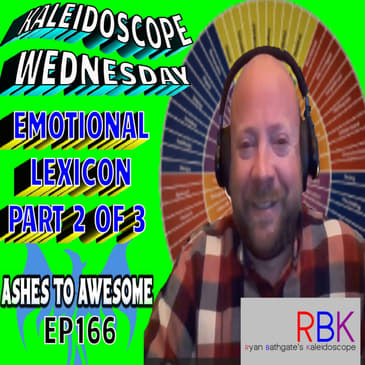


In the second of a three part series on Emotional Lexicon (defining feelings) we take a deeper dive into why having one is so important, and how to use it as a tool in the box when finding meaning in life
If you have a nonprofit or fundraiser that you would like to advertise for free and spread a five-minute dose of kindness to the world while doing it, you can on the latest Chuck LaFLange Production, Morning Cup of Kindness. Details herehttps://WWW.A2APODCAST.COM/MCK Click https://www.a2apodcast.com for links to Chuck's new daily 5 min podcast, "Morning Cup of Kindness", all of our socials where we have posted some great short-form content to help inspire. If you are listening on the Spotify platform, you are able to share your thoughts about an individual episode in the interactive element that Spotify offers. Doing this tickles the fancy of the algorithm and really helps us to spread the message. Also please visit our Facebook page here, and like, share, or comment on any of the posts. Your feedback there is sincerely appreciated, and taken quite seriously. Lastly, most of our alumni guests from the podcast are members of our Facebook group. If you would like to get to know any of them, or have questions, or perhaps would like to invite them onto another show, this is a great place to interact. You can join that group here .https://www.facebook.com/groups/79994... Ours sponsors, that make spreading the message possible :Rosecrest Recovery Services Call 615-484-8792 or email info@rosecrestrecoveryservices.com Dent Kits - http://www.dentkits.com Together We Can Recovery Society http://www.twcrecoverylife.org Revolution Recovery - https://www.revolution-recovery.com/ Yatra Trauma Therapy Center -https://yatracentre.com/ Nate D Foundation =https://nate-d.ca/
Chuck (00:02.37)
Hello listeners and watchers, supporters. Not sure what you're calling me right now, but we'll figure that out. Welcome to another edition of Kaleidoscope Wednesday on the Ashes to Awesome podcast. I'm your host, Chuck LaFlandre, and of course in virtual studio with me today is Ryan Baffgate for another episode. How you doing today, Ryan?
RBK Kaleidoscope (00:19.23)
I'm pretty good Chuck, I mean, you know, another week down. I don't know, you know, I got about 20 years till retirement. I don't know what to tell you man. No, things are good. Things are good. I'm actually really enjoying this these topics series we're doing. I think it's a lot of fun and you know I can get a little bit erratic in my thoughts so this kinda helps me to have a little bit of structure and ground a bit so.
Chuck (00:23.83)
Yeah, yeah, right, right.
Chuck (00:31.593)
Yeah.
RBK Kaleidoscope (00:49.042)
And more than anything, I've gotten some pretty cool feedback lately. Just people I've known for years that listen to the show. It's helping them. It's funny, you just go through life and you have all these personas.
Chuck (01:07.109)
at the end of the day, right?
Chuck (01:15.443)
Oh, okay.
RBK Kaleidoscope (01:16.158)
And so we have all these, and I have them everywhere I go. Like I got baseball, right, and I got work, right, and then there's family, right, you know what I mean? And so it's funny how some people are just like, wow, I didn't realize that this is what you do. So yeah, it's been very cool. It's enlightening to know. I mean, our goal here is, from the very beginning, has been to help people navigate through the figures of life.
Chuck (01:24.103)
Of course.
Chuck (01:32.826)
hahahaha
RBK Kaleidoscope (01:45.482)
We don't really have a system set up to support the human experience. We have a system to set up to support the consumer experience. And so, you know, I think that, you know, it's just more evidence of that people are actually getting something out of this and it's really fulfilling for me. Yeah, extremely, yeah.
Chuck (01:53.718)
your story.
Chuck (02:03.366)
That's validating, right? For sure, for sure it is, right? Yeah, and it may have, our recent move to doing these series here, I'm sure I told you, but you're busy doing your holiday thing there for a minute. Lisa and I got to go to Canmore and meet Mike Miller from the Autotreatment Centre. So we sat with him for hours and we could have sat for hours more. You know, we didn't get back to the city until about 1.30 in the morning and we could have just kept going. And for me,
It was incredible, right? To sit with that kind of experience and that kind of education. And I was just completely blown away. And some of the questions I asked, I'm sure seemed surface level or rudimentary to them, but they sure didn't make me feel that way, right? They felt like I had a seat at the big boy table there. So it was something else. But now Mike and I are talking about doing a series of some kind, right? So, you know, right? Yeah, I think it might have turned into a thing here now. So, yeah.
RBK Kaleidoscope (02:37.449)
Mm-hmm.
RBK Kaleidoscope (02:50.384)
Life.
Yeah, cool.
RBK Kaleidoscope (02:57.714)
Yeah, I think Mike's such a wealth of knowledge and really knows his craft well. And I think you just got the opportunity to sit down with two wonderful human beings and explore, which is, you know, it's a great part of our brain to be working out of, the exploration side, and it also invites so much access to connection through emotional mediums. So, yeah, no, I'm envious. How's that?
Chuck (03:07.337)
Right?
Chuck (03:13.746)
Yep.
Chuck (03:21.502)
Absolutely.
Yeah, yeah, it would have been great to have you sit in there, you know, as I said, you will have to do a real live in person episode one of these days, you know, when we got the opportunity to do it, because it'd be something else to put us all in one room. Right. Yeah. Another thing that happened, Lisa, as a school friend of hers from back in Sparwood, B.C. in high school.
RBK Kaleidoscope (03:32.576)
Yep.
RBK Kaleidoscope (03:36.542)
Yeah, that would be really cool.
Chuck (03:48.358)
Oh dear, why can't I think of it? Oh, Shannon, Shannon Burness. Her episode aired yesterday, and for anybody that's listening, go back and check it out. It's an interesting thing that's happened. So it was a recovery episode. And for me, recovery episodes are, I don't want to say, they're generally speaking not as interesting as some of the other stuff we do to me, right? But I feel they're really important, and getting those stories out is super important too. However.
After speaking to Lisa, this one actually, and I don't mind outing her, Lisa had cracked a tear over this episode, which is a very rare thing, as we all know. So the two of them had so much of the same experience in school, and all the same troubles, and neither one of them had any idea the other person was feeling that. Right? You know, right? Exactly, exactly, right? So, yeah.
RBK Kaleidoscope (04:23.657)
Yeah.
RBK Kaleidoscope (04:35.454)
Yeah, like how common is that? I mean, to be honest with you, a lot of the basis of our show is that. People going through things in isolation does not typically lead to a positive outcome. People going through things in togetherness usually leads to strength building.
Chuck (04:51.583)
No.
Chuck (04:55.446)
Absolutely, right, right. So, well, she's actually gonna come on for the ramble. So we can kind of dissect that a little bit more and unpack it and kind of dynamic between the two of them and just to talk about that and maybe help people in their future, open up to each other a little bit more and see how that goes. But yeah, so, mm-hmm. Yeah, yeah. Now, of course, if they had an emotional lexicon at their disposal back then, perhaps these things wouldn't have happened. So.
RBK Kaleidoscope (05:13.33)
Yeah, yeah, it's cool.
Chuck (05:24.278)
There's our segue. Yeah, it's kind of weak, it surfaces for sure, but you know, yeah, yeah.
RBK Kaleidoscope (05:24.358)
What a segue. Yeah. Clunky. That's alright. Oh, water. That looks good. So, I guess we're going to look at part two today.
Chuck (05:39.774)
Yeah, we are. Yeah, that's the plan. So I should say I've got the wheel up behind me here. That's the wheel we made in detox. It's nowhere near as Ryan's bit of an emotional wheel snob. Feeling wheel snob, I'm just saying. So but so it's up there just for kind of prosperity and whatever. We'll break out the real one, I think, on next week's when we finish off this series. But, you know, yeah.
RBK Kaleidoscope (05:52.138)
Hehehehe
RBK Kaleidoscope (06:01.522)
Yeah, I keep one on my corkboard right here, and of course on my fridge for the kids. I like the colors, man. They're really helpful for me to identify.
Chuck (06:07.53)
Yep, yep. Of course, right? I get that. I just yeah, I think it's funny to pick on.
RBK Kaleidoscope (06:13.958)
And to be honest with you, one of those things that I do when beginning a process like this is I stay away from the actual words and we use colors and shapes to start a process of expanding the emotional lexicon. So they will say, like, how do you feel? And it's like, you can't say good, bad, or mad, you know? So they won't know a word, so I'll just ask them to close their eyes and give me a color. And then what does that color mean to you?
Chuck (06:25.712)
Oh.
Okay.
RBK Kaleidoscope (06:43.622)
and then I'll ask to give me a shape. And like, you know, if it's a red spiky ball, there's probably a lot of anxiety or anger or something like that. If it's a circle that's blue or green, it's probably peaceful or tranquil or, you know, and so, and then we start to use those images to transcend into expanding the emotional lexicon. So if you ever like don't know how you feel, try using shapes and colors.
Chuck (06:44.194)
Okay.
Chuck (06:52.159)
Yep.
Chuck (06:57.812)
Okay.
Chuck (07:05.334)
Gotcha. Okay.
Chuck (07:10.222)
There you go. There you go. Right? Yeah. Okay.
RBK Kaleidoscope (07:14.627)
Okay, so, part two.
Chuck (07:16.823)
Mm-hmm, part two. What you got for us?
RBK Kaleidoscope (07:19.45)
I wanted to, like, I'm not, I'm not, I like Daniel Goleman a lot when it comes to emotional intelligence. So, you know, anybody ever gets the opportunity to pick up a Goleman book, his first book, I think it's 85, was called Emotional Intelligence, it's really put the term on the map, although it had been used since the 1960s. And so we did a definition last week. I think definitions are really important because, I mean, yeah.
Chuck (07:43.582)
Well, emotional lexicon would kind of, you know. Right? The whole thing is about definition, right? So yeah, I would say that's important. Yeah. All right.
RBK Kaleidoscope (07:51.742)
Exactly. And so defining these things and sharing a common language is... I mean, in any culture development, it's extremely important to have symbols, to have language, and the other thing is like rituals, like eating dinner together, for example. And so that's how we kind of develop or be invited into some sense of culture. And so...
Goldman says his definition is really simple, which I love simple. The more simple I can define something, the better off it is for me and my brain. Yeah, so his definition is the emotional intelligence is the ability to perceive, control, and evaluate emotions. Boom. Really simple. All right? Now, what isn't so simple is how do we apply that to, you know, success, perceive success in the areas of our life, whether it's, you know, social, family, friends, whatever.
Chuck (08:26.526)
I'm a fan of simple. Yep, absolutely.
Chuck (08:35.806)
Okay. Yeah.
RBK Kaleidoscope (08:51.178)
uh... and you know and work life uh... because i think you know we spend most of us in eight hours a day in some place doing something for the rest of the people from the age of nineteen to sixty five and so uh... i think it's is you know we get we don't necessarily choose our colleagues like we do with our friends circle uh... and so it's important to understand where we're coming from having a process to be able to
regulate our emotions when we come into conflict or we come into difference of opinion. Another example of that is like having an understanding of reality construction is important because it is, you know, back to that Boober thing, the I-it-I-thou. How we build the lens we see the world through at any time in any part of any given day. And so, you know, like...
Chuck (09:23.275)
Okay.
Chuck (09:32.781)
It's okay. Define reality construction. What do you mean when you say that?
Chuck (09:41.511)
OK.
RBK Kaleidoscope (09:44.49)
Often we live in a reality that is borrowed or given to us because we lack the awareness to have choice. And once we have choice we have freedom. So when we live in other people's reality that's been put upon us, and like Shane is a good example of that kind of reality put upon us, we start to feel a level of oppression instead of freedom, being the opposite, right? It's kind of a one or the other.
And so when I construct my reality, I mean, one of the things I like to practice is the lens of beauty. And that helps me construct the reality that I live in for me. Deaf-defining words is another example of how I create my reality that is built for me. And so at any given time, I can be seeing the world as a beautiful place. All I need to do is shift lenses. I want to see the world as a prosperous place. I shift lenses.
Chuck (10:33.816)
Yes.
RBK Kaleidoscope (10:42.71)
Instead of seeing like the world is a cold hard place, which it can be. And I accept that, but I also believe everything's an opportunity. And so no matter what I go through, I can always shift lenses to see the opportunistic lens of whatever my experience might be at any given time. And I usually find that, you know, I make plans and my plans never work out. But the happenings...
Chuck (11:09.088)
Yeah, if you want to make God laugh make plans
RBK Kaleidoscope (11:10.886)
Yeah, right, right
Chuck (11:17.982)
All right.
RBK Kaleidoscope (11:39.502)
open my eyes to the lens of beauty and see the world as a beautiful place and instantly I've shifted my consciousness into a different realm of existence. So that's what I mean by the reality construction. So where are we going to go from there? I think like, I think it's important to, should we talk about managing?
Chuck (11:49.941)
Okay.
RBK Kaleidoscope (12:05.839)
No, you know what? First thing I'm going to do is we're going to go off on the elements of E.I., Motion Intelligence.
Chuck (12:10.91)
Okay. Yes. Yeah, we're supposed to cover that.
RBK Kaleidoscope (12:13.458)
Yeah, and so, again, this is a Goldman concept. I'd like to say it's mine, but it's not. And so, Goldman says that there's five key elements to emotional intelligence. There's self-awareness, which is, I mean, you can't do anything without that. Self-regulation, which is the work. Motivation, empathy, and social skills.
Chuck (12:32.182)
Yeah, right.
RBK Kaleidoscope (12:44.678)
Okay? I don't know about you, but the difficult ones for me are the middle. Regulation, motivation, and empathy. Which is, you know, like I didn't come in...
Chuck (12:54.23)
motivation.
Yeah, right. I mean, for me, the apathy is like, you know, I'm a pretty hypersensitive guy, but. Right.
RBK Kaleidoscope (13:04.754)
Yeah, I know, but I'm hypersensitive, but extremely selfish. You know what I mean? So it's been work. And I'm not even, I'm not even, like, it's, you know, I consider myself an empathetic person now, but it's taken years of practice. And like, I want to say, like, if you're listening to this podcast and you're trying to apply these things to your life.
Chuck (13:14.305)
Yeah.
Chuck (13:21.898)
Of course.
RBK Kaleidoscope (13:34.134)
I think the most important thing is to understand that this is a practice in the art of living. And practice is the key word. And you know what? It's not the key word. Art is the key word. Because art is individual expression that is subjective, interpreted in many different ways. That's the hermeneutics word. The twenty dollar word, that, and other. Anyway. So. And it's kind of like, you know, I talk so much about like...
Chuck (13:44.542)
Yeah, right.
RBK Kaleidoscope (14:02.29)
emotional until we need to raise our level of emotional intelligence, but you know the IQ is also extremely important especially in this process because it's important to be logical about situations before attending to them. So we do need to use our brain or our monkeys.
Chuck (14:15.338)
Yeah, yeah. Mm-hmm. I just, I love that analogy. I think about that every single time the term EQ comes up in my brain, I think about the chimps, right? It just puts everything into perspective. And for anybody that wasn't listening, if you've watched that Chimp Empire on Netflix right now, it shows that with a high EQ and a low IQ, you just run around smashing each other all the time, right, yeah.
RBK Kaleidoscope (14:26.706)
Yeah.
RBK Kaleidoscope (14:40.818)
Yeah. Completely animalistic, I mean.
Chuck (14:43.739)
And if you go the opposite, well then you're not much good to humanity either, right? So somewhere in the middle is where we wanna be, right?
RBK Kaleidoscope (14:49.254)
And so, you've been downtown Eastside, right? And so that's a good example of what drugs do to our emotion center. Because pretty much all those, to quote Gaber Matey, hungry ghosts, they're really operating on a animalistic perspective. So it is fight or flight, survival mode at all times.
Chuck (14:54.102)
Yeah, of course.
RBK Kaleidoscope (15:19.338)
high sensitivity and not a lot of rational, logical reasoning. And pretty much, so when we're in a fight or flight, we lack our identity. We lack who we are as human beings, because we don't have access to those parts of our brain that really embody the characteristics that would make Ryan Ryan. And so, if I were to be in it, I wouldn't be this person. And so when we get away from it and you do your, you know, 18 months of post-acute withdrawal,
and there's almost like a rebirth of being. You know, and we all experience it. And then eventually, we have to keep working because trauma catches up to us. The things that we, the reasons that we used substances as a coping mechanism will always catch up to us. And so how do we prepare for that? Well, here's a good example. We start learning about emotional intelligence. I think it's a massive factor in our ability to navigate.
Chuck (15:52.354)
Yeah, yes, yep.
Chuck (16:08.788)
Okay.
RBK Kaleidoscope (16:17.266)
pretty much, you know, life itself, never mind addiction or mental health issues. So, and the other part is like emotions are the medium of connection. We don't connect cognitively, we connect emotionally. And it's an evolutionary design. You know, I've said it many times, love is the thing that's kept us on this planet for this long and keep evolving.
Chuck (16:33.494)
Yes.
RBK Kaleidoscope (16:43.318)
I feel like we've gone way off of what the design was for our being, due to the miscalculation of importance on IQ instead of a balance of IQ and EQ. So anyways, that rabbit hole can end. So let's talk about number one of Goldman's Five. Number one is self-awareness.
Chuck (16:43.405)
Yeah.
Chuck (16:56.948)
Okay.
Chuck (17:02.038)
Hahaha
Chuck (17:07.342)
Okay.
RBK Kaleidoscope (17:12.962)
Simply, and again, love simple, being comfortable with your own thoughts and emotions.
Chuck (17:19.818)
Is it about being comfortable or is it about being aware though? Right? Cause I mean.
RBK Kaleidoscope (17:24.446)
Well, what do we do in practice? Of course, in the beginning, anything new is not comfortable. So it is, but the practice of awareness is developing a level of comfort with our thoughts and emotions. And you think about it, and really the thoughts is the easy one because of the social dynamics. The emotions is the one that we struggle with, especially in mental health substance use, because we're not, like I said, I didn't have a feeling real in a textbook in school.
Chuck (17:26.366)
I mean, it did do.
Chuck (17:30.496)
Yeah.
Chuck (17:35.154)
Okay.
Chuck (17:53.718)
Yeah, yeah, right.
RBK Kaleidoscope (17:54.03)
I learned about up here, I didn't learn about in here. And for listeners, I'm pointing to my head and my heart. So, I guess, you know, it's important to have a complete knowledge of your emotions, your feelings, your behaviors, your values, strengths. And I don't like the word weakness, so I'm going to say our growing edges. And then, the awareness part is how it affects
Chuck (18:19.149)
Okay.
RBK Kaleidoscope (18:24.234)
the people around us. What are we bringing out in people that are around us? And so this is where the self-awareness is the logical part of like how is my experience impacting the person that I'm connected with. Does that make sense? Because often, I mean, I talk about being selfish, this is where I miss. I don't think about what I say and how it's going to impact the other person. You know, and so...
Chuck (18:30.86)
Okay.
Chuck (18:41.842)
Yeah, yeah, it does.
Chuck (18:51.114)
Yeah.
RBK Kaleidoscope (18:53.126)
As much as it's fun to come on here, I am the poster child of trial and error. Oh yeah, I've messed everything up at least once. I've hurt people with my words, I've hurt people with my actions, and I've done all these things because I lacked in self-awareness. So I guess this is a part of reactive and proactive.
Chuck (19:00.118)
Yeah.
RBK Kaleidoscope (19:22.694)
You know, like when I'm reactive I'm in history. When I'm proactive I'm in the now building for tomorrow. And so when I'm proactive I'm in choice, which means I'm in a state of freedom. When I'm reactive I'm lacking choice, history's making the choice for me, and I've created my own self-oppression. Make sense? So, then we go on to step two, which is self-regulation.
Chuck (19:28.839)
Okay, yep.
Chuck (19:34.39)
us.
Chuck (19:42.038)
Yeah, yeah, it does.
Chuck (19:51.15)
Okay.
RBK Kaleidoscope (19:52.282)
Right, so this is about understanding your emotions and how to use them instead of have them use us. So I wanna be careful around the word control because I don't know if that is fitting here. Yeah, or regulate. Right, yeah.
Chuck (20:02.496)
Yes.
Chuck (20:11.766)
Manage? No, maybe. Right, it's just the word given, right? Yeah, it ain't broke, right? You know, right? Jesus. A couple of engineers sitting here, aren't we? Yeah, yeah, okay, yeah.
RBK Kaleidoscope (20:22.554)
Right? Yeah, yeah, really going deep on that one. So, I think this is where we, you know, hearten, the psychosomatic or the mind and the body are connected and we, by regulating, we're learning how to appropriately manage our emotions and being, and then the mind comes in about being thoughtful of how we're impacting, right?
Chuck (20:50.034)
Okay. Yep.
RBK Kaleidoscope (20:53.074)
And I think this is a, you know, one of the big parts of this is learning about integrity as a value. Learning how, oh, that's the word I'm looking for, being accountable, which is to me, that's under the umbrella of responsibility, which is another form of freedom. And so, you know, I, this is where I get, you know, I always talk about like, you know, there are no mistakes, there's only lessons.
And so that's a matter of perception, which is a locus to control. And so when I learn how to be accountable, I experience freedom. You know what I mean? And so accountability is inside out. Victim is outside in. And those are opposite ends of the spectrum. So in order for me to be accountable, I experience freedom. When I'm a victim, I experience oppression. Right?
Chuck (21:41.153)
Okay.
Chuck (21:46.894)
Gotcha, gotcha, yep, yep.
RBK Kaleidoscope (21:48.102)
So just think about how freeing that is. The truth will set you free. And all that shit. Yeah.
Chuck (21:52.146)
Yeah, yeah, right. Yeah, without a doubt, if you own it, everything gets better, right? Every time, right? That's accountability for you.
RBK Kaleidoscope (22:00.914)
Yeah, yeah, so to self-regulate is to control and manage my emotions, my intrinsic resources, and the abilities that I can get to bring to the world. And so when we act on impulse, I mean, it's the opposite, which, you know, how many times have I felt self-oppression by acting on impulse? Like every time, you know? And so...
Chuck (22:25.282)
Yep. Yeah, yeah, right.
RBK Kaleidoscope (22:30.418)
I think like when we talk about impulse and self-control, this is under the self-regulation tag. So when we're in self-regulation, we are effectively analyzing our emotions and how they apply to a situation to make better choices for ourselves. And so really we're thinking about the now and the tomorrow and the unwritten future.
when we are in impulse, it's just rash. It's about the right now and probably an influence of history. So if you've been listening to the show all along, the first thing I ever talked about was the phases of yesterday, today, and tomorrow, two being fictional, one being in the now. Self-regulation falls under the now and affects the unwritten future, which speaks to, that's the freedom element.
Chuck (23:21.163)
Yes.
Chuck (23:24.845)
Yep.
RBK Kaleidoscope (23:25.518)
And then obviously the opposite happens with impulse or... What's the other word? It's an amygdala thing. Anyway. So this is... But you know what you always talk about turn my sorries into thank yous? That is a self-regulation tool.
Chuck (23:35.882)
Yeah.
Chuck (23:43.21)
into thank yous. Yeah. Without a doubt. I was thinking that as you're sitting here talking, actually, I was just Yeah, yeah. Yeah.
RBK Kaleidoscope (23:50.246)
Right, yeah. So that's choice. So that's me choosing to turn a perceived negative into a positive by shifting perception. Entering into our locus of control.
Chuck (24:02.329)
Mm-hmm. And in my anecdotal experience, by far the most powerful thing I've ever done that way, in that vernacular anyway, right?
RBK Kaleidoscope (24:06.898)
Right. And what you did there was you used your heart and your mind. You used logic to deal with a perceived negative emotion and turn it into a constructive problem solver.
Chuck (24:20.298)
Yeah, yeah, right. I guess so. Gold star on my chart. There you go. Yeah, yeah, right.
RBK Kaleidoscope (24:22.154)
So, yeah, yeah. So here's a good example of the internal dialogue that we have. I'm such an idiot. Now, that's not very helpful, is it? And so what can we change that into?
Chuck (24:35.236)
Mm-hmm.
Chuck (24:43.962)
an opportunity to learn something here. I guess, right? Yes. Yeah, yeah. And do better in the future, right? So, yeah, right? Yeah, yeah, right.
RBK Kaleidoscope (24:46.078)
And, alright, so that's the now, and then, and then, boom. Right. That's exactly right, you nailed it. I mean, and it's really that simple. It's like, so I think it's important from an emotional standpoint to pay attention to the dialogue that's happening between my ears. And then I also like to identify whose voice that is, because usually if it's talking, I'm listening. Which means, I'm the host listening, just based on basic tenets of conversation, that means something else is talking.
And then, so now we're talking about, and then I like to do a check. One of the things I like to do with my emotions when I'm in regulation, is the first thing I want to check is, is this feeling stale? Is it old? And if it's old, it probably doesn't belong and it's been hanging on for years, impacting my relationships all the way along in the way I see myself.
Chuck (25:16.774)
Yeah.
Chuck (25:35.323)
Okay. Yep.
RBK Kaleidoscope (25:36.702)
So I think with self-regulation, I think it's important to develop some kind of reflective practice for yourself. I would recommend on a daily basis. I would like to say that I do that every day, but I don't. And my life would be better if I did. I can tell you that much. And so, like, you know, but I mean, if you get the opportunity, you lay down at night, you think you look back on your day, I would pay attention to what the feeling is underneath that conversation you're having.
Chuck (25:53.851)
Right, right.
Chuck (26:05.132)
Okay.
RBK Kaleidoscope (26:07.214)
And then, if it's a negative one, then I want to use this regulation part to switch into a positive mindset and to analyze and understand what the emotions are from an asset lens. Does that make sense?
Chuck (26:21.166)
Okay. That does. Yep. Absolutely.
RBK Kaleidoscope (26:25.114)
Um, okay, so I think we touched on that pretty good, eh?
Chuck (26:32.134)
I think so. Yep. So next week we want to get into locating, right? Gingandolin. Yep.
RBK Kaleidoscope (26:38.022)
Oh yeah, but we still have a couple more to do here. I'll be quicker on these, okay? Okay, so step three is motivation. No, no, yeah, no, but we're gonna, no, we're gonna, so let's, we're gonna come back to that at the end. Okay, so step three is motivation. And really I'm talking about intrinsic motivation. So when somebody has a high level of emotional intelligence,
Chuck (26:44.19)
Yeah, yeah, yeah. Okay, yeah, go ahead. Oh yeah, I thought you were trying to segue in. Okay, edit, edit. Okay, okay, yeah.
Chuck (26:55.043)
Yeah.
RBK Kaleidoscope (27:07.158)
they're easily able to get themselves into a place to motivate and create meaning without needing extrinsic or external influence or support.
Chuck (27:17.622)
Really? I wouldn't have seen the two linked at all, actually. No.
RBK Kaleidoscope (27:18.815)
Yeah.
It's, it's, well, emotional intelligence isn't everything, man. Everything. Everything we do involves emotions. Emotions are, like, you know, that's the shame of, like, our modern society is that we are taught to be extrinsic in nature when really, and we're not taught about emotions, but emotions, they're always going, we're always feeling something. And if we can't connect to that, then it's probably doing damage outside of awareness.
Chuck (27:26.206)
Yeah, yeah, fair enough, okay.
RBK Kaleidoscope (27:49.33)
And so expanding our horizon of awareness gives us the opportunity to access the locus of control to be able to regulate these things. Now, it's not a coincidence that highly emotional, intelligent people they don't need external rewards, like money, fame, recognition, accolades. And if they do, it's usually fleeting or temporary and realize that all they need to drive is from within.
Chuck (27:49.622)
Okay.
Chuck (28:07.018)
Okay.
Chuck (28:10.647)
Yep.
Chuck (28:19.138)
Yeah.
RBK Kaleidoscope (28:19.706)
So, you know, like inner passion is something that we and I know well. And that is an excellent way to sustain a motivation. The other thing is, and I'll touch on this quickly, any behavior that we have is always sustained by an emotional foundation. So if we do a behavior that doesn't have an emotional driver behind it, it's not going to last. And I always think about when I went back to the gym when I was like 39, I hated every second of it. I lasted six weeks.
Chuck (28:24.526)
Mm-hmm. Yep.
Chuck (28:36.727)
Okay.
Chuck (28:43.211)
Yeah.
Chuck (28:49.834)
Yeah, yeah.
RBK Kaleidoscope (28:50.506)
But when I loved it again, which I do now, I feel that void when I don't get there. And it has nothing to do with the physical, it has nothing to do with appearance, and everything to do with how I feel about myself in that moment as a connected, comprehensive human being. And that's just one example of something that gives me sustainable motivation. Because if it comes from my heart, like this show, man, I love this show.
Chuck (29:12.555)
Yeah.
Chuck (29:16.062)
Yeah, right. I was just thinking, yeah, that's my motivation. It's coming from, it's definitely intrinsic. And I put in a ridiculous amount of hours. Yeah, yeah. So.
RBK Kaleidoscope (29:24.068)
Yeah. And, you know, like how many weeks have I missed? Yeah, like I've missed no weeks, two weeks I think, one sick, one on holidays. And I felt that void because my passion for this is a driver and that makes it sustainable. So it also gives us the ability to like have...
Chuck (29:32.911)
Yep.
Chuck (29:38.146)
Yeah.
Absolutely.
RBK Kaleidoscope (29:44.498)
better decision making and understanding situations from different perspectives and other people. So we kind of get into empathy, which is our next thing. So what I'll say about motivation is a good way of practicing this is setting small goals daily and knocking them down. And that develops, it raises our intrinsic resources of self-esteem, self-worth and self-respect, which is primary in our ability to navigate the world with our head held up high. So
Chuck (30:11.352)
Yeah.
RBK Kaleidoscope (30:13.206)
So empathy, simply, the simple definition, feeling with, our ability to put ourselves in someone else's shoes to try and understand, and try to, from an emotional perspective, trying to understand how they feel and what their experience is with the feeling, especially when you're dealing with conflict. This is where, you know, empathy, empathy and validation remove defense mechanisms.
Chuck (30:22.472)
Yeah.
Chuck (30:30.038)
Mm-hmm.
Chuck (30:37.196)
The difference between sympathy and empathy.
RBK Kaleidoscope (30:39.854)
Sympathy is outside looking in. So, sympathy is like statements like, but anyway, I'm talking about like, at least you didn't is a sympathy statement, you know? Where empathy is, I'm with you. I'm in the darkness with you. And, you know, and it's not, at least you didn't, you know, like, oh, I lost my child. Well, at least you can get pregnant. You know, I had a divorce. Well, at least someone loved you and married you. You know what I mean? Like, that's.
Chuck (30:53.095)
Okay, yeah.
Chuck (30:58.897)
Yeah.
Chuck (31:07.282)
Ah, gotcha, yeah, yeah.
RBK Kaleidoscope (31:08.37)
you know that's a sympathy statement, an empathy statement is that's got to be really hard, you know, what can I do, how can I help, how can I be with you. And so, you know, sharing feelings is, you know, like thoughts are individual, right, and so that's why it makes it hard to connect with thoughts, but emotions are like this massive pool that like encompasses the entire globe.
that we all share these things. We all have our understanding of love, of pain, of disappointment, of rejection, you know? And so, people who are empathetic are much better at understanding how to be with, how to respond to other people.
Chuck (31:43.167)
Yeah.
Chuck (31:53.034)
Yeah, yeah. Okay, yeah it does, yeah, yep, yep.
RBK Kaleidoscope (31:54.418)
Makes sense? So, I'm going to go ahead and start the video.
I guess it obviously opens us up to our ability to provide some uplift or some support or some validation. And so I guess there's a tripping spot here because if we don't use our self-regulation and our self-awareness, then it can almost work against us. So in order to be able to be empathetic, you have to have those other two, and that's why they're in this order.
Chuck (32:30.014)
Okay, okay.
RBK Kaleidoscope (32:32.89)
And you know, I think motivation is more personal, but it doesn't have to be. So I think that's why it kind of fits in the middle. And then we have number five, our social skills. So when...
RBK Kaleidoscope (32:51.21)
Let's see, how can I... Okay, so social skills gives us the ability to expand our horizon of understanding, making ourselves more than we were before we entered into any given connection. So building meaningful relationships, and I said meaningful relationships, is extremely important to achieve stronger understandings of others and myself. You know, so, you know, like I learned so much from a emotion connection.
Chuck (33:02.77)
Okay.
Chuck (33:15.157)
Yeah.
RBK Kaleidoscope (33:20.606)
about my, about the other, while I'm learning about the other person, I'm learning about who I am. And so it's just like transaction of growth that just bop keeps growing, expanding, you know, making us more than we were before we entered into each conversation. You know, the shame is that, you know, we come out of a conversation with somebody that we've made a really good, like, transcending time and space emotional connection. We walk away from that and we go like, I really like that guy instead of like, hey, you know, I just had a really good, cool, you know, transcendence of...
emotional intelligence. I wish we had that awareness, but clearly we don't. So we discussed why being aware of emotions and others' emotions through self-awareness, self-regulation and empathy is so important, and the importance of intrinsic motivation. So think about how all those come together and how that leads to our ability to create meaning in our existence.
Chuck (33:53.489)
Yeah, yeah, right.
RBK Kaleidoscope (34:18.666)
When we have meaning and we have purpose, we don't have existential vacuum, which means we're not attracted to the negative energies. We're not attracted to the car accidents and the, you know, the spice channel and, you know, watching cops. Like, watching cops has never computed with me. I'm like, why do I want to watch people get busted all day? This is awful. Yeah. Yes, but, I mean, it's, but it's the social skills that we need to really put it together. So, let's define that one.
Chuck (34:19.019)
Absolutely.
Chuck (34:26.63)
Okay. Yeah.
Chuck (34:31.895)
Hahaha
Chuck (34:37.921)
Yeah, right? It's horrible. But we all do, right?
RBK Kaleidoscope (34:50.135)
Social skills are capabilities or aptitudes, I'm going to use that word, employed by an individual when they're in interaction in an interpersonal level. Does that make sense?
Chuck (34:56.686)
Okay.
Chuck (35:07.762)
Okay. Yeah, so that's how you deal with other people, right? To dumb it down. Social skills, right?
RBK Kaleidoscope (35:15.134)
Yes, but through how we deal with people from our heart, not from the perceived shoulds or doing our mind reading and all that. Exactly, while identifying them as human beings. I think that's an important part because often we make them an it, as we talked about in the last episode. And then obviously being in those connections help us.
Chuck (35:21.364)
Okay. Yeah.
Chuck (35:25.122)
Gotcha, yeah, yeah. How you relate to other people, maybe it's a better way to put that, yeah.
RBK Kaleidoscope (35:40.97)
helps us, like we just talked about, understand ourself, and also helps us develop our identity or our self-concept. And so, you know, and we're social creatures, so it's extremely important for us to have some level, I'm an introvert, man, but I do have social skills, and I always have, and having those skills has helped me out, but what really helped me connect with people was the ability to have self-control and self-regulation relative to the behaviors that I encompass in any given connection.
Chuck (36:09.811)
Yep.
RBK Kaleidoscope (36:10.791)
So, um...
I guess, you know, we think of, I'm just kind of going over this in my mind and how like social circles can have such an impact by, you know, a social circle will reinforce a behavior. If it's a poor behavior and it's a toxic social circle, you won't know that it's an awful thing because it's accepted by the norm. So I think it's important.
to have those steps within ourselves and to be leaders within our own experience. To know that, you know, that doesn't make me feel good and, you know, I'm not going to engage with you guys even though you're telling me that it's funny or, you know, because as soon as I do something like telling, I don't know, like a racist joke and somebody smiles that person's giving me the permission for that to be okay. And it's not. You know what I mean? So I guess, I guess this is, I mean, it's at the...
Chuck (36:46.466)
Okay.
Chuck (37:01.15)
Yeah.
RBK Kaleidoscope (37:10.69)
social skills that we start to learn about emotional maturity and because of the interactive piece that we can develop our understanding of you know communication skills or How to how to navigate different personality types and things like that So I guess to sum it up
Chuck (37:25.428)
Okay.
Chuck (37:31.926)
Mm-hmm.
RBK Kaleidoscope (37:33.702)
Our emotions are in everything we do. They're everywhere. They are extremely important when we're trying to grow and develop. They are extremely influential in our state of mind. They affect our somatic experience or our body experience. If you think about how stress does that to us and ages us, that's a really good example of how the somatic experience is deeply impacted by our emotional intelligence or lack thereof.
Chuck (38:00.012)
Yep.
RBK Kaleidoscope (38:00.958)
And I know that based on all of my grad school studies, how important emotional intelligence is to be able to navigate stressful experiences and how to understand my own personal boundaries and what is good for me and what is not, or what is good for my social world and what is not. So I guess my hope is that listeners will take this and start trying to incorporate these five tenets.
Chuck (38:20.866)
Okay.
RBK Kaleidoscope (38:29.794)
in improving whatever it is we want to develop or grow. And most of us are on this path to looking for peace and contentment. I don't personally, I am, and that's kind of my everyday goal is to start my day peaceful, which rarely happens, but end my day peaceful, which often does. And so, again, those things are self-awareness, self-regulation, motivation, empathy, and social skills.
Chuck (38:54.762)
Yes. Alright.
RBK Kaleidoscope (38:56.63)
Okay, so now let me check. Yep, okay. Went a little bit over our usual, so I tried to... It's hard to not to make that quick, you know what I mean?
Chuck (39:02.434)
That's OK. Yeah.
Chuck (39:06.294)
I know, I know, I'm not complaining, not at all. And that's just fine, sorry.
RBK Kaleidoscope (39:10.206)
Did you wanna... So do you wanna go back to what we were talking about before, how we're gonna introduce...
Chuck (39:16.534)
Well yeah, let's talk about what we're gonna do next week and then just kind of give listeners or supporters, I don't know what the hell to call you all, supporters an idea of what's to come, right? So hopefully we can hook them in for next week as well. So.
RBK Kaleidoscope (39:29.298)
Yeah, okay, so what, there's this guy named Eugene Gendlin. He created a manual, it's a book, but he calls it a manual, and it is six steps to learn how to be psychosomatically connected or body and mind connected, motion center, in a way that we can understand what we're feeling at any given time. It's really cool because
when you get it, there's a shift in energy in the room. It's a knowing, it's called a felt sense. So when my body tells me what the emotion is and I say it out loud, there's this like paradigm shift that happens. And the more we practice this, the easier it is to be in that spot all the time. Bam, so I'll always know what I'm feeling, which creates self-awareness, regulation, motivation, all the things, yeah. So it's a really good practice. There's six steps, clearing space, felt sense.
Chuck (40:09.89)
Yep.
Okay.
Chuck (40:21.87)
All the things, yeah. Yeah, right?
Okay.
RBK Kaleidoscope (40:28.826)
handle resonating asking and then receiving. And so we'll go over that next week.
Chuck (40:32.754)
So we're going to actually do that next week with myself. I'm going to introduce me to that process. Yeah, why not, right? Why not? So to the listeners, maybe I'll put a link in the notes here so you can check it out in the meantime. And then if you want to follow along with us while we're doing it next week, that'd be great. And then the other thing I'd like to really get to is kind of unpacking the feeling wheel and how do we really use that in our day to day.
RBK Kaleidoscope (40:35.698)
Yeah. Yeah, we'll try it out.
RBK Kaleidoscope (40:50.198)
I want to.
RBK Kaleidoscope (40:56.774)
Yeah.
Chuck (40:56.778)
You know, so I think those two things, so that'll lead up our time next week and be a nice way to round up this three-part series. So.
RBK Kaleidoscope (41:03.598)
Is there a note thing here? Check? I'm gonna put this in the chat so you have it.
Chuck (41:08.202)
Yeah, yeah, there is.
RBK Kaleidoscope (41:10.55)
So that's a link to...
Chuck (41:12.914)
Okay, great. So now I have it. All right. So before we get into the mailbag, let's do a quick break here for a PSA with KTA. All right. Yeah. All right. OK.
RBK Kaleidoscope (41:24.004)
TTA my guy.
Chuck (41:30.036)
Hmm.
Awkward silence here.
Chuck (41:36.874)
gonna have to do some edits. Here we are.
Chuck (42:44.622)
There you go. Just the way he enunciates bothers me sometimes. He's so good at it. Right? It's just perfect at it. I know, I know. And of course I listen to myself talk all the time, right? I actually made a, really I think, I don't think you've seen it yet. My Lifeline to Connection video that I made yesterday.
RBK Kaleidoscope (42:45.712)
Mm.
RBK Kaleidoscope (42:48.862)
He's so good at it, I know. I never want to do one of those ever again after listening to him, dude. I'm so bad at that. Ha ha.
RBK Kaleidoscope (43:09.022)
Yeah, you know, you said it to me, I'm the worst, man. I mean, and it's not, you have to know, none of that. It's about time and then like exhaustion. Yeah, and I also, I want to be afraid of my mind to be able to absorb these things. And you know, after I've done four sessions and worked all day, there's nothing left.
Chuck (43:14.376)
Oh, I get it. Yeah, no.
Chuck (43:19.57)
Oh, I know. Forgetting and then I get it. Right. Yeah.
Chuck (43:26.734)
Mm-hmm, yeah. Yeah, right, yeah. Well, this one, like, I didn't even finish it till like one in the morning today, so I don't even know if I sent it to you, to be honest with you. No, not this one. So I like to think it's my best work yet. I kinda screwed up on the animation a little bit, but, yeah, whatever, so.
RBK Kaleidoscope (43:37.622)
Okay. Okay, I'm off the hook then.
RBK Kaleidoscope (43:44.702)
I'm probably just sure you're being hard on yourself, like you do.
Chuck (43:47.634)
Yeah, I do. All right, it's time for some mailbag questions. Got a couple of unique ones this time, speaking to your humanist approach. Let's jump into that one right away. Yes, yeah. Ryan, can you explain, oh sorry, this is from Carlos from San Antonio. Ryan, yes. Can you explain the importance of humanistic approaches in therapy, especially when dealing with addiction?
RBK Kaleidoscope (43:59.807)
Okay.
RBK Kaleidoscope (44:08.479)
Texas.
RBK Kaleidoscope (44:18.182)
Well, I think the first thing that comes to mind for me is, here's what I know about myself. If I feel judged by you, I'm shut down and you're shut out. And so, you said that humanistic approach makes me think of that I-thou relationship. So when we talk about using a humanistic approach when it comes to mental health and substance use.
It is about creating a level space for two human beings to share safe communication that provides an element of explorative nature. So, in other words, we need to be in the part of the brain that allows for connection, joy, love, curiosity, and it's cyclical and it's rhythmic. The left side, the other side, is defensive.
Chuck (45:12.895)
Okay.
RBK Kaleidoscope (45:16.43)
ego, fear-based, mathematical, logical, and linear. And so when working with clients, I mean, I use the humanistic approach all the time because there's so many similarities, there's so many common ground elements when we talk about one human being to another. I mean, it's not just two lungs, a heart, two eyes. There is hopes, dreams, goals. And so like...
Often, you know, when the system gets a hold of people that are struggling with the throws or characteristics of addiction, they're often put into a box and dehumanized in that experience by, you know, like that's the term junkie, for example. Right? See the reaction you have to that? So if I were to call you that in a session, I'm out.
Chuck (46:04.833)
Oh, yeah, yeah. Oh, yeah, yeah.
Chuck (46:13.982)
Yeah, yeah, right.
RBK Kaleidoscope (46:14.534)
You know what I mean? Unless I was being really creative and up to something. But I would never do that. So I think the humanistic approach is absolutely essential because it allows a human being to enter into a state of potential that could provide the elements of flourishing. When we talk about what a human is, a human is carbon matter that is organic, and we are of the earth from the earth.
Chuck (46:20.522)
Yeah. Ha ha ha.
RBK Kaleidoscope (46:45.899)
What that means is that we need certain elements to be able to grow, just like a flower. And so those elements are nurturing, love, being heard, being seen, you know, those, the tenets, to be heard, to be seen, to be loved, and feel lovable. And that is a very humanistic approach, that's a very humanistic statement, because it embodies what we have, our access to potential. And that is the thing, that's where hope lives.
Chuck (46:50.67)
Okay, yep.
Chuck (47:12.718)
Okay, okay, yep. Yeah, it does, most certainly, yeah.
RBK Kaleidoscope (47:13.686)
Does that make sense? So, as long as I believe I can be more than I am right now, and this person in front of me does too, now I have a chance. All I need is one freaking person to believe in me. And I've said it a hundred times on here, that's all I ever needed in my life was one person to believe I could do something. And you know, the more I believed that, the more other people did. So one person turned into ten, turned into twenty, turned into wherever I am now.
Chuck (47:19.571)
Mm-hmm.
Chuck (47:28.274)
Yeah, you have.
RBK Kaleidoscope (47:43.366)
I don't even know. But, you know, like I think about Martin Luther King, man, and like he believed he could change the world, and he did. He would have never done that if he didn't believe in himself. And he probably had somebody believe in him at some point to allow that to nurture and flourish. Yeah, I don't know if that answers the question.
Chuck (47:43.466)
Yeah.
Chuck (47:52.33)
Damn straight he did, yep.
Chuck (48:02.45)
Yeah, right. Yeah. I think it does. I think it does a great job of it, actually. Yeah. So it's the next one I wanted to pull out here. I've got kind of a bit of a backlog here, so I know I was I did not want to say that to you.
RBK Kaleidoscope (48:19.155)
Why?
Chuck (48:20.326)
Well, because then you're gonna wanna do them all. We don't have time for that. So, yeah. They come in peaks and valleys, right? So I might get six this week and the next week we might not get any. So it all evens out in the end, right? You know, right? So it's just maybe not as fast as people would like, but yeah, welcome to my life, right? So, okay. This one, this because it speaks directly to our three-part series, okay. Sophie from Toronto.
RBK Kaleidoscope (48:24.317)
Yeah, you know what Chuck, I trust you man, whatever you want to do.
RBK Kaleidoscope (48:31.942)
Yeah. Yeah, yeah. Yeah.
RBK Kaleidoscope (48:38.143)
Yeah.
Chuck (48:48.666)
says, Ryan, I often find myself struggling to put feelings into words. How important is it to develop an emotional lexicon in therapy and recovery, specifically? So let's speak to the recovery part of that question, because I think we've kind of spent an episode talking about the, you know, general terms.
RBK Kaleidoscope (49:04.002)
Okay, um, okay, I think I'll just, I'll talk a little bit about my personal experience in that if I don't define things for myself, then I borrow other people's definitions. And so when we talk about, I remember getting to a place in like, you know, like multiple years and almost like bitter.
Chuck (49:30.059)
Mm-hmm.
RBK Kaleidoscope (49:32.566)
I think if somebody came up to me and said, you know, let... What were they? I can't even remember the posters on the wall. Let God let go or something like that, or you know one of those sayings. Yeah, I would have just lost it, you know what I mean? So I think it's important to develop an emotional lexicon for ourselves and what they mean.
Chuck (49:49.646)
Also, yeah, yeah. No idea.
RBK Kaleidoscope (50:00.114)
to us. Nobody gets to change that. Nobody has the power to tell you you're wrong in your own reality. People can have different opinions because they have their own. This is another reality construction thing. So having a hard time getting the word to match the emotion, that's the gandolin trick that we're going to do next week. Because we know this thing is there, yet we can't figure out what it is. So what do we do? We try it on. We find somebody because verbalizing...
Chuck (50:07.649)
Okay.
Chuck (50:19.511)
Yep.
RBK Kaleidoscope (50:28.278)
takes the power away or gives the power to, depending on whether it's asset or deficit. So when it's a deficit line and it stays inside ourself, it turns into something nasty and destructive. That's when I don't get it out. When it's an asset emotion and I say it to you, then it becomes a strength building and connection. Right, so if I take this, Chuck, I'm going through this thing, it feels tight, it feels heavy, I don't know what it is, I'm gonna try some words though. I feel...
Chuck (50:33.622)
Yes.
Chuck (50:48.653)
Yes.
RBK Kaleidoscope (50:58.054)
Sad, no, it's not it. I feel anxious. Oh, it kind of has something to it. I feel worthless. Boom, shift happens. It goes out to you and it loses all of its power. And then you're gonna say something back to me that is empathetic, and then I'm going to shift and grow within that conversation. So to answer, Sophie, is that her name?
Chuck (51:14.349)
Yes.
Chuck (51:26.09)
Yes. Yeah, Sophie.
RBK Kaleidoscope (51:27.386)
It's extremely important to try to practice, to practice putting words to the feelings that we're having. So if you please listen next week because that six-step process will definitely help in understanding what that practice can look like and you know, anyone can do that at the end of their bed, sitting on, you know, before they go to sleep and do that six-step practice and that it completely evolves our intrinsic perception of self in the way we are in the world. For me, it was just like I used to give it to...
guys on our treatment floor to practice because it became such an easy way for them to access their own emotion center and then start to develop the lexicon by putting definitions to the words based on a feeling. And that makes it sustainable. So when it's not in here, it's from here through here and out. That gives me that sustainable lexicon that I can use any time. So when that motion comes up again, I already know what this one is because I did that focus on it and it came up, you know.
Chuck (52:10.19)
Of course.
Chuck (52:24.374)
Yeah. Exactly, right, exactly. Yes, so I think we've got time for one more question. Get it out of the way and then that's, you know, one less we're gonna try and play catch up on, so, right.
RBK Kaleidoscope (52:36.81)
By the way, listeners, thanks for the questions. They're great. Thank you so much.
Chuck (52:40.686)
Absolutely. Ah, this is good. This is good. Lana from Chicago says, I've heard of mindfulness being used in recovery. How can I incorporate this into my daily routine? Routine, Ryan. Zzzzzzzzzzzzzzzzzzzzzzzzzzzzzzzzzzzzzzzzzzzzzzzzzzzzzzzzzzzzzzzzzzzzzzzzzzzzzzzzzzzzzzzzzzzzzzzzzzzzzzzzzzzzzzzzzzzzzzzzzzzzzzzzzzzzzzzzzzzzzzzzzzzzzzzzzzzzzzzzzzzzzzzzzzzzzzzzzzzzzzzzzzzzzzzzzzzzzzzzzzzzzzzzzzzzzzzzzzzzzzzzzzzzzzzzzzzzzzzzzzzzzzzzzzzzzzzzzzzzzzzzzzzzzzzzzzzzzzzzzzzzzzzzzzzzzzzzzzzzzzzzzzzzzzzzzzzzzzzzzzzzzzzzzzzzz
RBK Kaleidoscope (52:43.294)
Watch your supporters.
RBK Kaleidoscope (52:55.178)
Well, you know, this expands well beyond recovery, but when, okay, so when we think about what mindfulness is, it's actually kind of a dichotomy, because what we're doing is kind, we're trying to stop the racing of the mind by getting into the sensation of our body. In other words, mindfulness is about being in the moment as the earth is spinning around the sun.
in the midst of who knows what. And so we can only access the now through feeling. So mindfulness is actually about getting out of the mind and into the body so we can experience life in motion as it's happening. And how that works in recovery is like, that gives me the space to identify, to attach to, to develop whatever thought or emotion or idea I have. And a lot of it is a negotiation of like...
Is this my idea or was this given to me by the social construct, the social tapestry? And I think that once I'm at that place, I'm now entered into a new freedom. So use a recovery example. When we do step nine, you are saying your sorrys. That's the sorry part. I'll say I don't like that part. What it really is, it's about...
Chuck (53:58.862)
Hmm.
RBK Kaleidoscope (54:22.514)
navigating accountability for myself and accessing a freedom through choice. And it's no coincidence, and they didn't understand the articulation of this idea when the book was written, but in the very next page, in 165 maybe, in the second paragraph it says you've now entered the realm of the spirit. In other words, you're now entered into a state of growth as an organic being flourishing on this earth. And it's because the oppressive state of victimhood
always keeps us down. A victim never grows. That's the same. So when we are in a state of accountability, we are actually in a state of progression and developing and flourishing as human beings. So that's just one example of like creating the lexicon for yourself and matching that in recovery and using a mindful state to be able to navigate that. So mindfulness also reduces pressure because and I'm going to be quick. I promise.
Chuck (55:02.797)
All right.
RBK Kaleidoscope (55:20.982)
Pressure is, from a scientific perspective, from a physics perspective, is force and a lack of space. That's how we have pressure. Now the force is life and life is, you know, the Earth is turning, so it's always going. Sun's coming up tomorrow. So that is a constant. It's static. What we, the pressure though, the, whatever the wall is that's holding that, creating that pressure, is perceptual. So we create a mindful space to, to really circumvent or repurpose
Chuck (55:21.174)
Yeah, yeah, yeah.
RBK Kaleidoscope (55:49.834)
where that wall is and how that pressure is. Because most pressure is, you know, it's between our ears. And if we just create a mindful state, we can navigate that pressure and realize that, you know what, worst case scenario, I don't get this thing done in time. Worst case scenario, you know, I don't know, let's use it in recovery. Worst case scenario, I don't get my step five done this week and I get it done next two weeks from now. But we always put this pressure on ourselves. I mean, you do it all the time with your...
You know, and like, I gotta get the show in, and it's like, worst case scenario, that show didn't go. Uh-oh. You know? But there's a good example of like, creating a mindful space to be able to navigate that. And sometimes we create a mindful space in connection, which you and I often do. And we kind of navigate it together. But yeah, no, mindfulness is extremely important in everything we do, because mindfulness is our act, our invite to life in motion.
Chuck (56:21.335)
Yeah.
Chuck (56:25.954)
Yeah, right, yeah, right.
Chuck (56:38.091)
Absolutely.
Chuck (56:48.398)
Okay, I'm gonna like that. Yeah.
RBK Kaleidoscope (56:48.498)
So when we are mindful, we are in the now.
Chuck (56:52.174)
Awesome, awesome, that's good, that's good. Well, that brings us to my favorite part of the show, that's the daily gratitude, and we're gonna do the thing with the thing again here, so, ah, because it makes my life easy. Hm.
Chuck (57:19.342)
It's not easier when I do it like that. You don't know. Yeah. What you got for us today?
RBK Kaleidoscope (57:21.184)
Yeah
RBK Kaleidoscope (57:27.164)
Man, you know I'm grateful for...
RBK Kaleidoscope (57:33.794)
I'm grateful for these series. There's a lot that happens in between my ears and this helps me organize it because I get overwhelmed by my own shit. So I'm grateful that we have a medium, we have an audience, we have people that, of course.
Chuck (57:36.537)
Yeah.
Chuck (57:56.002)
Can I interrupt your gratitude for a second? Is there something I did want to share with you? So a friend of mine from grade six, when we first moved out to Strathmore, Robin, who then was in school with us through all the years, reached out to me last week just to say, hey, I absolutely love what you guys are doing. It helps me in my day to day. And I just, it was really, for me, it was a big.
It was a really big deal to have that conversation with her. And thank you, Robin, I know you're probably gonna hear this, so you should know, I'm very grateful for that. But she was very specific in that, yes, these shows do help her, and I just thought it was just the coolest thing to get back, like you say.
RBK Kaleidoscope (58:37.202)
Yeah. Is it the student recovery?
Chuck (58:43.686)
She didn't get into her history, it doesn't sound, maybe something like that, I'm not sure, right? So it doesn't really matter though, right? One of the things she did say to me, which I found really interesting, was I remember you being such a sensitive and something to that effect, you know, kid or whatever. And I'd said of all the things I can think about myself back then, that's not one of the things I would have thought. But, you know, we talk about it quite often, how I guess I am that kind of guy or whatever, right? But...
RBK Kaleidoscope (58:45.534)
You know what, I can't even... I can't... No, I can't even ask that. It's supposed to be anonymous. Heh.
RBK Kaleidoscope (59:09.75)
Well, you've always been. You've always been.
Chuck (59:11.762)
Yeah, right, and I just never, I never saw it until, you know, we started doing this, I guess, but her comments were so appreciated and just wonderful. But just when you say that now, I just, I thought I'd bring it up real quick and say thank you for that, Robin, you know? And then, hey, and then she bought a hoodie. So, oh, here we go, segue, right? Yeah, so, get on the hoodies and t-shirts, guys. They are absolutely free to customize and shipping is free as well. So they're actually really well priced and we've made some really cool designs for people this last week. So, you know, hit me up.
RBK Kaleidoscope (59:21.93)
Yeah, I know, I know.
That cool. Very cool.
RBK Kaleidoscope (59:34.026)
Yes.
RBK Kaleidoscope (59:38.194)
Yeah, I gotta get on that. Yeah. Yeah, so, and of course my family. I love my family. And grateful for summer, man. Now that we're at the end. Yeah, I had a real nice summer this year, so yeah. And over to you, over to you.
Chuck (59:45.454)
Of course.
Chuck (59:54.446)
Good, good. Ah, good stuff. I'm actually gonna switch up the end of the show, believe it or not, this time. Yeah, the lessons that I've learned, the gratitude, right? The things that I've learned through this show, in no small part due to yourself, but also with Lisa and Mike and everybody, the recovery episodes, every single, I've learned so much about myself and what I was talking about earlier, that video that I'd made.
this morning I figured you know what I'm just gonna play that as the end of the show because it kind of wraps everything up and of course to say thank you to the listeners you guys you're doing all the things please keep doing them please keep doing them it's working out really well for us so I think I get to switch it up now and again I know it's weird that I'm switching things so I don't want you to be you know yeah do you do you though yeah I'm not sure how yeah I used to say that to my ex she didn't know
RBK Kaleidoscope (01:00:41.039)
I like it.
Variety is the spice of life.
RBK Kaleidoscope (01:00:49.31)
Heh heh heh. It doesn't always land well.
Chuck (01:00:53.226)
Yeah, no, it really doesn't. No. Okay. It's funny. It was easier to say than it was to receive. I can tell you that much. All right. All right. All right. All right. Here we go. Here we go. Here we go.
RBK Kaleidoscope (01:00:59.491)
Yeah, yeah.

Shattered Stigma
Yatra

Morning Cup