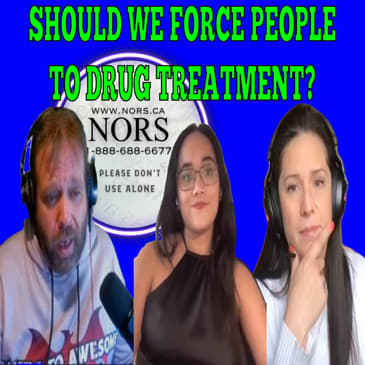


Dr. Lisa, Atika-J, and Chuck have an impromptu debate on mandated treatment, after discussing the NORS (National Overdose Response System) and how Ashes to Awesome has agreed to help get the word out.
Atika's email atika@j-initiative.org
NORS https://www.nors.ca/
If you have a nonprofit or fundraiser that you would like to advertise for free and spread a five-minute dose of kindness to the world while doing it, you can on the latest Chuck LaFLange Production, Morning Cup of Kindness. Details herehttps://WWW.A2APODCAST.COM/MCK Click https://www.a2apodcast.com for links to Chuck's new daily 5 min podcast, "Morning Cup of Kindness", all of our socials where we have posted some great short-form content to help inspire. If you are listening on the Spotify platform, you are able to share your thoughts about an individual episode in the interactive element that Spotify offers. Doing this tickles the fancy of the algorithm and really helps us to spread the message. Also please visit our Facebook page here, and like, share, or comment on any of the posts. Your feedback there is sincerely appreciated, and taken quite seriously. Lastly, most of our alumni guests from the podcast are members of our Facebook group. If you would like to get to know any of them, or have questions, or perhaps would like to invite them onto another show, this is a great place to interact. You can join that group here .https://www.facebook.com/groups/79994... Ours sponsors, that make spreading the message possible :Rosecrest Recovery Services Call 615-484-8792 or email info@rosecrestrecoveryservices.com Dent Kits - http://www.dentkits.com Together We Can Recovery Society http://www.twcrecoverylife.org Revolution Recovery - https://www.revolution-recovery.com/ Yatra Trauma Therapy Center -https://yatracentre.com/ Nate D Foundation =https://nate-d.ca/
Chuck (00:02.068)
Hello everybody. Welcome to another episode of The Weeknd Rumble on the Ashes to Awesome podcast. I'm your host, Chuck LaFlandre, and in virtual studio with me today are my two lovely co-hosts. We have Attica, how you doing today, Attica?
Atika (00:12.782)
Hi Chuck, I'm doing great. How about you?
Chuck (00:15.9)
I'm pretty good, pretty good. A little bit of an afternoon recording here. We can tell because you're obviously been awake for a long time, whereas normally we catch you first thing in the morning, so. Me deflecting. Lisa, how are you this morning?
Lisa (00:25.648)
Hehehe
Lisa (00:29.925)
I'm good Chuck, how are you?
Chuck (00:31.696)
I'm all right, what's it about this morning? It's afternoon, isn't it? Yeah, yeah, so. Peek behind the curtain, I might have slept past our recording start this morning, so things are getting a little, are things, we're kind of winging it today, but there's always lots to talk about, so when it comes to all the things that we talk about.
Chuck (00:50.904)
The guest that I missed was from Norse, but that's okay because we have somebody else from Norse, which is a passion of Attica's. So Attica, why don't you tell us about Norse? What is it if you can kind of give us a Cliff Notes?
Atika (01:04.141)
So National Overdose Response Service, or NORS, is a overdose prevention line that people can use for free, Canada White, and people can use for different things. So they can, for instance, call us when they want to use certain substances, or if they have a...
a bad psychosis related to the substance that they are using and they're panicking and we can kind of help to de-escalate that. It can also be something for peers, for instance, someone who just witnessed an overdose and panicked about what happened and kind of wanted to debrief or there as well. We can also be there for family members or friends of users who
might need some guidance navigating the complexity, like the stress and pressure when dealing with an overdose situation. Which is very important. Yeah, which is very important because now it's a check week. So this is basically where the overdose numbers peak. And that's just well known.
Chuck (02:10.298)
Okay, so primarily around the, okay.
Chuck (02:25.952)
course.
Atika (02:25.974)
And there were two overdoses in the morning yesterday and then two overdoses the day before that within a span of 30 minutes, I heard. So yeah, not from North, it was just like in person, but yeah, overdoses usually peaks up during the third week of the month when there's a check week. Yeah, and it's not like because the check is bad, it's because...
Chuck (02:47.636)
the social assistance check or whatever coming up. Yeah, yeah, right, yeah.
Atika (02:53.77)
It's a big, like it's a lump sum of money being given to people without giving them sort of the financial advisors that are also trauma informed and can have appropriate dialogues and guidance to people who receive the welfare. So they are basically just given check and then kind of left like that. So
Chuck (03:15.324)
Of course.
Chuck (03:20.084)
Well, and I'm not proud to say it, but back in my day, we used to get excited for Check Day, right? Because that was, well, I mean, as a dealer, as a dealer, we used to get excited for Check Day, right? Because we knew it was guaranteed, right? So, yeah.
Atika (03:24.95)
Everyone gets excited. Everyone's happy. Yeah. Oh, yeah. I can see like the dealers, there are certain dealers that are only there during the check week. Other than that they're not there. They're just like, yes, this is like making money, but it's also like, um, uh, a time where crime spikes up as well, just because dealers are, can be quiet.
Chuck (03:37.424)
Yeah, right, I get it. Right, yeah, unfortunately. Yeah.
Chuck (03:53.351)
Of course.
Atika (03:54.674)
mean to each other. I mean, I don't know if I'm allowed to say this, but there's this insane crime happening. Like, I just got into the hood. Like, I just got into the alleys and then there were two dealers like stabbing each other for 10-20 minutes. And yeah, the whole road, the roads are blocked and that was just like meandering around. And yeah.
Chuck (03:56.137)
Yeah.
Chuck (04:13.408)
That's crazy. That's a crazy place to be.
Chuck (04:23.942)
Lisa, you look kind of blown away. I guess for you, this is so far from anything that you would have ever experienced firsthand. I mean, yeah. Yeah, yeah.
Lisa (04:34.592)
Yeah, very far, very far. I mean, I see the end results of some of these things, right? Like if I'm in working in the emerge or something, I see people coming in with these kinds of things, but I'm like picturing Attica just like nonchalantly walking around saving lives, like, you know, well, all this is happening. And it's like, I feel like we need to get her a cape.
Atika (04:51.222)
Oh yeah.
Chuck (04:57.989)
Right? There you go. I'm in.
Atika (05:00.633)
It's like, it's not even like at that point, it's like everyone just kind of like know what's going on and then like people ask each other and like, Oh, how long ago I was like, Oh, 20 minutes ago, what happened? We're just stabbing. And, you know, just like, it's crazy.
Chuck (05:15.388)
You see, but that right there is exactly where the term muggle came from as far as me using it. When I referred everybody as muggles, it was then, those conversations. I was sitting in a motel room, talking with a bunch of other people that were in the life, and we were talking about how so-and-so got robbed, stabbed, whatever, all the bad things that had happened in the last 24 hours or whatever the hell it was. And I said, can you imagine, guys?
what a muggle with a mingle. I said, everybody, that's not us. Can you imagine? They're all sitting around talking about Karen and accounting or how their lawn looks. And we're over here casually speaking about stabbings and shootings and all these crazy things. And that's when I started using the term muggle, right? Was right at that moment. But it is, it's nuts, right? Yeah, yeah, right? Yeah.
Atika (05:54.2)
So true.
Lisa (05:57.508)
Yeah, it's so true. It's so true. I have a question for Attica. Do you know, through working with Norris, like do you know if they provide any swag as we were talking about, but in hospitals? Like, so I feel like this is something that we should have.
Atika (06:00.15)
That's true. That's true.
Chuck (06:04.892)
Yeah.
Atika (06:20.116)
Oh.
Lisa (06:21.76)
available to in the psych emerge to be able to give to people because we'll have sometimes folks who come in and they might be you know sometimes they come in because they're intoxicated but a lot of the times it's more like intoxicated and psychotic but there's a lot of times when the psychosis settles you know within hours of them coming in and they want to leave and they're not certifiable and so we let them leave and
Chuck (06:22.027)
Ho ho.
Atika (06:24.942)
Yeah.
Lisa (06:46.092)
Like in Calgary, we do always give them information about, you know, the detox, adult addiction services, the rapid access addiction medicine clinic. But I feel like NORS is something that every emerge in the entire country like should have to be able to give to people, you know, whether it's a card or a sticker or something.
Atika (06:55.116)
Mm-hmm.
Chuck (06:58.76)
little more boots on the ground, start, yeah, right.
Chuck (07:09.192)
No kidding. Let's have a conversation. So again, behind the curtain, Lisa Morris from Norris was supposed to be our guest today. Unfortunately, it was my bad, we missed her. But she's supposed to be sending me out some swag, but I'm gonna talk to her about that and making sure that maybe you guys got some in the emergency room here. It's a good place to start, right? I mean, why not? You know, absolutely. And what a great place to raise awareness to it too. Family members that are there, all of that, right? Like that's a fantastic place to really meet people and get it going.
Atika (07:28.401)
Yeah. Um.
Lisa (07:28.6)
Yeah.
Atika (07:36.586)
Yeah, I distributed the stickers. I actually just put it on my iPad too. And I just put it everywhere.
Lisa (07:43.672)
Yeah, right? Because I feel like people can put it on their phone, put it on your phone. And until doing this podcast and until recently doing this podcast, I didn't even know Nors existed.
Chuck (07:49.676)
Yeah, right. Absolutely. Why not? Right.
Atika (07:50.198)
Yeah.
Chuck (07:59.628)
Me neither. No, absolutely. Yeah. Yeah, right.
Atika (08:00.174)
A lot of people in the alley still don't know about it. And you know what Lisa, like in the meantime, I was thinking even just like printing Norse and just like the webpage, just like print it, like A4 and then just like stick it everywhere in the hospital probably can work too. Yeah.
Lisa (08:03.512)
Yeah.
Chuck (08:14.449)
I got, yeah.
Why not, right? Why not? Like, I mean, yeah, definitely. I've actually got some promo material that we could probably print off and you could, if you're allowed to do that in the hospital, I can't imagine why you wouldn't be, but you know, right? Yep.
Lisa (08:18.304)
Yeah.
Lisa (08:29.324)
Yeah, no, totally. I mean, we often print things out and there's times when, you know, for clinics, like I'll just go to the clinic website and print out a screen grab with information. So we can absolutely do it. I just think, yeah, like if people from NORS are listening, it's like, if that's not already being done in other places, I do think it would be great, you know, to have stuff available like.
Chuck (08:39.228)
Yeah.
Chuck (08:52.22)
No kidding.
Atika (08:52.607)
Mm-hmm.
Lisa (08:55.464)
I mean, most people have cell phones, you know, to have the sticker like we just saw on the back of a Vatican's tablet or whatever that was, like to have something like that to be able to give to people to put on their phones.
Atika (09:05.854)
Mm hmm. Yeah. Yeah, it's like one of the most effective ways to, you know, promote it, the emerge, um, overdose prevention sites, like slash safe consumption sites. And then what is it like shelters? So low barrier shelters and then well,
Chuck (09:06.096)
No kidding, no kidding, right? No. Go ahead.
Lisa (09:07.884)
I think it would be good.
Atika (09:33.758)
you know if anyone like I remember I gave some to my friends that like really have a good networking and she said oh I hand them I hand some of these stickers out to the dealers if anyone you know god who knows a lot of users it would be dealers so I don't I don't know yeah
Chuck (09:50.225)
Oh my lord, that is something else right there, right? Yeah, yeah, yeah.
Lisa (09:54.484)
I know, in some ways it feels sad and twisted, but if it's gonna save somebody's life then whatever. Whatever. You know?
Chuck (09:58.688)
whatever works, right? Yeah, yeah, no, I'm of the same mindset myself. Absolutely, I am, yeah, yeah. I'm just gonna add the Norse sticker here to my background. Oh, there we go. So we can see it kinda. I gotta move myself out of the way a little bit and then I'll get her in there though because you can do that now.
Atika (10:15.598)
ooooooooooooooooooooooooooooooooooooooooooooooooooooooooooooooooooooooooooooooooooooooooooooooooooooooooooooooooooooooooooooooooooooooooooooooooooooooooooooooooooooooooooooooooooooooooooooooooooooooooooooooooooooooooooooooooooooooooooooooooooooooooooooooooooooooooooooooooooooooooooooooooooooooooooooooooooooooooooooooooooooooooooooooooooooooooooooooooooooooooooooooooooooooooooooooooooooooooooooooooooooooooooooooooooooooooooooooooooooooooooooooooooooooooooooooooooooooooooooooooooooooooooooooooooooooooooooooooooooooooooooooooooooooooooooooooooooooooooooooooooooooooooooooooooooooooooooooooooooooooooooooooooooooooooooooooooooooooooooooooooooooooooooooooooooooooooooooooooooooooooooooooooooooooooooooooooooooooooooooooooooooooooooooooooooooooooooooooooooooooooooooooooooooooooooooooooooooooooooooooooooooooooooooooooooooooooooooooooooooooooooooooooooooooooooooooooooooooooooooooooooooooo
Lisa (10:19.097)
Hahaha
Atika (10:22.026)
I think if I'm not mistaken, yeah, pretty short-coring. There's one volunteer now from, one other volunteer from Vancouver. So it's not just me now, there's like two people from Vancouver. Yep.
Chuck (10:28.064)
There we go.
Lisa (10:34.713)
No!
Chuck (10:35.472)
Well, we hope to change that. That's one of the things that we're really gonna be focusing on, is to try and get you guys some more volunteers, right? So in speaking to Lisa, she had mentioned that it's not just people answering the phones either, it's people trying to network with other agencies and that type of thing, right? So to anybody that's listening, first I should say, and to me, Norris is one of one of many, many people and organizations that are trying their absolute best to do
However, I think Norris is one of the very few that's doing something in real time that's working. And to me, that's why I wanna get behind it so bad, and that's why I wanna contribute as much time as we can from the show to it. So it's important, it's really important. 8,500 phone calls and zero deaths, right? That is zero, right? That's amazing. And there's no way to prove how many lives have been saved, but there's a bunch, right? There's an absolute bunch in there, and I can guarantee that, so.
Atika (11:20.402)
Mm-hmm. Zero deaths. Zero.
Chuck (11:32.612)
That's why I'm so behind it, right, is I feel it's one of the things that's really, really truly working. Now I went off on a tangent and I forget what I was about to say. That's that. Because I do that. Oh, the volunteer thing. If you are interested in volunteering, the thing about Norris is you do it from home. So you're able to, how did I word that? I worded it somewhere on a Facebook post with a small imprint on your life.
Lisa (11:46.992)
That's okay. It'll come back to you.
Chuck (12:02.372)
you can save the life of somebody who's loved and that loves. So it's not a huge time commitment. You're able to do it from home, answer the phone when you need to kind of thing. And to me, why wouldn't you if you've got the time to do that? So I know I've already got a couple people willing to sign up, and that's just from chatting, so I'm sure we can get you a bunch more there too.
Atika (12:15.254)
Woof!
Atika (12:23.595)
Yeah, it's...
Lisa (12:23.716)
Do you know, like when you were speaking to, or maybe Attica, you might know too, or Chuck from speaking with Lisa, like do you know how many people they have in the country currently who are answering the calls?
Chuck (12:35.376)
Attica, baby, do you, any idea?
Atika (12:37.398)
Ooh, I have a rough estimate looking from probably about 60, 60. That's, that's from our band app, which is basically where volunteers just like, oh, I'm toggling on toggling off. And that should be including the staff as well.
Chuck (12:43.644)
Well, yeah, we need exacts. 60? OK. Yeah.
Chuck (12:59.952)
Okay, okay, so yeah, yeah. Yeah, well, I'm sure we can get some more volunteers, actually, I know we can, so. I mean, there's lots to talk about with Norris. Oh, you know, go ahead, yeah, yeah.
Atika (13:12.106)
Yeah, I was up so late. I was doing my shift at North, like it's so flexible that I could just, I could just tell like, okay, I want to be on, I want to toggle off basically whatever I want. So it's really accommodating to my, yeah. Yeah, yeah, yeah. And yeah, yesterday I just happened to be on until like.
Chuck (13:32.712)
when you're able to. So if you've got a spare hour, you can say, hey, I'm available and kind of thing. And yeah, okay.
Atika (13:40.522)
really late so I overslept and I'm glad I didn't miss anything.
Chuck (13:42.76)
No kidding, eh? No kidding. Hahaha.
Lisa (13:46.832)
Okay, how do the calls end? Like, you know, so somebody calls in, they're like, and I'm sure there's tons of circumstances or examples, but let's say that they're by themselves. So they're wanting to use, they don't wanna use alone. So they call Norse, they use. How, like, is there a set time that you remain online with them and how does it work?
Atika (14:08.982)
Yeah, I usually like, we usually try to limit about 30, 40 minutes. And then after that, that's basically they're outside of like, basically we, we think that they're safe. Um, and then we could just be like, Hey, you're, you know, how are you feeling? You still feel good. Now you're safe and you know, um, you're, you're safe to hang up. Yeah, it's it. It's.
Lisa (14:37.36)
Are there stats on people who use the service on repeat kind of thing? Like, because I feel like that would be a way of confirming that people are finding it supportive and helpful and they feel safe and they don't feel judged and, you know, is that they call once and then they continue to call.
Atika (14:57.222)
Oh yeah, we definitely have returning.
Chuck (14:58.032)
Lisa said something about half of the people that called are calling again kind of thing, right? Yeah, yeah, right. I believe that's what she said, don't quote me on that. So, yeah, yeah.
Lisa (15:02.688)
OK, repeat users. OK.
Atika (15:06.282)
Yeah, I definitely see at least one. Yeah. Like I know some people because they use in a certain hours. Like I know exactly, okay, if I pick up this call, it will be this person, you know, because it's so predictable. Some people just call us every single day, every time they use, which is great. I think I think people should do that. Yeah.
Chuck (15:27.284)
No kidding.
Chuck (15:30.932)
Yeah, well definitely, right? You know what I'm gonna do is I'm gonna play the commercial because it's about the time I would cut a commercial in anyway, so the one that Lisa sent me, and yeah, so...
Chuck (15:44.952)
Oh, wow, this is the intro with commercial, oops.
Atika (15:51.967)
Peace.
Chuck (17:42.656)
There you go. And of course, I mentioned a Brave there at the end. This is the international kind of version of that, right? They're worldwide. Oh.
Atika (17:51.319)
That would be my friend who can... Sorry. I turned mezzo.
That would be my friend who can speak to Brave because he's with it a lot. So, yeah, I think you're still on the call.
Chuck (18:07.629)
Yeah, yeah, yeah. Well, so again, a peek behind the curtain. We did have someone from Brave who ended up being busy taking a phone call from somebody, a client. So if he's free and he's able to join us, then all the better, then he can jump in.
Atika (18:20.278)
Yeah, it's great.
Lisa (18:20.997)
Can you tell us a bit more about Brave?
Chuck (18:25.088)
Are you ready?
Atika (18:26.442)
Oh yeah, so Brave is basically like Norse, but they have an app. So the Canadian version of that app would be Lifeguard app. In the U.S., there is a line called Don't Use Alone, and then it basically also connected to the app called Brave. And so there are volunteers who are actually...
responding to calls and basically similar to North, but the line in the US. Yeah. It's basically overdose prevention as well.
Chuck (18:59.828)
Couple of the stats.
Chuck (19:03.752)
A couple of stats mention that commercial are disturbing, to say the least. Four times more people to overdose than car accidents. And again, we've had this, go ahead.
Atika (19:10.718)
If I'm not mistaken, it's actually increased close to 80% in the shelters when they use the loan.
Chuck (19:16.26)
Oh, I'm sure it has this year. That was for 2022, right?
Chuck (19:26.624)
We've talked about this in the past in different scenarios, you know, the whole 747 falls out of a plane thing, or falls out of the sky every day, is one of the comparisons we've made, right, to the amount of people that die in North America. And again, anything else, if this was anything else, the country would shut down, right? You know, I don't think COVID numbers got close to 85 people a day, right? You know, like the country shut down for that.
Lisa (19:43.632)
Absolutely. COVID. No.
Lisa (19:49.776)
Yeah.
Chuck (19:52.344)
And all we're asking for is some money and some attention to the issue. So I don't think we're asking for too much, right? You know, I just don't. But as long as we continue to look at addiction as a moral failure, you know, that's what's going to happen. And I think that's that is why we are where we are anyway.
Lisa (19:58.32)
Yep, yep. Now it's crazy.
Atika (20:09.834)
You know, I'm trying to develop this thing in the J-Healthcare Initiative, my nonprofit. It's basically like an overdose prevention system that doesn't necessarily include a person in there. It's just like an apparatus and a technology using very simple things like geolocation app, geolocation feature, motion detect.
Lisa (20:10.334)
Yeah.
Atika (20:39.875)
and sensor and if we can put that in every shelter that would be good. You know the challenge to that? Funding. And why? I have no clue why that has to be so hard for families.
Chuck (20:41.806)
Oh.
Chuck (20:45.568)
No kidding, eh? Funding, and well, and I know, I know from some very limited personal experience about an app completely unrelated to anything that we'd be talking about now. My mom was trying to make, geolocation inside an app is brutally expensive to build in. I know that much, right? Which is, you wouldn't think now, these days, I mean, everything's got geolocation, right? You're forever telling something yes or no on your phone, but.
Apparently it's a really expensive thing to build in. So the one flaw in the whole thing is how many users don't have a cell phone. That's the one part of it all that I'm just like, oh, I could do better that way, right? Because there's so many, especially when it comes to an app. Right? It's like, you know, but, you know.
Atika (21:30.294)
Well, that's why the apparatus I was talking about, the sensor. Like if we can, yeah.
Chuck (21:36.907)
So explain what you mean then. Maybe I misunderstood what you were saying, Attica. Would that be in the phone? Or like, I assume that's what you meant by that. So what are you envisioning?
Atika (21:44.366)
No, so my non- my non-profit basically has- I feel like I'm advertising my non-profit, but hey, it's non-profit, so...
Chuck (21:55.633)
Yeah, yeah, right. No, no, absolutely. And that's the J-Healthcare Initiative, right? So yeah, continue. Yeah, yeah, yeah.
Atika (21:59.282)
Yeah, so basically the first idea was to connect the Narcan kit. It has like a little, like a microchip or some kind that it has like a geo location feature in it. And it's connected to an app. So when someone spots an overdose, you can just touch up a button and you know who around you carries Narcan and you can notify the person to like help.
Chuck (22:25.undefined)
Oh... Okay... okay...
Atika (22:27.842)
So that's one, but like you said, not everyone has data. And so another thing is basically to face the overdose using basically focus on the highest stats where overdose deaths are very common, which is shelters, which is the single room of occupancy. So occupancy, so.
What I was envisioning was me and the engineers at the GeoHealthcare Initiative were trying to design a sensor motion detection system in which if the person indicate that they're using and then they're not moving for a certain period of time, the system will dial the north turn 911, which is specifically for overdose.
Chuck (23:15.808)
So that would be built into the infrastructure at the shelter, for instance, or whatever, in a single occupancy room or wherever. Okay, yep. Yeah, right, so, yeah, and now that's a funding thing as well, of course, right, I can see that being, you know. Yeah, yep.
Atika (23:18.834)
Yeah. But every room has to have that. Yeah.
Lisa (23:27.589)
Mm-hmm.
Atika (23:27.91)
Oh yeah, everything. Now, what are the places to put that? That would be A, shelters because highest overdose deaths. The second one is washrooms, bathrooms. Yeah.
Chuck (23:42.088)
Public washrooms, yeah, yeah. Now, yeah, trying to convince some people to use an app that's actually tracking them in real time or their GPS location might be a little tough too, right? Because people are a little paranoid, but I know. Certainly, yeah. But it's a fantastic idea. It really is, it really is, right? And actually where I found out about geolocation, just think about it now, was I'd envisioned this thing where you'd have an app telling you where
Lisa (23:42.617)
Mm.
Lisa (23:57.115)
Totally.
Atika (23:58.77)
Yeah, but if it's like a sensor, then no one really...
Chuck (24:11.06)
people had in our can in your area. So, and then that's when my mom explained to me that geolocation is brutally expensive and you know, so it might not be the way to go, but so something similar, right?
Atika (24:13.485)
Mm-hmm.
Atika (24:18.754)
Yeah, because when I reverse overdoses, it's just like people, really the community members, just like yelling OD and like, well, you know, you can only yell into, you know, you can only yell so loud. And that's basically 100% of the overdoses that I reverse are basically just someone yell of an OD or I just basically notice someone OD in front of me. But yeah.
So it's helpful if there's like an alert, you know, system. And the reason why that is because it's more, it's more, it's faster, it's more efficient than calling a 911. I'm not saying like calling 911 is a bad idea, it's a good idea, please do that. But what usually happen is that they don't know what's going on, okay, it's an overdose. Meanwhile, if we dial directly to an overdose line, like we know what we're dealing with.
Chuck (24:54.264)
Yeah.
Lisa (24:54.393)
Yeah.
Atika (25:17.782)
you know exactly where to go and that's basically it. You don't have to, in my experience reversing overdoses, I have to be engaged with the person, the operator at 911 for 20, 30 minutes. And it's very, very frustrating because you just try to focus to keep this person alive in front of you. And at the same time, like you're like, okay, yeah, the address is this and this and this, and then you have to repeat again the address. You have to like, you have to,
Chuck (25:32.799)
Yeah.
Atika (25:47.81)
top and top and top and your mind is like split into two.
Chuck (25:51.784)
Yeah, and if you're the only person there that's of a mindset to handle the situation, then yeah, that'd be super frustrating. The one time we ever had to call 911, many times we should have, the one time we did, there was somebody else there with me. So they were on the phone with 911 and I was giving CPR the entire time, right? But yeah, yeah. I tell you, eight minutes seems like a lot longer than eight minutes, right?
Atika (25:57.16)
Oh, it's very frustrating.
Atika (26:05.343)
Mmm.
Atika (26:08.782)
Oh wow, yeah. No, I was alone.
Lisa (26:12.292)
Why is it like that? But why and why? Like, cause I mean, I called 911 once years ago. I actually saw a guy so inebriated drunk that he could barely stand up, get into a car with a child in the back seat and start to drive. This was like almost 20 years ago actually. And I was like, ah, like I didn't know what to do. So I got his license plate and I called 911. And yeah, it was like, I was on the phone forever.
Chuck (26:29.295)
Oh no.
Chuck (26:34.208)
Jeez.
Chuck (26:38.268)
Yeah.
Lisa (26:40.944)
I'm like, this is ridiculous. I'm like, I don't ever want to call again. And like you said, yes, that's what you do. You call 911. If there's an emergency, you call 911. No one's questioning that. But I don't get how an emergency line, why it feels so inefficient when something acute is happening. That's strange.
Chuck (26:43.052)
No kidding, right? Yeah. Yeah, yeah.
Atika (26:45.395)
Right? Yeah.
Atika (27:02.034)
Oh yeah. Yeah. I remember curb of the street and OD, that one very hard. And, um, yeah. And I had to administer Narcan, uh, like, um, intubated and, um, well, yeah, just like opening the airway and everything and phoning.
Chuck (27:03.463)
Um.
Atika (27:27.474)
911 and checking the oximeter everything by myself and I was so frustrated for how many times I told them the address like I was like I literally have been repeating the address like five times to five different people like when are you guys gonna come over here like just come here already you know like this person's blue
Chuck (27:37.696)
kidding.
Chuck (27:43.772)
Yeah, yeah, right.
Lisa (27:43.984)
I know. And you almost...
Lisa (27:50.192)
And I feel like my one thought is like, cause I'm pretty sure those calls are recorded, you know? My one thought is like, I'm gonna say the address once, I'm gonna hang up. And if you need to hear it again, just play it. Just play it, listen to it. You recorded it, right? Anyway.
Atika (27:55.435)
Yeah.
Chuck (27:55.788)
Yeah. Yeah, and I'll bet you find the place, right? Yeah, yeah. Yeah. Yeah, yeah, yeah. No kidding, no kidding. And it's a common misconception about 911, and I went through this with an ex, who was, she was trying to get the police to, if she called, to say, like if she hit 911, not to have to say anything, because she had somebody in her life that was,
Atika (28:02.208)
I'm sorry.
Atika (28:07.394)
Yeah
Chuck (28:25.876)
threatening your life and whatever. And they said, no, we can't do that. What do you mean, you can't just register a phone number and say, like, this is my address. If I call and I'm not able to talk to you, then come, please. Like, what do you mean you can't do that? Which is crazy. And then, and I said, well, they know where you are anyway because they geolocate those calls. No, they don't. A 911 call from a cell phone does not get located at all. That's a myth, yeah, right? So, yeah.
Lisa (28:45.376)
Oh really?
Lisa (28:48.936)
I didn't know that.
Atika (28:48.982)
Why not?
Chuck (28:53.2)
It's crazy that it doesn't. And I'm sure there's some sort of technical reason and legal reasons, of course, too, and all that stuff. But I feel I can't think of a good, can't think of a good common sense reason why a 911 call wouldn't have a geolocate on it, right? Like it just, come on, right? So yeah.
Atika (28:53.397)
Oh my god.
Lisa (28:59.376)
privacy or something.
Lisa (29:05.568)
Yeah.
Atika (29:06.978)
The challenge to that, well, in Canada, not really, not in downtown Eastside Vancouver, but think about the overdoses that happened in the alleys. How are you supposed to tell the address of the alleys? Like, you know. Yeah, yeah, yeah.
Chuck (29:23.256)
Yeah, yeah, well, and that's the same if you're in the country when you have one, you've got to get the nearest cross streets and you know what I mean? You know, have a good idea of where you're at, right? So and then you're supposed to send somebody out to that cross street. Well, if you're alone, then, you know, that gets tough, too. But yeah, yeah. Yeah, so go ahead.
Lisa (29:39.509)
Um.
So this is not nor specific, I mean, I guess everything that we talk about is kind of Norse, but did you happen to see the article in the Calgary Herald? It was an opinion piece?
Chuck (29:55.28)
did not. What are we talking about though? You have my attention.
Lisa (29:57.undefined)
So it's called Compassionate Intervention for Addiction Saves Lives. And it's a piece.
Atika (29:57.027)
Leave it.
Chuck (30:05.616)
Oh, Dr. Tangay posted that on LinkedIn. Yes, I did read it. Yes, I shared it on LinkedIn as well. Yeah, yeah.
Lisa (30:09.75)
Yeah.
But didn't you find that one part so interesting? So Attica, maybe you didn't read it, so I'll tell you, because my mind just kind of went, poof. It's talking about a program in the States called 24-7 Sobriety, and it's an incentive program for people with a history of repeat DUIs. So they have to go and breathalyze morning and evening.
And if they don't, then they get picked up and they are put in jail for 24 hours, I think. And apparently with this program, it says that monitored individuals, they've appeared and passed their breathalyzers 99.1% of the time. So kind of, and it talks sort of to the fact that having these, you know, quick consequence, quick reward for behavior,
from a behavioral intervention model works, right? But the thing that really stood out to me, so it's kind of like a form of mandated treatment. But one of the things that's talked about, because again, I've been pretty vocal on here in various capacities about the fact that I support mandated treatment and addiction. You know, I think there's a time and a place for it. Again,
Atika (31:10.458)
Hmm.
Chuck (31:11.796)
Cough cough
Atika (31:15.746)
Yeah.
Lisa (31:31.46)
to repeat, I'm not suggesting we get vans and go around picking everybody up with addictions and locking them away, just like we don't do that to people with schizophrenia. But one of the things it talks about is that if people who cannot provide, like if you shouldn't provide treatment to those who cannot provide consent or who have not provided consent, then by analogy, those people who you see overdosed on the street, you shouldn't Narcan them. They didn't consent to Narcan.
Chuck (31:36.38)
Hehehehe
Chuck (31:58.3)
Yeah. Right? That's an argument, you know?
Lisa (32:03.584)
It's just kind of because I think there's, I mean, maybe there are people if we go real dark and sinister who would say, don't Narcan them. But I think the majority of people in the world agree with and support the idea that if somebody is overdosed on the sidewalk and dying, that we should step in and do something. But again, they're not consenting to that. And we feel that it's ethical to do anyway. So it just like, right? I've
Chuck (32:29.34)
are at that point now, right? Yeah, that's another strong point. Where do you come in on that one, Attica? I know this is a touchy subject for you, so, right? Maybe that's not the right term, not touchy subject, but it's a passionate subject for you.
Lisa (32:34.311)
Yeah.
Atika (32:37.846)
Oh no no, I-I-I mean even... I mean...
Like, if I'm not mistaken, it is a legal obligation to do a life-saving measures when someone is in that state. Because, well, because it's basically a medical distress. It's overdoses a medical distress, and if we just leave it, then they're going to die. So we are legally obligated.
Chuck (32:56.987)
once you've started it, you have to complete it. That's where the obligation is, but yeah.
Chuck (33:06.511)
Mmm. What?
Chuck (33:11.964)
What?
Lisa (33:12.816)
But there are people, like there's different levels of care, right? So there are people, and again, not with addiction, but there will be people who are terminal with cancer who will have do not resuscitate orders. And they're like, we don't want that intervention, right? And so, you know, people like that will have information logged in hospital systems that that's their level, their goal of care is they do not want, you know, extreme measures being taken to keep them alive.
Atika (33:24.032)
Oh yeah.
Atika (33:40.158)
With the Narcan, I never prioritize Narcan, and I do not tell people to just, yay Narcan, Narcan. It's actually not a good solution. It's very invasive.
Chuck (33:53.32)
But now you're getting away from the question though. The question is, saving their life when they have not agreed to it, isn't that the same thing as mandating somebody into treatment that's incapable of making a good decision at the time?
Atika (33:58.31)
Like what? Saving their lives.
Atika (34:08.338)
I don't know how it's not the same though because...
Lisa (34:11.695)
Well, they're not giving consent in either case, right? And you're making a decision on their behalf because in the moment, the impression is that they are not able to consent for whatever their reason might be, right? So it's like if they can't provide consent, be it because their brain is not functioning properly, be it because they're passed out, be it for whatever reason, the point is that for a variety of reasons, the common denominator is that they can't actually provide informed consent.
then is it reasonable that temporarily decisions are made on their behalf from an ethical perspective to try to save their lives?
Chuck (34:51.932)
And of course it is. I mean, if somebody's dying, you help them, right?
Atika (34:54.238)
I don't know, because like what really interesting about it is because we don't treat other things that way. Like, if we see someone who are, we don't, if we see people who are severely obese, if we see someone who keep on eating junk food and they're obese and they have had heart attack multiple times, we don't do mandated treatment on them.
Lisa (35:02.169)
Yes, we do.
Chuck (35:02.231)
Ah, but that...
Lisa (35:17.332)
Yeah, I think obesity is a good analogy. I think that one way in which I still think that we see less stigma towards obesity than addiction is that when an obese person comes to hospital with repeated heart attacks, which you could attribute to their weight and their cholesterol and their hypertension, all of these things that underlying are related to their obesity, they're provided care.
Chuck (35:17.6)
That's fair.
Lisa (35:42.86)
right, a lot more often than people suffering with addiction who show up and they're like, oh, you know, it's like, you can go into the hospital. And I'm not suggesting that obese people do not face stigma, because they absolutely do. But when someone who's obese shows up in an emergency department having a heart attack, it's not like, well, you know, you chose this, you know, should we treat the heart attack? Should we not treat the heart attack? Like, this was their decision. Whereas I feel like when it comes to people with addiction,
Chuck (35:43.913)
Yeah.
Lisa (36:12.344)
we still kind of hang the, well, it was your choice hat, a lot more over addiction than what I personally see compared to people who are obese.
Chuck (36:23.572)
And as well, you know, the cancer, or schizophrenia is one that we've used quite a bit to compare to, right, you know? You know?
Lisa (36:29.24)
Yeah, yeah, I mean, yeah, with.
Atika (36:30.346)
Yeah, well, I just looking into the, like I said, it's the mandated treatment, it's what is it in it? Like the problem of addiction is not so much about stopping because I just had two friends who told me, oh, I just decided to stop and good for them, but it's not about just stopping. They don't need mandated treatment to just stop. They need.
tools, they need tools to basically attain that sobriety so that they don't, so that the trauma doesn't compel them to use again. And that's a tool, the toolbox that they need instead of just like telling people, stop.
Chuck (37:11.661)
without a doubt, you're very right, Attica, and I wouldn't disagree with you not for a second. However.
Sometimes, in a lot of cases, people aren't in their right mind to make that decision because all they care about is getting their next. It's not being dope sick, right? And that's just the reality of it, right? Their brain is telling them they're gonna die if they don't do this, right? But why do we let them kill themselves? Because that is our reality now. Our reality is when you're waiting for somebody to finally hit their rock bottom, to be compelled enough to go seek treatment, they die.
Atika (37:30.382)
Yeah. And that's okay, people don't want to be.
Chuck (37:48.616)
That is the reality we live in now. We are letting people die that don't need to die. And that's where I really struggle with it, right? Like I just, I do. I think in some cases, you know.
Atika (37:53.343)
Well...
Lisa (37:56.952)
I think the other piece to that though Chuck is that we're letting them die and we know scientifically from functional MRI imaging that their frontal lobes are not working. They don't have the ability to make informed decisions weighing pros and cons and risks and benefits and you know all of that is not working. And so that to me is the piece. It's like I always say in my mind.
Chuck (38:07.504)
See, that, right?
Lisa (38:25.472)
An analogy that I think strikes a chord is would you let a two-year-old go sit in the middle of the deer foot or would you let a two-year-old go sit at East Hastings and die in East Hastings? You wouldn't because they don't have the ability to make that decision for themselves. Would you take somebody with mental retardation who said, well, I just want to walk down the highway and see if I can get hit by a car? We wouldn't just stand out of the way and let them do it. We would say, no, we're not going to let you do that.
because you don't have the ability to make that decision for yourself. And so, you know, but with addiction, we still often, you know, we, we know scientifically that their brains are not working. And yet we still, and we, you know, and it's all, it's a brain disease. Everybody in the medical community is, I think, getting on board with the idea that it's a brain disease. But then there's still this, you know, it's on one hand, we're saying, okay, yeah, it's a disease. It's a brain disease. And then.
Chuck (38:58.676)
So, yeah. And I...
Chuck (39:08.476)
Not the way they should be. Yeah, right.
Lisa (39:23.428)
we're still turning around saying, oh, but it's your choice. You know, it's like, it's either a brain disease or it's your choice, it's not both. And I don't know, I still think that's the old stigma that still permeates through the science, you know, we're learning about it, but that's still there.
Chuck (39:27.304)
Right? Right. You know? Sure.
Atika (39:32.77)
I think...
Chuck (39:36.397)
Of course it is. Of course it is.
Atika (39:41.926)
Um, if the mandated treatment did offer more benefit than not, I would have been into the mandated treatment, the failure rate is insanely high that it's.
Chuck (39:43.218)
And I f-
Chuck (39:54.292)
the failure rate for all sorts of recovery methods is insanely high. That is like it is, it really is, right? But I'm telling you, the recidivism rate for somebody that goes to an AA meeting is shit. That like, you're talking, the percentages are so low for success, I'm saying for all recovery methods. The percentages are shit. If we can, what was that one guy on my LinkedIn post that 20%? He's been working with people in the United States mad at a treatment.
Atika (40:00.117)
No for mandated treatment. It's not like injectable opioid.
Atika (40:09.799)
Oh, I'm not saying A8.
Chuck (40:21.844)
or the success rate is only like 20%. It's like 20%. If any other recovery method could claim a 20%, and I don't know that that's a fact, I don't know that his numbers are right, but for the sake of that argument, if anything else could claim a 20% success rate when it comes to recovery, they would be rock stars. It would be like the only thing we would ever do, because there's nothing that even comes close to that. You walk into an A meeting and ask how many people managed to do it their first time?
Lisa (40:32.688)
where his numbers come from.
Lisa (40:47.856)
And I think, you know.
Lisa (40:51.972)
Yeah, and I think Attica, you're right.
Atika (40:52.686)
Well, yeah, I'm not saying AA is the best. I am not strongly to AA. But there is certain things like injectable opioid agonist therapy. There's methadone-based treatments. There are treatments that are
Chuck (40:57.349)
Yeah, I'm not, I'm just using that as an example, right? But there is.
Chuck (41:07.528)
But that's all part of the mandated treatment, correct, Lisa? Like that's all included in that. It's not saying.
Lisa (41:10.348)
Yes, yeah. That's the thing is that if you... Yeah, it is. We do that inpatient all the time.
Atika (41:12.278)
But it's not inpatient, right? Not all of them are inpatient.
Chuck (41:15.776)
What do you mean? Sorry? Of course it would be.
Chuck (41:21.372)
No, if it's mandated treatments, go ahead, go ahead Lisa.
Lisa (41:25.588)
Yeah, so I mean, we don't mandate treatment in Canada right now. You know, I know that there are some, you know, in some cases, the legal system will sort of give that as an alternative to jail to people. But I would say for the most part, as a blanket statement, I would say we don't mandate addiction treatment in Canada currently. And if you talk to anybody in the medical world who is in support of mandated treatment, we're not talking about locking people in cupboards and leaving them there.
we're talking about forcing people into treatment where they receive treatment. Whether that's treatment of opiate use disorder with opiate agonist therapies, whether that's treatment for underlying depression, anxiety, PTSD, trauma, whether that involves getting, you know, ART, EMDR trauma therapies. It's the idea being that they are forced into a treatment program.
where they get the pharmacologic psychotherapeutic modalities that are needed for their case, and they get the proper support. So, you know, I have, there's a paper.
Atika (42:34.086)
That's the thing where the proper support is actually more rare than not.
Lisa (42:40.58)
Yep, definitely.
Chuck (42:41.985)
In what though? Because we don't have that right now, so what are we comparing that to? Right, like the not, when you say that, I mean, where does that come from, right?
Atika (42:47.522)
Um, there are usually, uh, the, we did have that in the past and I've, uh, seen, uh, people get, uh, religious based. So it's like you go into, you know, it's yeah. Yeah. And, and that doesn't work. That doesn't work. Um, so.
Chuck (42:55.42)
We've had mandated treatment in Canada in the past.
Chuck (43:01.28)
Oh, pray the gay away stuff or whatever, yeah. Yeah, yeah, well, that's a different world, right? Obviously, that doesn't work. That's a totally different argument there, but.
Atika (43:09.95)
You know, so like I said, it depends on what kind of treatment are we talking about? Like we cannot say that, okay, you stop using, but are we addressing, are we putting them into social work or like, are we assigning a social worker for them? Are we assigning a case worker for them? You know, just addressing, like Lisa said, everything, the pharmacological side of it. Yeah.
Chuck (43:32.968)
would be holistic and comprehensive, otherwise there's no point in doing it, right? And I think anybody with any sort of, you know, whatever stake in all of this or opinion that means anything would absolutely agree with those, that yes, it has to be holistic and comprehensive, right? Yeah.
Lisa (43:36.927)
Yep.
Atika (43:45.898)
Like I'm not saying that religious based treatment is not good. I think some people do benefit from that, but I also see people that, that have cho chosen just to quit everything rather than being in mandated treatment that it's more like, you know, religion based. So.
Chuck (44:01.933)
And for the people that can, then by all means, do that.
Lisa (44:04.676)
That's the thing, my thought would be, like when I think about, you know, again, as an analog, and I do think the closest analog we have is the Mental Health Act, you know? So I think psychiatrists are the ones who probably see this and deal with this the most, you know? And we certify people and temporarily take away folks' capacity, you know, not all the time, but it's not an uncommon thing that we do either.
Chuck (44:15.548)
Yeah, right.
Lisa (44:34.732)
And so yeah, I don't think it's a blanket thing that is done to everybody. And if somebody has the capacity to literally quit on their own, then to me that would probably be somebody who doesn't need mandated treatment. But there are people who can't quit on their own, and they'll even admit it. I've heard people say, I've had people in the Emerge ask me to certify them under the Mental Health Act.
Chuck (44:46.396)
Without a doubt. Right.
Yep. Yeah.
Lisa (44:59.428)
because they want to get better, but they know the minute they start craving, they're not gonna be able to remain in hospital. I've had people tell me, I wish I would get arrested because maybe I would have a hope if I was put in jail. But they feel like they cannot control it on their own while out in the community. And so, yeah.
Chuck (45:10.729)
Mm-hmm.
Chuck (45:21.512)
Right? You know? And I think it's important, again, like you said, we're not talking about running around putting people in vans, and taking away people's rights and all of those things. There has to be a set of controls. There has to be some sort of, you know, protocols to make sure that these people are the right candidates for a mandated treatment. But to say no because it's mandated treatment, I think is doing a disservice to a lot of people that could use it.
Atika (45:46.222)
No, yeah, I think a lot of people who are against the mandatory treatment do see it in a way of like a human rights or ethical issues that comes with it or the success rate. So I've seen more success rate, for instance, on the clean supply program, which changing people from
Chuck (46:14.248)
that people get to sobriety from clean supply? I'd like to see those numbers because I gotta say that doesn't sound right. Because, right? Yeah. Most certainly, of course it does, right? Yeah.
Atika (46:17.191)
Yeah, so basically because
Lisa (46:22.488)
Yeah, I suspect that stops people dying, but I don't know if giving...
Atika (46:22.53)
to sobriety because that stops people dying. And it's very, it's very, like, it's very good numbers in preventing deaths. And I think, right, so.
Lisa (46:35.428)
But there needs to be a step though, Attica, right? And like, I feel like, and again, we all have a lens that we see things through. And I think because of where you work, I think keeping people alive is like, that's what you're doing, right? And that's step one. If people aren't kept alive, there's nothing else left for them. But I think the point is, is we can't be satisfied by just keeping people alive and sick. Like, it's like, then what? You know what I mean? Like...
Chuck (46:35.764)
on.
Chuck (46:59.272)
Right? And if you look at actually Portugal, I just read an article the other day, Portugal, who's everybody's favorite child when it comes to clean supply and regulating and all that. Not anymore. It's falling apart over there real fast. Right? Yeah, it is. So, and again, there's gonna be different opinions. You're gonna watch different numbers. The article I read said that. So I should be careful about stating that as fact. But it is not the end all and be all.
Lisa (47:07.598)
Yeah.
Lisa (47:13.961)
Oh really?
Chuck (47:26.592)
is to do that, there has to be a mix. And if mandated treatment is one of the tools in the toolbox, so be it. Clean supply, absolutely adequate. Keeping people alive. And there's no point in mandating shit if everybody's dead. So 100% I agree with that. But none of these are the answer unto themselves. There has to be a box full of tools to use.
Lisa (47:34.704)
Yeah.
Lisa (47:40.132)
No. Yeah.
Atika (47:51.278)
I think I'm wondering about how much do we want like a drug free world? Do we actually trying to fulfill our fantasy about everyone being sober? Because that is not going to be a case. That's not going to happen. Dolphins use substances, animals use substances. They try to get high, they try to get toxicated.
Chuck (48:06.868)
That's never gonna happen, no. But there's some people, it's never going to happen, right? No.
Chuck (48:18.549)
That will never happen, and you're right that will never happen. But what we don't want is people sick and ruining their lives. That is the part that's horrible. And you see it all the time at work, Attica, right? Like you see these people, right? You walk amongst it more than any of us do by a long shot, right? So like, you know, and.
Atika (48:21.159)
And I just...
Atika (48:30.567)
Oh, I do. I do.
Atika (48:36.874)
I do, I just think that treatment has to be very holistic in a way that are also designed by the peers themselves, not just by, you know.
Lisa (48:45.552)
But again, mandated doesn't define whether it's holistic or not. Right? I agree. It needs to be holistic mandated treatment. But I think the conversation, yeah. Yeah. And it'll be interesting. Hopefully, we'll be able to get Dr. Tangay to come back on at some point. But we had touched on before that he's recently
Chuck (48:50.108)
No, it doesn't. Right.
without a doubt, right? And anything less than that is bullshit, right? So, you know, if we can agree on that much, right? You know, then we're getting somewhere.
Lisa (49:13.524)
It hasn't published yet, but he has done a review of all the literature that exists around mandated treatment, looked at all the studies, and has sort of summarized the findings of all of these studies. And I'm in a very simple form, and hopefully he'll come back on once it's published and talk about it more specifically. But what he was saying is that the studies that exist that say it doesn't work,
are studies where people were not receiving holistic treatment. It's studies where they were just held so that they couldn't use. And then when they were released, they went back to using. But it's like, well, of course they did.
Atika (49:46.977)
Yeah.
Atika (49:51.628)
Yeah.
Atika (49:57.042)
That's basically the reason I'm against the mandated treatment, because the current literatures on mandated treatment looks like that. They look like locking people up, just deprive them out of things that humans really need, like connection, peer support, and social worker, caseworker, addressing the trauma. And so, yeah.
Lisa (50:18.064)
But I would challenge, but I mean, it's, you know, you've said this in your own words. And so all I would say is, I don't think anybody should say they're not in support of mandated treatment, because non-holistic mandated approaches have not worked. I think it comes down to, if they were holistic, you know what I mean? Then what, right?
Atika (50:36.694)
Hmm I got what you mean. Yeah If they were holistic, yeah Yeah, I would be really interested to find that stats on that because I don't think there there's enough Holistic. Yeah. Yeah, exactly Yeah, like I don't know like I'm just Yeah, like I honestly it's not really like I don't really
Lisa (50:49.396)
I don't think there's tons of them. There's hasn't been done properly.
Chuck (50:51.768)
And that's the problem, right? Nobody's tried that. Because in the past, mandated treatment has been done from a moral, from looking at addiction as a moral issue. That's why, right? You know?
Atika (51:02.974)
It's not really an opinion for me because I just look at like the systematic review and the meta-analyses and what do I see from there? That's it. Like if the magnetic treatment and holistic do work, then sure. You know.
Lisa (51:12.592)
What?
That's the thing, because you can't just say, well, mandated treatment doesn't work, per the evidence. You have to say, do you know what I mean? Exactly, right. Cause I think.
Chuck (51:24.392)
Yeah.
Atika (51:25.053)
the non-holistic mandated treatment do not work.
Chuck (51:27.712)
Yeah, right, which again is all based on addiction being a moral issue, right? Anything that's been attempted in the past has been attempted through that lens, right? So, and that's where we need to look at something different because we know it isn't now. And I think compared to 10 years ago, we are so much further ahead than we were even 10 years ago, nevermind 20, 30, 40, 50 years ago, right? So in that regard.
Atika (51:32.776)
Yeah.
Lisa (51:36.845)
Yeah.
Atika (51:38.178)
That's, yeah.
Lisa (51:40.62)
Yeah. But I.
Atika (51:42.093)
It's not a moral failure, no.
Lisa (51:45.869)
Yeah.
Lisa (51:50.004)
Yeah. And I think, again, I feel like it's important though to like hone in on that detail, because it's a critical detail, right? And to simply shut down the idea of mandated treatment and to say, I don't support mandated treatment without adding in that detail that I don't support holding people in boxes where they just don't have access because we know that doesn't work.
Atika (52:10.815)
Mm-hmm.
Atika (52:19.298)
That's basically what people, yeah, that are doing the work that I do basically. When we talk about mandated treatment, that's like, oh, you're talking about that. You're talking about like depriving people and yeah.
Lisa (52:19.832)
You know what I mean? Yeah.
Chuck (52:24.125)
which is.
It's like, right away, that's where it goes to, right? Yes. And that's unfortunate, Attica, because I think if the side four mandated treatment did a better job of explaining themselves and took the time to make sure, and opposite to that is if the anti-mandated treatment side did a better job of listening between the two of them, if we could get to the middle somehow and just figure out the right way to do it, right? And it's...
Atika (52:53.11)
I'd be interested in that actually. Like just. Yeah.
Chuck (52:57.044)
It's those biases, those built-in biases to it, that have stopped so many great conversations from happening, right? It really does, because instantly, for instance, on LinkedIn, you remember that thread, Lisa, Dr. Tangade, he had mentioned that it's about stigma, right? It's why we don't mandate treatment right now, right? It's, oh, well, you know, we wouldn't let somebody jump off a bridge, but we'll let somebody slowly kill themselves with fentanyl, right, and that's because of stigma. That's why it's like that.
somebody jumped in and said, oh, you think stigma is it? And it's this huge argument. And I countered with, that was that 20% guy. And I countered that by saying, 20% is a hell of a number, man. Right, like, that's a pretty great number if we could have 20% on everything. We'd be doing something else. Because I'll tell you what, I will piss off eight people to save two lives every day of the week. Right, and that's just whatever. The next person came in and said, well, if we really cared, we'd be doing this, and this. So that's a yeah-butt argument.
Lisa (53:41.324)
Yep. Yeah.
Lisa (53:46.8)
Mm-hmm.
Chuck (53:56.028)
and it doesn't hold, right? It's got nothing to do with it. Immediately, that person assumes Dr. Tangay, or whoever, insert whatever name you want, doesn't care because they don't view things the way they do. And that is the problem right there. Just because I have a different way of helping people, the same way you want to help people, in the end of the day, we just wanna help, we just want all the fucking deaths to stop.
doesn't mean that I don't care. Right? And that's, that attitude stops so many good conversations.
Lisa (54:30.016)
Yeah.
Atika (54:30.059)
Mm-hmm.
And another part of the mandated treatment that I think people from my side like to see is basically how are we getting into mandated treatment without perpetuating the stigma? Because when someone feels stigmatized, they feel ashamed. They go into isolate. And that's basically what leads to death. They become more isolated, they use more and more, and they feel so ashamed. And...
self-shame in people who are using substances is already staggering. So I would be really interested. Yeah, right? Like there's a lot of self-shame in people who are using substances, like regardless what we have in mandated treatment or not, but I'm interested into seeing how can we bring about mandated treatment without perpetuating stigma.
Chuck (55:05.577)
Yeah
Lisa (55:24.undefined)
See, I think the opposite. I see it completely opposite to that. I feel like mandating treatment means we're starting to treat addiction like the disease that it is, and that takes stigma away. It's not a moral failing, it's a brain disease. Let's treat it like we treat the other brain diseases. You know what I mean? Like if someone has schizophrenia and they're off their medications and they're psychotic and they can't make good decisions for themselves, then we take over and we bring them in, we stabilize them, and then we let them go. And...
Atika (55:36.462)
Mm. Yeah, it is.
Lisa (55:53.208)
You know, the idea...
Chuck (55:53.772)
So can you list the boxes again, Lisa? Can you do that? Like I know without it in front of you. So these are the conditions somebody with a mental health disorder has to meet to be certified into care.
Lisa (55:56.844)
Yeah, I feel these forms out all the time. You think that it'd be like boom, boom.
Lisa (56:08.708)
So they need to have a mental disorder, right?
Atika (56:09.31)
Yeah, yeah. No, my mom is, my mom has been in, like my mom is schizophrenic and been, you know. Yeah.
Chuck (56:14.682)
Okay, so for the sake of the listener and whoever, Lisa, what are the boxes, right?
Lisa (56:18.496)
Yeah. So you need to have a mental disorder, right? And this mental disorder needs to mean that you have some impairment in your thinking, your judgment, your decision making, your ability to recognize reality. And you don't need all of them. So something, a brain disease that is impairing your judgment qualifies. Okay? It needs to be a condition that is treatable. Check.
Chuck (56:21.588)
check. Yep.
Chuck (56:38.292)
check.
Chuck (56:42.976)
check.
Lisa (56:44.628)
It needs to be a condition where either you're at risk of harm to yourself, you're at risk of harm to other people. And I mean, I think addiction satisfies those in a lot of ways, like you're, you know, you're putting yourself at risk of overdose. You're, you know, people who are in active use, there's more criminality. People end up getting killed and shot and stabbed and whatever.
Chuck (56:59.629)
Every day, right? Yeah, yeah.
Lisa (57:07.932)
But you don't need the safety piece. It can also just be that without intervention, you're at risk of mental and or physical deterioration.
Chuck (57:17.664)
Check.
Lisa (57:18.568)
Okay? And the last criteria is that you won't seek the treatment voluntarily.
Chuck (57:26.26)
check for everything else, for every other disorder, somebody can be certified except for addiction. But yet all those boxes are clearly checked. Clearly checked, right? In not every case, in a lot of cases, right? So why don't we?
Lisa (57:27.716)
That's it.
Lisa (57:43.428)
And again, it's temporary because one of the things, and I do appreciate that perspective that we, when somebody is being held against their will, that they are being denied, being able to walk to the corner store temporarily, being able to go get some fresh air temporarily, being able, and I mean, not that they can't get fresh air. We have people who are certified and they go outside all the time. We give them passes, they go for the day. So it doesn't mean you're not allowed to leave.
Once you're deemed safe to do so, you can be a certified patient who's not allowed to leave for good, but you can go out for two hours or nine hours or 12 hours once you're well enough to be able to manage that appropriately. But to me, it's like you're temporarily holding somebody to hopefully allow them to then leave and go and live a healthy life without shame.
that they're proud of, where they're not hurting themselves, they're not hurting their loved ones. And so for me, I feel like it's in the grand scheme of things, it's a brief hold that I think can have monumental long-term benefits. Yeah.
Chuck (58:56.2)
So again, so long as the approach is holistic, you know, all those things have to happen, right? And it's gotta be better than what's happening now. Something has to be better, right? Because the deaths aren't getting any better. You know what I mean? I think in Alberta, they might have gone down a little bit. I don't know if you know those stats, Lisa. I think they took, well, I'm almost positive they took a dip at one point, whether or not that's maintained, I'm not sure, right? But yeah, yeah.
Lisa (58:59.564)
Yeah, totally.
Atika (58:59.946)
Yeah.
Lisa (59:10.234)
Yeah.
Lisa (59:14.124)
I don't know. Haven't looked at them lately.
Atika (59:14.151)
Oh, I don't think so. I really doubt that.
Lisa (59:22.32)
Mm-hmm. Yeah.
Chuck (59:26.756)
Alberta though and believe it or not. I know you guys think we're all a bunch of rednecks out here and you know It's all about praise God and whatever Has more treatment beds per capita than anywhere else in the country and is building a lot more a lot more, right? You know, so
Lisa (59:31.556)
Hehehehehe
Atika (59:39.346)
Yeah, I think when we're talking about harm reduction and stuff, I get a lot of people asking, Oh, you're not into recovery? I'm like, yeah, dumb into recovery. Like, what do you mean? We all know drugs aren't good. And it's like harm reduction and yeah, so harm reduction and treatment bids, like more treatment bids. Because do you know how many times people tell me, okay, I want, I'm ready, I'm sick of this crap, I want to recover.
Lisa (59:49.023)
Hehehe
Chuck (59:52.984)
Mm-hmm. But so that's that same bias that, you know, yeah.
Atika (01:00:09.342)
and they have to wait. And it's just, are you serious? You know, like I want it to be like, okay, today, right now, you want to recover, let's go there, get you a bed, you know, and it's not like that. So I think harm reduction, safe supply, and beds have to be all available all the time. And then that's it.
Lisa (01:00:11.745)
I know.
Lisa (01:00:21.604)
which is so sad.
Lisa (01:00:25.776)
Mm-hmm. Yep.
Chuck (01:00:25.916)
All of it, all of it, right? And Dr. Tangay made a really good point too, in that none of it matters if we don't have the beds anyway. We can't mandate treatment for a bunch of people and we don't have enough beds for the people that want it. So that's the next point, the next thing to tackle.
Atika (01:00:35.224)
Right?
Lisa (01:00:37.162)
nowhere to put
Atika (01:00:43.414)
No, I've seen a lot of people wanting to recover and don't have beds right away. And it's so frustrating because where are they gonna sleep? Where are they gonna stay? Yeah.
Lisa (01:00:48.244)
I know. Yep.
Yeah, I know, I know. And I do think, you know, like, if you look at mental health, I always say, like, I literally couldn't do my job without my social worker. My social worker is Jeremy, and he is God sent, like, couldn't, could not. Oh, yeah, we should. Couldn't, couldn't do what we do without him. And again, that is part of the treatment, you know, like when
Chuck (01:01:08.96)
We'll have to get him on the show. Hey? Absolutely, yeah. Yeah.
Atika (01:01:11.81)
They are angels, I think. Yeah.
Lisa (01:01:18.176)
you know, and the majority of the patients we're working with have things like depression, schizophrenia, bipolar disorder, but we see lots and lots of addiction, often comorbid, but we see tons of it. But like, you know, yes, I agree that we don't get people better and then send them to sleep under a bridge. You know, we need to get them well, and they need to be housed, and they need to have outpatient follow up. And, you know, yeah, it's they need financial support.
Atika (01:01:36.394)
No, exactly. Then you, yeah.
Yeah, get a good job. Yeah.
Lisa (01:01:48.088)
And so I do think that's another part of what, you know, what I think would need to be incorporated into an effective mandated treatment process, right? It's the meds, it's the diagnosis, it's the therapy, it's the social work.
Atika (01:01:48.588)
Yeah.
Atika (01:02:01.31)
It's really holistic, yeah. It's like, yeah, got to involve a lot of different people.
Lisa (01:02:05.272)
Sometimes when we talk about it, I'm like, it feels like a pipe dream. But then I'm also like, you know what? If we don't talk about it, it'll never happen. But it like, it should be able to happen, right? Like when we've talked about before, the study is looking at the cost of not treating people with addiction and compared to the cost of treating people with addiction, it is economical to treat people.
Chuck (01:02:14.777)
Yeah, right.
Lisa (01:02:27.872)
So we should be able to have mandated treatment with beds, with the necessary treatment involved in the mandated treatment. It shouldn't be a pipe dream, but it feels like one.
Chuck (01:02:40.012)
100%. So I gotta go back and say, for one month at the beginning of 2023, things were lower than last year, but that didn't maintain. That was just a, that was a freak month. So things have not gotten better in Alberta. Yeah. I think a lot of politicians jumped on to one month there. But you know, yeah. Yeah.
Lisa (01:02:53.08)
Interesting, huh?
Atika (01:02:55.626)
I mean, we have this tranquilizers and things like that, which is just annoying. Um, we have tranquilizers like that and like the drug seizures don't really help because then they start to put different things into the mix and then that's how people die out of drug toxication. Um, yeah. So the tranquilizer situation doesn't really help. It's more prevalent in Toronto than over here.
Chuck (01:03:21.868)
Oh, it certainly doesn't.
Chuck (01:03:26.096)
Really, eh? Yeah? Hmm.
Lisa (01:03:26.559)
Yeah, I don't we don't see it as much here. I don't think either but
Atika (01:03:27.563)
Oh yeah.
Chuck (01:03:31.508)
I'll have to test the sewage water and find out. Yeah. Yeah, yeah, you want to test the water for this? Yeah, yeah. That's it, yeah. That whole thing there just kind of blew my mind. I went back and watched that episode after the fact, of course, as I do when I'm editing, and I was like, oh wow, I should, like, I wish when we're recording sometimes that I picked up on everything, but I'm constantly, you know, my brain is what it is, right? I've got a lot of things happening in there at any given time, so sometimes I don't really catch something when that went like that.
Lisa (01:03:33.973)
Yeah, exactly. I have to ask Monty. That's right.
Atika (01:03:39.84)
Ehh
Lisa (01:03:43.395)
I know.
Chuck (01:04:00.56)
even though I did at the time, but I didn't really focus on it until I went back and watched it. I just went, oh my God, that is just the coolest thing. Like, you know, and you think about that, it's a gazillionth of a whatever, whatever the measurement is, right? But I guess if three gazillions show up when there's normally one gazillionth, then things have tripled, right? So it does make sense. It's pretty cool though, right? Yeah, yeah, they can do things that way. If they could get in front of it, you know, if they see, you know.
Lisa (01:04:06.941)
I know. Yeah.
Lisa (01:04:18.316)
Yep, it's crazy.
Chuck (01:04:28.52)
more tranks hitting the drug supply, for instance, right? And let's, we know this is about to happen. Let's make sure that we've got EMS stationed in high risk areas or whatever, you know, to try and mitigate some of that, you know? And I suppose that's ultimately what the idea would be, right, you know, right? So, yeah, yeah.
Lisa (01:04:30.637)
Mm-hmm.
Atika (01:04:37.758)
Yeah, yeah, wound care kits. Yeah, that's what my organization also working on too, just getting more wound care kits and people training how to do that. Because we do have enough nurses how to like to train but we don't have enough supply kits. And when people say like, oh, how.
Chuck (01:04:51.516)
Right. Absolutely.
Atika (01:05:01.566)
Like what should I donate? And like blankets and like there's a lot of blanket. There's a lot of clothes. That's not a problem. Foods are good in downtown East side Vancouver. We just need wound care kits. Seriously, the abscess from drug use. It's yeah.
Chuck (01:05:12.828)
Really, eh? Okay, okay.
Lisa (01:05:13.448)
Yeah, I know I would never have thought that either.
Chuck (01:05:18.28)
But that's a relatively new phenomenon too now, right? Because of the different drugs that are hitting, right?
Atika (01:05:22.866)
actually from 2019 but it's now more prevalent than back then so yeah
Chuck (01:05:29.492)
So that's something else there, right? And that's a result of what drugs again? You knew this, I didn't.
Atika (01:05:36.379)
Scylozine, tranquilizer, scylozine. Yeah.
Chuck (01:05:37.704)
Silasine is causing the... Okay, yeah. It's causing people to break out and whatever that is. Oh, jeez, eh? Right?
Atika (01:05:44.858)
Oh, the ulcer is just like, I've never seen anything like that before. Yeah.
Chuck (01:05:49.052)
No kidding. So, wound care kits, just in case somebody's listening and wants to help out and donate. A, what would they buy specifically? And B, where would they take it, for instance, to help out with you guys there in downtown Eastside, Attica.
Atika (01:06:04.826)
I think you can give it to the distribution hub. You can email me, atik.o.
Chuck (01:06:08.629)
Okay, but if I'm listening, yeah, okay. If I'm listening to you, I don't know what the distribution hub means. That's just, yeah, right, so.
Atika (01:06:14.006)
That's right. That's right. It's 41 East Hastings. Yeah. Emergency hub. Emergency distribution hub. Yeah, that's where we receive donations. Or you can also email me and because our organization will also hand those out as well.
Chuck (01:06:19.78)
Okay, okay. And that's called, like, what is the brand on the door say?
Chuck (01:06:27.876)
Okay, okay, great, 41 East Tastings, right, okay. Okay, yep.
Chuck (01:06:40.068)
Okay, so yeah, why not help out J-E-A Healthcare Initiative, right? We know you're out there in the alleys, and yeah, so I will put that email address in the show notes, but for reference right now, what is it?
Atika (01:06:44.76)
Yeah.
Atika (01:06:50.977)
or the what.
Chuck (01:06:51.004)
Addica, your email address to people can get in touch with.
Atika (01:06:54.038)
Oh, atika at j-initiative.org.
Chuck (01:06:59.772)
Okay, yeah, and again, I'll make sure that's in the show notes. We've gotten to 430 all of a sudden. That went really quick, right? Like really quick, didn't it, hey? That's, yeah, and I think we could go on for a while too. I'd like to right away thank you both for being so great about it, because it is a bit of a debate. I don't like to call it debate. I like to call it conversation, but it is, and it's core it is, and you know.
Lisa (01:07:07.768)
know, it flew by.
Atika (01:07:24.33)
scientific conversation.
Chuck (01:07:26.1)
Right? Yeah. Right. So I, myself, my mind goes back and forth on the whole thing. As of late, I'm a little, you know, as you can tell, Attica, I've been kind of, you know, I've gone biased. But just from experiences as of late, you know, you guys saw me last weekend as a bit of a wreck and I'm just tired of feeling that way.
Chuck (01:07:49.365)
Um, that brings us to my favorite part of the show, and that's the Daily Gratitudes. What you got for us today, Attica?
Atika (01:07:58.726)
I am Chuck, where are you? Okay. Oh no, it's your wifi.
Lisa (01:08:01.397)
I was just like, so it's not just me. I was like, are we losing Chuck?
Chuck (01:08:01.46)
What do you mean? What? I'm still here, can you guys hear me? Can you hear me?
Atika (01:08:09.194)
Yeah, it's like a little bit... Yeah, you're choppy. I can't see you.
Lisa (01:08:09.437)
You're kind of a little bit choppy and I can't see you anymore.
Chuck (01:08:11.904)
There is no reason in the world I should be right now.
Okay, I'm gonna stop and I'm gonna come back, okay? Yeah, stop recording. Okay.
Lisa (01:08:18.243)
Yeah.
Atika (01:08:18.83)
See you.
Lisa (01:08:20.976)
Okay.

Shattered Stigma
Yatra

Morning Cup