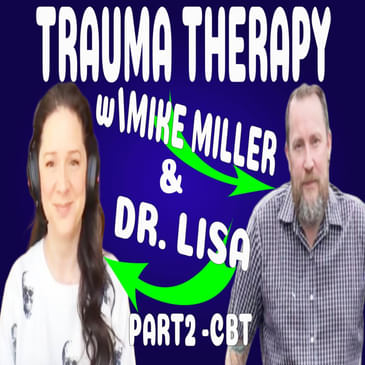



Mike Miller, Head Clinician and Cofounder of Yatra Trauma Center in Thailand, is back for the second episode in our series on Trauma Therapy. This week, we discuss Cognitive Behavioral Therapy, what is, and the way it is meshed in with the other modalities offered at this one of a kind facility.
Mike reference's a video on the CBT process, here it is
Ours sponsors, that make spreading the message possible
Yatra Trauma Therapy Center - Together We Can Recovery Society
Chuck LaFLange (00:02.176)
Hello everybody, watchers, listeners, supporters of all kinds. Welcome to another episode of The Weekend Ramble on the Ashes to Awesome Podcast. I'm your host Chuck LaFlange, With me in virtual studio is Lisa out of Calgary, Alberta. How you doing today, Lisa?
Lisa (00:14.813)
cold. I'm cold. It's like minus 40 something here has been all week. I at times think I might be on the moon. But I'm here. Staying warm.
Chuck LaFLange (00:17.908)
Hahaha!
Chuck LaFLange (00:31.148)
Good stuff good stuff. Of course, we don't have that temperature here in Krabi Do we to my other guests a Mike Miller from the Autotreatment Center? How you doing today Mike?
mike miller (00:41.494)
good. My toes are a bit cold. The aircon's still going, you know, it's one in the morning, 30 degrees. No, I'm good.
Chuck LaFLange (00:44.4)
Just just blasting hey yeah.
Chuck LaFLange (00:49.524)
Yeah. Glad to hear it. Yes, come and visit. Well, I'll tell you what. I'll tell you what, Mike. Her daughter is taking to calling me Uncle Chris, so they're going to come for a visit. They have to now. Right. They have to. Yes. So, yeah. Yeah. I would certainly love to have them out here. That's for sure. So. Hey, listen, last week we
Lisa (00:52.761)
I hate you guys!
mike miller (00:54.79)
Common visits. You're welcome. You're invited cordially.
Lisa (00:58.643)
Thank you.
Lisa (01:08.525)
Yeah, yeah. Right?
mike miller (01:09.346)
Found by blood.
mike miller (01:18.07)
Oh yeah, and I'm not joking.
Chuck LaFLange (01:19.756)
Okay, yeah, yeah. Come visit, oh, of course not, of course not. Yeah, right? I'd love to have the whole family out here. They'd be kind of, I would say second family, but I'll say extended family to me, the entire Dr. Lisa family has, so yeah, right. So last week, we're here to do, to move into another part of our series. I don't even wanna call it a three-part series, I just wanna call it a series, because who knows where this goes from here.
Lisa (01:23.045)
Thank you. I appreciate that.
mike miller (01:23.214)
Come visit.
Lisa (01:34.362)
Mm-hmm.
Yep, yep, that's right.
Chuck LaFLange (01:50.948)
Last week, you know, we had a great conversation about internal family system therapy. With the benefit of hindsight, Mike, is there anything that you missed out saying or that you would have said or, you know, if you think back? I never even, we never talked about this pre-recording and it never even occurred to me until just now to ask you that question. So I've kind of put you on the spot a bit there. But, you know.
mike miller (02:17.143)
You're exposing me for the person who doesn't listen to podcasts that they've just been on. But I didn't have that like post-recording remorse that I have had in the past. I didn't leave feeling like, oh, I've really left something out or I'm, you know, so I guess I would be more up to, I'd be interested to know like comments from anyone, like what they thought about it, because for me, I kind of do what I do. I just ramble.
Chuck LaFLange (02:24.124)
Most people don't, it's crazy.
Yeah.
mike miller (02:45.422)
That's why I'm on the weekend ramble.
Chuck LaFLange (02:45.792)
Fair enough, eh? Fair enough, fair enough. Well, and to be fair, you were answering questions for most of that from, of course, Dr. Lisa and somewhat from myself. Lisa, did you have anything that maybe you would have asked about internal family systems therapy, given some time now to think about it? Of course, your week hasn't really been conducive to a lot of thought about a podcast last week. I understand you've been really busy, but you know. Yeah.
Lisa (03:14.873)
Yeah, no, I don't think so. I mean, it's interesting though already this week, like I've been incorporating, I have not read the book yet. So I'm going to read the book, but just in, you know, we had talked last week about certain patients that I felt like this might be really helpful for particularly, you know, people who have sort of a more borderline personality construct or
people who develop alternate identities as a means of kind of coping with trauma and stress. And I have a few of those patients right now in the day hospital program that I work at. And this week I was actually incorporating in that language. I wouldn't say I was doing that modality of therapy per se. I'm not trained in it. I don't claim to know it, but I can see a lot of value in using that language. I think it's less pathologizing and I think it's validating.
So was using that this week, which.
Chuck LaFLange (04:07.868)
Okay, so to interrupt you, it just occurs to me, every week we have more and more people, that the platform is growing and accelerated at a great rate right now. Maybe we should, let's just give a little bit of background about who both of you are before we get into the rest of it, not making assumptions about what people have listened to, right? So Dr. Lacey, you are my regular weekend co-host for the Weekend Ramble. Let's start with you, and then we'll kind of get a little bit about who Mike is.
Lisa (04:35.577)
Yeah, so I am an adult psychiatrist. So I work at a major hospital in Calgary and I...
Chuck LaFLange (04:42.164)
Does that mean you're an adult or that you work with adults?
Lisa (04:47.525)
I'm an adult some of the time, some of the time I'm not. Yeah, so I work with, that's right, part of me is an adult, part of me is still a child. I love that. But yeah, so I work with adult patients. I work on an adult inpatient psychiatry unit for patients who are admitted for psychiatric reasons. I work in the emergency department.
Chuck LaFLange (04:47.732)
grown. Touche, touche.
mike miller (04:51.969)
Part of you is.
Lisa (05:16.273)
doing psychiatric assessments in the eMERGE. And I also work in a four week intensive therapy day hospital program. So this is a program where patients do not stay in the hospital, they sleep at home, but they come in Monday to Friday from nine in the morning till about three in the afternoon. And it's a, we do multiple modalities of therapy.
There's group work, there's individual work. They have an assigned case manager therapist. They also see me as their psychiatrist every week. And I'm also a loved one of somebody who lives with addiction. So I have a brother who's four years younger than me who struggled with addiction for 25 years or something. And so, yeah, I'm also a family member.
So I kind of have an interest in addiction from two angles. And I'll just add that I've done a fair bit of addictions work. So I've spent time at addiction residential treatment programs in the US, in South Africa. And I've been fairly heavily involved to fluctuating degrees with the Canadian Society of Addiction Medicine. Yeah.
Chuck LaFLange (06:09.884)
Okay.
Chuck LaFLange (06:40.864)
So definitely a packed up resume there and more than qualified to be on the show with us. Mike, tell us a bit about you.
Lisa (06:41.713)
That's me.
mike miller (06:51.914)
the co-host, but it kind of sounds like I got roped into like longer extended series of podcasts. No, yeah. Yeah. So, well, I'm personally in recovery and I currently am, I've co-founded and
Lisa (06:58.215)
Hahaha!
Chuck LaFLange (06:58.92)
Well, who knows, right? Let's see what happens with this, man. You know, right? Yeah, yeah.
mike miller (07:17.61)
I'm the clinical director of a trauma treatment center here in Thailand. After working in addictions in residential inpatient, outpatient, medical monitoring, like a bunch of different sort of aspects of substance use disorder treatment. And what I...
Once I started getting trained more in the trauma end of things and still working in the addiction treatment, what became apparent to me was that I think all of the clients that I had the underlying traumas that were like fueling the substance use or the behavioral what people would call process addiction. So whether that's sex, gambling, food, you know, whatever it might be. And so...
I decided what I wanted to do was address the underlying stuff rather than the behaviors. Like, I don't need to tell someone to stop using drugs. And it's funny when we tell someone to stop using drugs, guess what? They aren't necessarily as well as they want to be at that point because there's other stuff that needs to get done, right? The drug isn't necessarily the problem. It's their solution to the problem, which is how they're feeling and what they want to get away from. So we want to address that stuff. So
Yeah, I've been clean for over 20 years and worked in the field for 20 years. And yeah, that's basically me.
Chuck LaFLange (08:45.096)
Okay, yeah. Sounds about the man I know. And I've come to call friend now, of course, after months of some episodes, and of course, to stay at the Autra Treatment Centre. I mean, that's why I'm in Thailand at all, and most people that have been following me in the platform know that, but again, new listeners, so peek behind the curtain, came to Thailand to attend the residential treatment program for trauma at the Autra Centre. Left there.
a month and two days ago, I guess now, to start my new life in Krabi. And what an amazing experience it was. I mean, we'll see if we can get through the first 10 minutes of an episode without crying like we did last week when we started this kind of mini series. And I do, I have to say right off the bat, the experience was absolutely transformative and amazing and I'm forever grateful for it. So I thought it was important that, and maybe we got Mike on here to.
Lisa (09:29.073)
Thanks for watching!
Chuck LaFLange (09:42.568)
talk about some of the things that I tend to bastardize when I as a lay person try to talk about with them with people and last week we went into some great depth about internal family systems therapy the IFS if you go back and check out that episode I think you if you want to become a little more trauma-informed than you are it's a great place to start and of course today I think we're gonna talk about cognitive behavior therapy or CBT if that sounds good to you right
mike miller (10:12.554)
Yeah, I would just like to do a qualifier like what we did last week just because people haven't heard everything because it might seem strange that you came as a client to our trauma center and here I am on your podcast and you're calling me a friend is that we had a relationship through the podcast before you actually came to the center. So it wasn't like we met. Oh, you're a podcaster. Great. Let's get on there.
Chuck LaFLange (10:13.349)
Um, yep.
Chuck LaFLange (10:30.369)
Ah, yep.
Chuck LaFLange (10:37.203)
Yes.
mike miller (10:41.57)
blow up my treatment center for my benefit. You know, like I just want to qualify like there was a preexisting relationship that, you know, could blur the lines a bit, but we've been pretty good about maintaining boundaries around that stuff. But it's just to kind of name that.
Chuck LaFLange (10:42.072)
No, no, not at all. Yeah.
Chuck LaFLange (10:52.948)
And it's funny, I don't know Mike, if you read my post on Facebook that accompanied the testimonial that you posted of mine. Did you read my thing there? And very clear to say, those boundaries about making sure that promotion was not a part of the deal were put upon me by yourself, and boundaries put upon yourself by yourself as well, to make sure that didn't happen. And I think, you're right, it is important to qualify that.
mike miller (11:06.669)
I did.
Chuck LaFLange (11:21.808)
and you did a really good job of doing that, right? I was no different than any other client while I was there. There was never any expectation of anything. This was, you know, just, it really was an experience to better myself, and you know, that's exactly what it was, so, yeah.
Um, CBT. Uh, okay. Yeah, yes, yeah, fair enough, right? Fair enough. Um, cognitive behavior therapy was, um, I'll kind of speak to my experience before I got there with it anyway, which was virtually none. I think, and I've said this before, I'll say it again, I think because of the name, people think that they know what it is.
mike miller (11:41.866)
Yeah, it's important, I think, and which is why it's important to also name it.
Chuck LaFLange (12:07.464)
Right? And I, because it sounds like a simple name, you know? And that was the case for me anyway. And I thought I really understood, you know, I'm reasonably intelligent guy, I'm like, oh, cognitive behavior therapy, okay. I'm just teaching you to modify your behaviors. Not really, kind of, right? There's so much more that goes into that. And maybe Lisa, to get you involved here, if you wanna talk about CBT as you know it, and if you don't just kind of wanna define what CBT is.
and then we'll get into Mike if that works, right? Yeah.
Lisa (12:39.458)
Mm-hmm.
Mm hmm. Yeah, I mean, kind of in keeping with what you just said is that, I mean, you know, to sort of define it, it's, it's very simple and yet not, right. And so cognitive behavioral therapy, I would say that the underlying goal of it is to draw connections between the way we think and the way we feel and how it affects the way we behave. Which sounds
simple and also sounds so broad that it can also, I think, sound overwhelming. And I think, you know, some of the keys of it are that people often, well, when they are oversimplifying it, what I notice is that people are often unaware cognitively about their thoughts, which sounds kind of impossible. But, you know, we touched on this last week, but
I'll have patients in sessions who will say things. And I'm like, hit the brakes, rewind, what did you say? And that sounds sort of silly, but people have automatic thoughts that are a function of just long-term patterns of thinking. And all of us, me included, are often not aware of those until we have somebody external to us help us identify those.
And those automatic thoughts have a lot of impact on, because what I'll say to a patient is for everything you say to me, there's a hundred thoughts in your head, you're not saying it out loud to anybody. So if we can start to help people recognize those thoughts, then the hope is that they start to catch the thought, check the thought and change the thought.
Lisa (14:35.757)
And one of the tools, you know, we'll get into it, but there's things like thought records and, you know, patients will often say to me, oh, well, that's simple, or I do that in my head. And it's like, no, like when you're particularly early in CBT, get the pen and paper, do the work, and I'll wait for Mike and we can get more into what a thought record is.
But another skill that I really love in the CBT that I use a lot and was taught to me by a preceptor during my residency program is something called IQ EQ. I don't even know if that's a term or if that was just the term he created, but it's talking about IQ being the thought and EQ being how it feels physically, emotionally. And then we'll do reframing of the thought, which is the IQ, and then we'll read.
will reassess the feeling that comes with it. So it's drawing those parallels. And we do, like I do a lot of work where I will demonstrate that. So I'll take something they've said, like one of those thoughts that I hit the pause button on, and then we'll talk about how that feels. And then I will demonstrate reframing that thought in a way that's often more compassionate and more kind. And it's not about...
blowing smoke, it's not about pretending life is rainbows and butterflies, but you can reframe a thought in an honest way that still captures the struggle or the challenge. And it can generate a very different physical and emotional reaction in a person. So that would that's sort of a overview that I would offer.
Chuck LaFLange (16:09.021)
Okay.
Chuck LaFLange (16:14.092)
All right. All right. Okay. So Mike, unless you have something that you would want to add, change or remove in that in that definition. And if you do, please do. Because because we are talking about
mike miller (16:28.214)
No, I just found myself nodding along quite a lot.
Chuck LaFLange (16:30.78)
Okay, okay, great. So let's talk about how that process, the ABC process or whatever. You know what, you know how to talk about CBT, it's what you do. I'm not gonna try and lead you into that, right? Go ahead.
mike miller (16:44.598)
Well, I mean, so it's not what I do. It's a portion of what we do. And actually, as Lisa was just sort of saying, CBT has like a wide range of tools. We utilize one specific tool. We don't actually do CBT therapy with you on an ongoing basis.
we teach you a tool so that you can utilize it in your life and walk away with it much like a lot of the practices that we have that aren't psychotherapies, right? So like, you know, you come in and you're in our center, you're gonna learn mindfulness. You're going to learn.
yoga, you're going to learn possibly TRE, things like that. And these become practices that you can take and into your life and practice on an ongoing basis. Because, you know, it's not surgery. We're not wheeling you in doing stuff to you, wheeling you out, you're done and you're cured. Like this is, you've got to do the work with us and then on an ongoing basis. So the one tool that we do is called the ABC tool. And actually,
it's a bit of a misnomer because it's actually A, B, C, D, E, and F, right? But it's just, historically it's called the ABC. When I got introduced to it, I saw it as an ABC when a organization I used to work for had ABCDE, and I've added the F onto it because it's...
makes the process make sense to me. And now right now, none of these letters mean anything to anyone who's watching or listening. So I'll kind of go through like some of the core sort of like tenets of CVT a bit, and then all the different sort of components that we need to utilize this tool. So CVT makes some assumptions and I'm gonna, you know, Albert Ellis didn't say it this way, but you know, who's?
mike miller (18:48.806)
CBT founder guy. This is my take on it. So you know, for all the qualified CBT therapists out there, this is just my sort of hit on this stuff. CBT assumes a few things and one of them is that in this podcast right now there are four conversations happening. So there's the one that we're having together, right?
Chuck LaFLange (19:10.79)
Okay.
mike miller (19:16.434)
And there's the one that I'm having in my head at the same time, like, make sure you make this make sense. Uh, you know, you better don't forget this. Don't forget that. Do all that. And then there's the one that Chris is having in his head and he's going like, what is this guy talking about? And then there's the one that Lisa is having. She's going like, oh, I know way more tools of APE. No, just kidding. Um, but you know, like we, we were constantly like, we have this internal sort of dialogue that's going on all the time. We can't stop it. If we could, we wouldn't need.
Lisa (19:35.666)
No.
mike miller (19:44.65)
meditation, we would all be like enlightened Buddhas or whatever. Like it just constantly happens. And what that that's doing is it's interpreting what's going on around us. All the time. That's what it does. Now, sometimes and it's automatic and it's not like I'm not intending. It's not an intentional thing. It's just happening. And a lot of times it's like quite innocuous, right? I like look out and I go, oh, it's sunny. I will wear shorts today.
absolutely inconsequential, just pretty normal, all that. But sometimes it's automatic and it's negative, right? And that interpretation can affect a lot of things. And so the one assumption is that we have this dialogue that's going on all the time. Another assumption is that what is happening
isn't the thing that made me feel a certain way. It's my interpretation of that thing. So the example I always use with the clients is, we're sitting in a room together. I'll use Chris as the example. Chris and I are sitting in a room together. Chris gets up to leave the room. He steps on my foot and walks out. And because I have this dialogue that's happening all the time, I make a meaning of what just happened. And I go, oh, he did that on purpose. He wanted to hurt me. He doesn't like me. I'm always in the way. I'm constantly getting underfoot. I'm such a loser, et cetera, et cetera.
This might be what someone could do who is sitting in my office, who might have aspects of anxiety and depression and all that kind of stuff. This might be a familiar dialogue to those people. And then I feel, right, maybe hurt, maybe angry, maybe embarrassed, maybe shameful. And then because I feel that stuff, I act in a certain way. So if I was feeling angry and stuff, I might get up and bop Chris in the nose or
You know, I might go and recruit Lisa and be like, Lisa, did you know Chris, he's a real jerk who steps on people's feet. Or I might go into my room and I might like ruminate on stuff or I might go and grab a bottle or a bag or whatever. You know, like there's gonna be behaviors based on the fact that I'm feeling the shame and anger, all that stuff. Now let's suppose that Chris steps on my feet and.
mike miller (21:59.67)
what I say to myself in my head, my meaning that I make of it is, oh, Chris and I have a really good relationship. We seem to be mutually respectful, get along really well, it's a great connection. He clearly accidentally stepped on my foot. Now, I don't feel anger, shame, guilt, any of that stuff, embarrassment that I had said. So it can't be Chris stepping on my foot that made me feel that way.
It's the meaning that I made of it, my interpretation of it, that made me feel that stuff, and then act in a way. So what we want to ask with CBT is, is the meaning that you make of it true? Right? Is your mind lying to you about stuff, making you feel certain things, and you act based on those lies, as opposed to an objective truth? Right?
Lisa (22:30.17)
Mm-hmm.
Lisa (22:46.725)
Mm-hmm.
Lisa (22:53.65)
Mm-hmm.
mike miller (22:55.762)
And so then one more component we want to talk about, and then I'll tie them all together, is core beliefs. So the thought is that we have core beliefs, so they're kind of constantly there. They've been there for a long time. They've been installed usually at a pretty young age. I kind of look at them almost like the operating system of a computer. When I'm dealing with a computer, I'm dealing with programs and I'm dealing with applications. I'm not necessarily...
interacting that much unless I'm a coder with the actual operating system. But the operating system is informing that computer of how to interact with me. And I kind of look at core beliefs like that. They're informing how I interact with the world, even though people aren't interacting with my core beliefs in a knowing way. So let's say I'm six years old, my parents split up and my dad moves away, and I form a belief about myself, which is I'm not lovable.
Lisa (23:34.853)
Mm-hmm.
mike miller (23:54.918)
Right? I might form a belief about other people, which is I can't rely on other people. I can't trust other people, maybe. And I might form a belief about the world, which is the world is unfair or the world is unsafe. So these would be like beliefs that are installed. And I don't necessarily even know I have them, but they inform the meaning that I make of the things that happen around me. They become the filter.
Lisa (24:10.414)
Thank you.
Lisa (24:16.164)
Mm-hmm.
mike miller (24:23.266)
that I see the world through, even though I don't even necessarily know that they're there, like the operating system operating in the background. So let's say I have that experience. My father leaves, I form a belief, I'm not lovable, can't rely on it, I can't trust other people, and the world is unsafe and unfair. Chris is in my office, he steps on my foot. Through that lens of those beliefs, I see that happening of him stepping on my foot.
And as it goes through, I'm not good enough or I'm sorry, I'm not lovable. I'm like, he doesn't like me. He did it on purpose. He was trying to hurt me. I can't trust other people. He's trying to hurt me. The world is unsafe. Uh, you know, like it's informing how I am interpreting the events that are happening around me, if that makes sense. So this is kind of like my view of like sort of how CBT operates and then
Lisa (25:02.213)
Mm-hmm.
Lisa (25:11.901)
Mm-hmm. Yep.
mike miller (25:20.214)
We take all of those components and we put them into this ABCDEF tool. And it would be great if I had a whiteboard behind me, but I don't. So I'm just going to say them all and hopefully it'll make sense to people. A stands for activating event. The trigger. Chris stepping on my foot. Objectively, that's what happened. Chris stepped on my foot. No meaning to it. It's not Chris stepped on my foot on purpose because that's the making the meaning of it. It's just objectively Chris stepped on my foot.
That's A, the activating event. B stands for beliefs about the activating event. So that's where I make a list of all of the meaning that I make. And under my B column, I would write, he did it on purpose, he tried to hurt me, he doesn't like me, I'm always underfoot, it's my fault, I always get in the way, like all those negative sort of things. And I probably would rattle off 100 of those, because those thoughts can come pretty quick.
They might be repetitive, they might be the same sort of a different flavor of the same stuff, but generally speaking, we get a lot of these thoughts in our head going on. So that's the B column, beliefs. C is the consequences of believing those beliefs. So the consequences come into forms, the feelings and behaviors. So the activity, Chris stepped on my foot, my beliefs are, he did it on purpose, he doesn't like me.
Lisa (26:24.69)
Mm-hmm.
mike miller (26:49.926)
I'm always in the way, he tried to hurt me, et cetera. The feelings are gonna be, like I said, I might get angry, I might get hurt, I might feel ashamed, I might feel embarrassed. And then the behaviors are, like I said, depending on what of that is sort of the strongest, either go and bop Chris in the nose and then get my ass kicked or whatever, or I wonder what the meaning is he's making of that right now.
Chuck LaFLange (27:09.469)
Please don't do that.
Lisa (27:17.346)
Hmm. Yeah.
mike miller (27:19.73)
Or I go and I recruit Lisa, or I go and I ruminate in my room, or I go and I chain smoke cigarettes, or grab a bottle, or whatever the behavior is that I might do. That's the activating event, the beliefs, and the consequences, right? Does that make sense so far? That's kind of, for lack of a better term, for lack of a better sort of way to characterize it.
Chuck LaFLange (27:38.276)
to me, of course it's pretty fresh in my memory.
mike miller (27:47.134)
the way I look at it, that's the problem side of the equation. And now we're going to get into the solution side. So D stands for dispute, or sometimes I would say disprove. So I have these beliefs in B. And I single them out one by one. He stepped on my foot on purpose. That's a belief that I have about the activating event. How do I dispute that? Well, I can do the Socratic questioning. It's like, is that even true?
Did he really step on your foot? Or did he do it on purpose? How do you know he did it on purpose? Like, what's the evidence of that? What's your relationship like with him? And I could look at it and I can go, well, actually, objectively true. I don't know that he did it on purpose, unless he like said, I'm gonna step on your foot on purpose and stomped on me. I would, there's no way I can know what his motivation is. So I would write that down. I actually don't know.
Chuck LaFLange (28:34.886)
Absolutely. Right.
mike miller (28:39.798)
that he did this on purpose. I wouldn't say he didn't do it on purpose because like Lisa said, it's not all about like rainbows and lollipops. That's a distorted thought just as well is to say he didn't do it on purpose because I also don't know that. So I would just put the objective truth. I don't know if he did on purpose or not. Then I would look at what's the cognitive distortion. Now myself talks big. I forgot to talk about what cognitive distortions are.
Chuck LaFLange (28:51.06)
Yeah. Yes. Right. Yeah.
mike miller (29:06.926)
They're basically just patterns of impaired thinking, and people will be familiar with all kinds of catastrophizing, mind reading. So catastrophizing is like mountains out of mole hills. It's the worst case. I'm going to be late for dinner, and I go, oh, my wife's going to kill me. Clearly, she's not going to kill me. That's catastrophizing. Labeling is when I call, oh, you're a jerk, or whatever. Black and white thinking is a cognitive distortion.
You know, so that all or nothing sort of stuff. So there's a list of cognitive distortions readily available. You could just Google CVT cognitive distortions, but it's one of the ways that I dispute the belief that I have. So he stepped on my foot on purpose is the belief. Socratic questioning is, well, did he? And I go, well, actually I don't know that he did. That's one way to dispute it. And then I look at, well, what's the cognitive distortion in that statement of he did on purpose? And it's mind reading.
I'm acting like I can read Chris's mind and Noah's motivation when I can't. And it's just a pattern of impaired thinking that I fall into. And I walk around the world thinking that I know what people are thinking, feeling a certain way because of it and acting a certain way because of that. And it's all based on something that's distorted. I don't even know that it's true. So I always do the Socratic questioning, like, is that a true statement? And then I do the like, what pattern of impaired thinking is in that statement? So I dispute it two ways on each thing. And I know that that's getting kind of
complicated. Luckily, I have a YouTube video that Chris could link maybe to this where I explain all of this except I don't do the F, I do the ABCDE. Just to make, because I know it'll be hard for people to follow without a whiteboard behind me. So then we go through each one of the state, oh yeah, beautiful. So I go through each one of the beliefs, the statements that I've done, the self-talk.
Chuck LaFLange (30:40.6)
Yes, certainly.
Chuck LaFLange (30:49.384)
Well, I could also put a visual in as well. Most certainly I can. Yeah, yeah, yeah.
mike miller (31:01.378)
the interpretations of the activating event. And I do the same process. I do the Socratic questioning, you know, he tried to hurt me. It's like, well, did he? Do I know that? And it's also mind reading. It's also probably catastrophizing because what would be the worst thing is this person is trying to hurt me, right? So, oh, that one's got two cognitive distortions in that. So I would do that for each one of these beliefs. Is it true and what's the cognitive distortion? Eventually I get,
dispute enough of these and it can be really hard, right? Some of the things seem like true statements and they're difficult to dispute. So like, you know, this is kind of a different example, but if Chris punched me in the nose and my thought was, hey, you shouldn't do that, like it's actually kind of true. Like that you shouldn't do that, right? But.
Lisa (31:35.293)
Thanks for watching.
Lisa (31:52.43)
Mm-hmm.
mike miller (31:55.334)
should or must is also a cognitive distortion that's about not being able to accept the reality of the situation. It's like, yeah, but he did. So like, you know, sitting there and saying you shouldn't just makes me feel a certain way. And I just wanted the reason that I write down what all the cognitive distortions are, even if it's a fairly true statement, is because it's just after a while of this is the thing that Lisa said, get the pen and paper out, I start to see the patterns, the go to patterns of cognitive distortions that my mind uses. And I'll tell you right now, I know
Lisa (32:18.877)
Mm-hmm.
mike miller (32:25.058)
that my mind goes to labelling more than any other cognitive distortion. So you're a jerk, you're an a-hole, you're an eff in this, you're that, this is stupid, that's a waste of time. And it's like I have these sticky notes that I just go put on everything that's kind of, and what happens when I do that? Oh, I end up frustrated and angry and stuff all the time when I'm labelling. So now through realising that pattern that labelling always leaves me frustrated and
Chuck LaFLange (32:32.172)
when you're driving. Right?
mike miller (32:54.966)
When I start labeling things, I can catch it. This is where if you've done enough practice at writing it down, you can start doing it in your head where I go, oh, I'm doing that labeling thing that always leaves me angry. And what that does is it stops that chain of the negative beliefs from going. Because after the first belief where I go, Chris is a jerk, I go up. I'm doing that labeling thing. And guess what doesn't happen? And he's this and this and this and this. Now I've diverted my thinking. And that's a bit further down the road, right?
Lisa (33:07.077)
Mm-hmm.
Lisa (33:22.405)
Mm-hmm.
mike miller (33:24.246)
But getting back to the whole A, B, C, D, E, H. So the disputes, we do the cognitive, or sorry, the Socratic questioning and the cognitive distortions for each belief that we can list. Now E stands for effective beliefs or behaviors, and I like to go with effective behaviors. So if what I did was I bopped Chris in the nose, and then I went and I recruited Lisa and campaigned against Chris, and then I...
ruminated in my room and then I chain smoked and grabbed a bottle of whiskey. Like these are not effective behaviors, right? So what would I do that would be more effective? And that's where I get different sort of parts that where we always bring into play the things that we do in our treatment center. So first off, what would be more effective than doing that stuff? Well, go write an ABC on it. That's the first thing. That's always a good thing to do. What's the second thing?
Lisa (34:19.517)
Mm-hmm.
mike miller (34:21.954)
go do some breathing exercises, do some physical exercise. Like, you know, there's a lot of different, you could journal about it, you could do mindfulness, you could do some art, you could, whatever it might be that you would find would sort of help you regulate. And then possibly have a conversation with Chris and say, hey, did you know that you stepped on my foot? At which point Chris probably goes, oh, actually, I didn't really know, I was in a hurry. Sorry about that. So I...
If I could get into that effective behavior at the beginning, all of this stuff becomes moot, but I don't. So, you know, I have to remind myself of that to train myself so that the next time that someone steps on my foot, I can be like, hold on, wait, um, I don't know that they did on purpose. I don't know that they hurt me. What the effective thing to do would be like to just clear that up with them right now. And then I avoid the whole bopping them in the nose, getting my ass kicked, smoking, drinking, like all that shit. Pardon my language. Right. Um, so.
Lisa (34:54.173)
Mm-hmm.
Lisa (35:20.2)
Mm-hmm.
mike miller (35:20.534)
We always list out what the more effective behaviors could be with an assumption that if I'm behaving based on distorted beliefs that are creating exacerbated, heightened feelings, those behaviors are going to be ineffective. Now they're effective in trying to soothe myself, but they're not effective long term, right? They're like a bandaid as opposed to like healing. So F stands for find that core belief.
Lisa (35:43.821)
Mm-hmm.
mike miller (35:49.922)
that's driving all that negative talk. And so what we do is we take one of those beliefs from the B column, Chris stepped on my foot on purpose, and then I just, we do what we call drilling down. So we just ask, if that's true, what does that mean? So if Chris stepped on my foot on purpose, what does that mean about me? Well, I guess it means I'm not important.
Lisa (36:06.429)
Hehehe.
mike miller (36:16.066)
Like that could be something it could mean. People will come up with their own sort of interpretation of that, but that could be an answer. I'm not important. Okay, if that's true that you're not important, what does that mean about you? It might mean people won't like me. People won't take care of me. I can't, you know, I'm not safe. Like, you know, we just keep doing the thing. If that's true, what does it mean? It might be like, if that's true,
Lisa (36:40.167)
Mm-hmm.
mike miller (36:46.166)
that Chris stepped on your foot on purpose, what does that mean about him? Because remember, core beliefs can be about others and stuff. I can't trust him. Now we're already into the language of core beliefs, right? So what we do is we just keep drilling it down until we get something that sounds like a core belief. And so, you know, if I get to the, if I do, he stepped on my foot on purpose, I'm not important, what does that mean? He doesn't like me. If that's true, what does that mean about you? I guess it means I'm not good enough, boom.
Core belief, I'm not good enough. Would it make sense if I had a core belief of I'm not good enough that when he steps on my foot, I'm gonna think he did it on purpose, he tried to hurt me, he doesn't like me at all? Yeah, that's for sure, that's gonna support that sort of a belief system if I'm seeing it through the lens of I'm not important. So how do we tie that into the whole program is we take that core belief and we put it on a list of beliefs that we have to target with EMDR.
Chuck LaFLange (37:27.924)
Yeah.
mike miller (37:44.926)
eye movement desensitization and reprocessing. And we say, if I have a core belief of I'm not good enough, what memories do you have that support you having that belief? Well, guess what? My dad left when I was six, that supports that belief of I'm not good enough. I didn't get picked for the team. I got bullied at this point. And now I have all these memories that I can target for desensitization using EMDR so that I don't carry these
core beliefs and have this distorted perception of the world on an ongoing basis and it can lessen the triggers and that's kind of how we tile it in. I know I've been rambling a lot. I hope that makes sense.
Chuck LaFLange (38:23.96)
No, it does make sense and it might be hard for someone to follow along, but hey, go ahead and keep listening. Lisa, you've got something off of there? There is something that I want to touch on that you kind of wanted to, Mike, but Lisa?
Lisa (38:35.613)
Do you want to go first? Because you got something ready. I have a bunch of thoughts, but why don't you if it.
Chuck LaFLange (38:38.32)
No, I've got something that's more, okay, maybe I will just quickly as kind of an interjection into kind of the CBT thing. Well, you just said, Mike, at the end, the things that support our core beliefs. Dad left, I didn't get picked for the team. Kind of the small T trauma stuff, right? And something that I've, when I,
As I become more trauma-informed, and I've got a long way to go before I could ever take that title, I think, but something that I try to articulate to people, and maybe I don't do a great job of it, maybe sometimes I do a better job of it, is that these things happen to us when we are young, and they're seemingly insignificant, but this is the thing with trauma, is it's not. And the way I've kind of simplified that
mike miller (39:30.69)
Yeah.
Chuck LaFLange (39:33.9)
I don't want to call it an argument, but to simplify that statement or that ideal to somebody is to say that, yeah, it was 30 years ago, or has it been snowballing and turning into something in your brain for 30 years? Right? This is a very different perspective on that and potentially why. But go ahead. I just wanted to touch base on how important those small t-, I hate that term, traumas are. Right?
mike miller (39:50.849)
And
mike miller (40:00.37)
Yeah, well, I think it doesn't matter where the like, if I was sexually abused as a child, I would still come up with that core belief of I'm not important.
it doesn't really matter where it came up. Like trauma isn't what happened, it's what you're left with from it. And core beliefs are one of the things that you're left with. There might be physiological stuff, right? There might be like, you know, really strong startle responses. There might be anxiety that like, there can be all kinds of stuff. Core beliefs is one of the things that you're left with. It doesn't matter what it was that created it. And one of the myths about trauma is like, you have to be sexually abused in a war zone, in a plane crash. Like that's the stuff that creates trauma.
not true. Those things obviously could be traumatic, but trauma is like what you're left with. And so when we apply, so CBT wasn't designed for trauma, it wasn't designed for addiction. You know, it came up to help with anxiety and then depression. And well, if you look at anxiety, like what does traumatic stress look like a lot of the time? It looks like, you know, a hyper aroused nervous system, which looks like anxiety, right? And we're getting triggered and
Lisa (41:05.725)
Mm-hmm. Yep.
mike miller (41:10.494)
apply that CBT to clean up and address some of the thinking that comes arises from those traumatic events that create the core beliefs. And then we use the EMDR to desensitize the triggering of those events so that I don't have to live in that thinking so much. That's how we tie it into the trauma stuff. So I think it's a good point. The other thing is if I had that a long time ago and formed that belief, like
that belief just gets reinforced. So say my dad left and I formed this belief I'm not important. If that never happened and I didn't get picked for the team, that might not seem as significant.
But because of the thing with my dad preceding that, now I don't get picked and I'm like, oh, there you go. See, I'm not important and it just reinforces it over, I don't get the right office at the, or the right desk at the office, or I don't get this, or I don't get that, or the girl likes my friend instead of me, or like whatever it is, it's like just keeps reinforcing it. So what we wanna do is we're gonna go back to what we call the touchstone memory wherever possible. Where does this come from at first? And we try to clean that stuff up. But.
CBT in and of itself isn't always applied to trauma because you have to have access back to your prefrontal cortex where you can actually like use cognitive abilities. And if you're in a survival mode, you can't because like I need to survive this moment. I'm not sitting here going like let me examine my thinking. So what I need to do is be relaxed in my body before I can get to that. So it's not always used in trauma. But when you come into our center day one.
Chuck LaFLange (42:28.881)
Okay, yeah.
Lisa (42:41.383)
Mm-hmm.
mike miller (42:46.334)
yoga, mindfulness, breath work, ice baths, sound balls, progressive muscle relaxation. Like there's a bunch of stuff that you do to regulate the nervous system, relax the body, give you access to the cortex, then we get you into the CBT, which can then lead into the EMDR. And that's kind of how it like one knocks into the next one and the next one.
Chuck LaFLange (43:07.508)
Fantastic. Lisa, you've got some things.
Lisa (43:12.365)
Yeah, first one is I've never actually heard or seen the practice of using EMDR to desensitize to those situations that led to those destructive core beliefs. Like that's like, that's amazing, right? Because again,
We at the day hospital program I'm at, we do offer some trauma therapy, but it is often centered around the big T. Like I know we've talked about big T, small T, whatever, you know, it's like if there's a rape, if there's a death, if there's, you know, a car accident, it's like that's where we tend to utilize it. But it makes so much sense to me that if you can try to figure out
mike miller (43:45.39)
events.
Lisa (44:01.725)
what were those early childhood events that led to those core beliefs that are destructive to you to desensitize to that? Like that's like I feel like my mind just going, like that's awesome. I know I need to come to Yatra. Can I come? Like I don't, I don't have big T's. I'm not going to claim that I do, you know, but it's like we all have core beliefs like and they're, they're not always helpful.
mike miller (44:17.322)
Welcome to Yatra, Lisa. No, I'm just kidding.
Chuck LaFLange (44:21.792)
hahahaha
mike miller (44:25.731)
I will put.
mike miller (44:30.722)
No, they're debilitated.
Lisa (44:30.993)
But I was just, yeah, right? But just kind of as you were talking, and I didn't wanna keep like interrupting and interjecting, but just, I was jotting down thoughts. Like one of them being that everything we experience creates a lens in front of our face, right? Through which we see the world. And it's not all bad. Like we also have, you know, rosy lenses in front of our face too.
But I think sometimes people who haven't done therapy, they don't necessarily get that. And so again, simple concept, but I think there's value in naming it, is to sort of say that everything that happens to you from birth right on through, changes the lens through which you're going to see the world.
mike miller (45:22.958)
Absolutely.
Lisa (45:24.017)
You know, I feel like I see a lot of people minimize childhood things, you know, it's like, Oh, well, like, whatever, like, there's other people who have it worse than me. And it's like, but this is not a competition. It's not to say, Oh, well, that event was, was smaller than, than some other big event that we can all name, it still changes the way that you see the world, right. And another thing I find is that, like, I'll usually, in my first session with a patient in the day hospital program,
mike miller (45:32.578)
Get over it.
mike miller (45:46.655)
Absolutely.
Lisa (45:53.965)
I focus on the kind of like, where are we at today? Right? So like, I start off in that first session screening for, is there major depression? Is there some particular form of anxiety? Like, and then in my second session, I go back to childhood every time. And not to say that there aren't people out there who've had, you know, textbook perfect childhoods and then have like a catastrophic event.
when they're older and that that's where it's at that happens. But I would say by far the majority of things that I see in session one going, okay, like we're dealing with generalized anxiety or we're dealing with depressed mood or whatever it is, almost, I won't say ever, I won't say always, but by far the majority of the time. When I do session two and we talk about your childhood, I wanna know, describe your mom.
describe your dad, describe their relationship, describe, you know, your validation or invalidation in childhood. Describe how you were, you know, disciplined as a child. Describe what happened to you in school. Describe early, major relationships in your life. I can almost every single time formulate, OK, so, so now we have anxiety or we have depression or we have this.
And I can say to them, so what I'm hearing is, and go back to those childhood things, and so often patients are sitting there look like going, oh my God, like have never connected that to this, and suddenly it makes a lot of sense, right? So I think those early childhood things. Another thing as you were talking was I always like to tell patients, your brain does so much without your conscious involvement.
you know, and I think it's validating for patients, you know, I find it works a lot in OCD, because people are like, why is my brain, you know, like OCD, a lot of people will think of like the what they see in movies, chronic hand washing, you know, standing at the lock, check the lock, you know, for two hours or whatever. But a very like what I actually see clinically in OCD is a lot of patients having these really horrific intrusive thoughts about murdering their loved ones or, you know,
mike miller (47:47.915)
Absolutely.
Lisa (48:16.561)
doing terrible things to people they love, and they would never do it, but they have these thoughts and they feel like, well, I must be a bad person because this is what my brain is thinking about. And so I always tell people, the brain is such a weird organ and it does things all by itself. It comes up with thoughts and ideas.
that have, they're not related to who you are, your values or your morals or what you would do or what you wouldn't do. It's like the brain just does shit. And I think that can be really validating for people because sometimes people feel like every thought their brain has equates to who they are as a person.
mike miller (49:03.406)
Well, it's that pathologizes pathologization. Is that the word? But pathologizing people and being like, you know, that locating the problem within them. One of the things I'll talk to you like to dispute that you have their belief is oh, I'm bad because of this the way I would dispute that about controlling your brain is like, so how do you sleep? Like are you telling your heart to beat? Are you telling your lungs to read like your brain is doing that?
Lisa (49:10.128)
Yeah.
mike miller (49:29.31)
You know, this is autonomic stuff that you're not choosing to do. I had a manager who used to call it ants, A N T S, automatic negative thoughts. Right. And he would like draw a little ant on the board and be like, this is an ant, automatic negative thought. You're not choosing it. And actually the dispute part of it is the well thought out, reasoned, intentional thinking that you is more in line with your value system usually, right? It's like, yeah, actually I don't want to kill my family.
And I would never do that. And I'm actually really the evidence that I'm a good person is that I'm really bothered by these thoughts. And so, you know, I would bring that in as a...
Lisa (49:59.607)
Yeah.
Lisa (50:05.789)
Exactly. Totally. Like I'll never forget a little girl that I saw in the emergency department of the Children's Hospital when I was a resident and I was on a child rotation. And she was this like absolutely adorable, sweet, I think she was probably about 10 years old little girl. This was not a kid with conduct disorder. This was not a girl who was going to grow up to have antisocial PD and go around killing people and be in jail. She was a really sweet little girl with OCD and her OCD
presented as intrusive thoughts of killing her mother. So like she couldn't wrap Christmas gifts with her mom because she would, the minute she put scissors in her hand, she would picture herself stabbing and killing her mother with the scissors. And she would throw the scissors across the room and run and hide because she was so terrified that she might hurt her mom because these thoughts would pop into her head. I mean, OCD is like a horrific, horrific illness, but you know,
even at 10 years old, I said to her, like, you know, your brain can come up with thoughts. It's like it just does it all by itself. Like you're not doing that. This is just our brains are weird. And to be able to separate herself from those thoughts and realize the thoughts do not equate to who I am, can be, you know, super powerful. Core beliefs, you know, you talked about that and
I find that so fascinating to watch through the day hospital program is people discovering their core beliefs, you know, because again, people, they're there, we all have them. And people, unless they've done therapy, I would say people don't know what their core beliefs are about themselves. It's, you know, it.
mike miller (51:48.979)
Agreed. Yeah.
Chuck LaFLange (51:49.744)
100%. I can speak to that real briefly, just because of my recent experience. I'm a pretty introspective person, I like to think I spent most of my life, even in my worst, darkest days of active addiction, I'm pretty self-aware. I had no idea until sitting in that office with Mike. I didn't even really know what a core belief was. Again, had you asked me, I would have told you I knew until I knew, right? One of those situations, right? So yeah.
Lisa (51:52.781)
Yeah.
mike miller (52:17.09)
Fake it till you make it.
Chuck LaFLange (52:18.464)
Yeah, right. I would offer that, yeah, that the vast majority of people, unless you've had direct exposure to the idea and definition of a core belief, that you would have no idea what your core beliefs are. Right? Yeah.
Lisa (52:19.957)
Right?
Lisa (52:29.597)
Mm-hmm. And like there's the expression too that you'll often hear in CBT is name it to tame it, right? And again, like our core beliefs drive so much of all the ABCDEF that Mike just went through.
Chuck LaFLange (52:47.22)
Mike, you have a great software to hardware analogy that you use for core beliefs, right? Wanna share that? Software, operating systems.
mike miller (52:57.39)
Didn't I just, did I do that? I just did that.
Chuck LaFLange (52:59.048)
Yeah. Oh, sorry, I missed it. I wasn't making shit. Okay, edit, edit. Okay, okay, fuck. Right, oh. I'm sorry. There's a couple things going on in the background as I tend to do when I'm hosting, so I apologize. Okay, fuck. Edit, edit, edit. Okay, okay, I got that.
mike miller (53:02.89)
Yeah, I was like, oh my you should have heard myself talk right then. Am I going crazy? What is like? No, it's okay
mike miller (53:12.938)
Yeah, no worries. Yeah, but I did that.
Lisa (53:16.164)
Yeah, yeah.
mike miller (53:17.474)
Ha ha.
Lisa (53:19.121)
But yeah, it's just the core beliefs do drive so much of all the other things, right? Like, you know, talking about when someone steps on your foot, everything that happens after they step on the foot is ultimately driven by your core beliefs. And so if you don't know what that is, you can't name it. If you can't name it, you can't tame it. And so I, yeah, I just think the core belief piece of it is so big. And I feel like what I see throughout
mike miller (53:33.518)
Absolutely.
Lisa (53:47.461)
the day hospital program is at some point in that four weeks, the person has this light bulb go off and they're like, I didn't know I believed that. And all of a sudden, everything makes sense, you know, because even subsequent to the discovery, they'll come in and they'll be like, you know, pissed off about something. And even once they know it, and this is why again, it's simple yet not because
They'll come in to see me and they'll be like pissed off about something somebody else said in group or pissed off about something that their caseworker did or said or whatever. And I'll often just go, what was that core belief again? Like, and I often don't need to say anything else. I'll just say, what was that core belief that you discovered? And then it's just like,
you know, it's just going off again. And they'll often once you guide them back to the core belief, once they've discovered it, they're then able to go, okay, now I'm going to recognize all the things that have been going on in my head for the last hour or day or week about this thing that's bugging me. And they can tie it all back together once they figure out what that core belief is. Yeah.
mike miller (55:04.362)
If I can give an example of my experience of that personally, of being aware of being helped to become aware of what a core belief I had. So I did, I do have some abandonment and attachment stuff because of my father. And the core belief that I had that I didn't know that I had was people are disposable. Right?
Interestingly enough, it wasn't I'm disposable, it was people are disposable. That's kind of what I learned from the stuff that had happened. And so I remember being, and Chris has probably heard this story, because I use it as an example quite a bit. But I remember being about 17 years old and working as a prep cook in a restaurant. And my job was to put dates on things and put them in the walk-in cooler and stuff. And
One day, the manager, I was relatively new, I'd been there like a couple of months or something, didn't have a strong work history at the time either, by the way. And the manager came up behind me and said, oh, you've put the wrong date there, that's tomorrow's date or yesterday's date. I was off by one day. In my head, I went, he's gonna fire me. And I went home that day, and I literally never went back to that job.
because I was like, they're gonna fire me anyway, so I will dispose of them before they can dispose of me. I didn't think of it in those terms, but I was like, I just can't go back there, they're gonna fire me. And then I had all these relationships with women where there's a part of me really yearning for this connection, so I would do what I had to do to get into the relationship, whether that was like...
saying the right things or doing the right things or whatever, because I really wanted to connect with women, then I would get, you know, we'd have like an argument or something. I'd be like, well, I guess that's over, you know, and I would like, or they're going to break up with me, so I'd have to break up with them, or they're going to break up with me, so I'd get really clingy. Like my behavior would all be because I thought I'm going to be disposed of, so I would either dispose of them or get disposed of. I had this really long history of like short, intense kind of relationships. When I became aware of that core belief,
mike miller (57:18.714)
I literally have had all long-term relationships from that day. I had like a couple of longer-term relationships when I was younger, but that wasn't the norm. That was like outside of the norm quite a bit. And what I consider long when I'm a teenager isn't necessarily how long now.
Chuck LaFLange (57:34.998)
That would have changed over time as well, right? Yeah, yeah, of course.
Lisa (57:35.173)
and it's interesting.
Cause that's making me like draw connections to between like, and I'll preface this by saying that one of my favorite therapy preceptors throughout residency was a psychiatrist who was very upfront with me. He was my assigned CBT preceptor. And he said to me, I don't do pure CBT. And he's like, I don't do pure anything. Cause he said, there's no patient who shows up.
they just need CBT. He said one day or even within a session they might need support for 10 minutes, then they might need some CBT, then we might need some DBT skills and some mindfulness skills. And so he's like realistically as a therapist you need to know you don't need to know them all, none of us do, but you need to know a handful of modalities and if you're being attentive to your patient you're going to go in and out of various modalities in the span of an hour.
But what you were just talking about was making me even see like how you can draw connections between using CBT and learning your core beliefs about yourself and then tapping into psychodynamic psychotherapy, where one of the things that we'll talk about is that we create the thing we fear, right? So it's like what you're talking about there is that there were these core beliefs that people are disposable or that you're not worthy of somebody staying with you and committing to you and standing beside you.
So then what you start doing throughout your life is you start going, You know what, I'm going to anticipate that you're about to leave me. So I'm going to push you away. And then I'm going to sit there and go, See, that relationship didn't last. And it's like, But you push them away. And, and that's starting to get into psychodynamics, right, where it's like, you push them away, then you validate the belief that, See, this relationship was never going to last. And it's like, But
Lisa (59:34.949)
you just ended the relationship in anticipation of them ending the relationship, and you're the one who ultimately created the very thing you fear, which is that you're sitting here alone again. Right? Yeah.
mike miller (59:47.094)
Yeah, absolutely. Yeah. And I think, you know, it's a very good point is that I remember getting trained in narrative therapy and they're like, narrative therapy is a standalone, like, you don't do an eclectic mix or an eclectic approach when you do narrative, you're a narrative therapist or you're kind of not. But, and I love narrative therapy, but there are elements of CBT and it's like,
What are you doing when you're disputing is you're changing the narrative, right? And you're taking some power back and you're shifting that power imbalance. And all the, you know, it's all sort of, I don't think anyone's necessarily reinventing the wheel. I will say, you know, some of the things that we do like EMDR, not a lot of like stuff stolen from other places too much. It's a bit of a different animal, but now there are other modalities that kind of piggybacked off of EMDR, right? And I guess if you thought about it way back.
Lisa (01:00:30.617)
Yeah.
mike miller (01:00:38.806)
Maybe EMDR piggybacked off of hypnotism because there's eye movements involved. But I think it's good to, I don't get too precious about any therapy. I'm not a gatekeeper. I've been gate kept a lot of times in my life. And I just think like there's a skillset and which skillset is gonna help the person in front of me. Like, it's like what I tell the clients. It's like, you need a toolbox. Like if you have a hammer, everything's a nail, but that isn't gonna help you.
in the long run. So we need different tools to pull out at different times. And if in an IFS standpoint, I have different parts that have different roles, and they come out at different times in different protective ways to help me. I don't want like, you know, I, you know, for me, there's a part of me that like doing drugs to relieve pain. And when it was like, you know, the hammer and everything was a nail, I was doing drugs all day, every day, whether I felt good, bad
mike miller (01:01:38.13)
Um, so I think that, you know, in the world of therapy, quite often in a session, we will go from, uh, EMDR into IFS until like, you know, some talk supportive therapy, add a little CBT in there, you know, back to the EMDR, that kind of stuff. And I think that it's whatever the presenting issue is now what we do is we do have like sort of an order of operations that we try to adhere to, but
I'm not working for an arbitrary order of operations, I'm working for the client. So what does the client need that's sitting in front of me in a client-centered way? That's what it should be. But definitely, I think a varied toolbox is gonna be a lot more useful as a therapist, my opinion.
Chuck LaFLange (01:02:23.985)
I have to say, you know, with my experience at Yatra, I think I was about two and a half, maybe three weeks in, before I even realized that there was kind of this thing by design that you were doing, the formula as I called it. And I think when we were sitting in your office, I said like, there's a formula here or something, or what are you doing? Or I can't remember how that conversation went exactly, but it was completely outside of my awareness for like three weeks anyway-ish, right?
mike miller (01:02:38.018)
Hmm.
mike miller (01:02:51.886)
I was like.
Chuck LaFLange (01:02:51.976)
Or is this like this fucking guy? Yeah, yeah, it's like I see what's going on here now, right? And I wonder how many people go the entire thing. Because again, I do consider myself a little more introspective or self-aware than a lot of people or whatever, but that might be my ego too.
mike miller (01:02:55.51)
It was like a gotcha moment. Oh, busted.
mike miller (01:03:11.918)
Well, different people have different parts of them, right? That like to protect themselves in certain ways. And one of the ways that, you know, quite a few people have a part that if in their past, they've been out of control.
Chuck LaFLange (01:03:16.468)
Yep.
mike miller (01:03:31.61)
Nowadays, the apart will be like, I need to control stuff. And one of the things that they want to control is what type of therapy do we do on which day and they don't want to let me lead it necessarily. And it's a way to feel safe. It's like, I'm not up for EMDR today. And I'm like, what do I usually do? I'd be like, okay.
Chuck LaFLange (01:03:44.998)
Okay.
Chuck LaFLange (01:03:52.809)
Yeah.
mike miller (01:03:53.074)
I might say which part of you isn't up for it or something like that, but I'm never going to make someone do something they don't want to do. But I think some people are so wrapped up in their own stuff that they maybe don't see that it is by design. But it is.
Chuck LaFLange (01:04:09.032)
Yeah, yeah. It really is, yeah. It was like, for me, it was just kind of by-blowing. I was like, this is actually really cool because now I can, you know, the fact that I can see what's going on and it just kind of, you know, well, made me want to shout your praises from the rooftops. Listen, yep, yep.
Lisa (01:04:26.623)
Hmm.
mike miller (01:04:26.87)
Thank you. Lisa can probably, I just want to say one last thing before you, Lisa can probably talk to it. I can go into that room with all the best plans in the world, right? But we're going to follow this like, unless it's like a really structured DBT program, right? Which is literally like go to this page on this date. Yeah. It's like X amount of weeks. It's, it's a really structured program. Most therapies aren't like that, right?
Lisa (01:04:43.325)
Mm-hmm.
Chuck LaFLange (01:04:44.748)
CBT.
Chuck LaFLange (01:04:50.558)
Okay.
mike miller (01:04:52.978)
So unless it's DBT, I can go in and be like, oh yeah, me and Chris are gonna do EMDR today because he's got that one memory that's really been hanging around. He'd like some relief from it. And then we sit down in the room and you go, actually, boom, I got this email from someone that's like, well, that plans out the window and now we're gonna deal with this thing that's in the room, right? So perfect world. There'd be scheduled sessions that could unravel like that, but especially in the world of trauma, like in between sessions, a lot of stuff is happening.
Chuck LaFLange (01:05:10.937)
Okay, okay.
mike miller (01:05:22.806)
that can dictate where we go next. So again, it's like, ideally, sure. Practically, sometimes, right? Sometimes.
Lisa (01:05:28.914)
Mm-hmm.
Yeah. And like in the day hospital program, I only see the patients once a week. So they're, you know, they're seeing the case managers are running the groups. And so even though they're not doing one-on-one sessions with their patients every day, they're seeing them daily. I don't see them daily. And so I totally agree with you. Like I'll usually have at the end of a session what I plan to do at the next session. And very oftentimes the next session has nothing to do with what I wrote. And I usually tell the patients, I'm like, this is your session.
like this is not mine, it's yours. So I'll say if they bring something into the room at the outset, I'll say to them, you know, we had considered, because I'll also review my plan for next week. So I'll say, you know, we planned last week that today we were gonna focus on this. This is now something you're bringing up. Which do you wanna do? Doesn't matter to me, you know? Yep.
mike miller (01:06:02.355)
Yep.
Chuck LaFLange (01:06:20.228)
I feel like I had that conversation three times a week in Mike's office. Right? Yeah. Right. Yeah.
mike miller (01:06:23.286)
Well, I think one of the things that I would just say to people is like, what do you think would be the most productive use of an hour of our time together? Um, and you know, because say, say someone comes in and sleep disturbance is a really, really common thing for us because some people have been coping through different substances, you know, different, uh, hyper aroused nervous systems, they're not sleeping well, nightmares. It's, you know, it's just really common. And people might come in and they'll be like, you know, I was,
ask how are you right like that's a greeting how are you um and people i get one of two responses um one is like i'm good or i'm fine you know like that happens and then i have a kind of canned question how come because like we never focus on why the things are going well we always focus on the shit so when it's well i would like let's bring some attention to that yeah you tried to get around it but we've got away we found our way around you getting around it um
But the other thing is that they will tell me what the presenting sort of situation is they're having today. And a lot of the times it's like, I'm really tired because I didn't sleep. Like that happens a lot. And so sometimes I'll say like, do you think you would be best served by this hour of actually going and sleeping right now? Because...
I know what it's like for me when I have, because I do see people four times a week and I can also be flexible and I have, I don't book sessions on a Wednesday. So like on a Tuesday, if Chris is like, absolutely can't be present, can't be here, go sleep and I'll see you on Wednesday. You know, like we have some flexibility with that. Like, is that a useful way to spend the time or are we just gonna sit down across from each other for an hour because that's the schedule? Like, are we working for the schedule or are we trying to get Chris's needs met?
Lisa (01:08:08.941)
Yeah, yeah. One thing I'll say too is that, you know, because I think for anyone listening, this probably sounds overwhelming. It's my guess, right? It's like we're gonna do explain all of CBT to you in an hour. There's like really awesome workbooks. Obviously, if you can
mike miller (01:08:19.35)
Hmm. Yeah.
Lisa (01:08:29.885)
If you have a therapist, if you can get a therapist and you feel like you'd benefit from CBT, that's great. But there are people out there who don't have the finances, don't have the schedule, don't have the access. And CBT is actually one of the modalities that I would say where you can get some really great, you know, go on Amazon, Google CBT workbook, and there's some really great workbooks that will sort of step you through doing CBT. Because, you know, you don't go into CBT and...
and do all of this by yourself on day one, right? It's like it's generally guided, we step you through it. But there are some really, really good ones. Like I don't even have a specific one that I'm like, if you're gonna do it, order this one, because I've seen so many great ones. Read the reviews, if they've got good stars, go for it, but it's definitely something that you can get workbooks on and work through on your own.
Chuck LaFLange (01:09:21.641)
is.
Chuck LaFLange (01:09:25.96)
Mike, is there anything on the website or anything, or is there anything available to people?
mike miller (01:09:25.982)
My first one was...
No, our resources are alumni. Sorry, I lied. I'm a gatekeeper. If you're an alumni, you have access to our resources. But like I said, I have a YouTube video up. I can send that to you, Chris, about the, it doesn't have the F of finding core beliefs because much like Lisa said.
Chuck LaFLange (01:09:36.064)
Ah, okay.
Chuck LaFLange (01:09:42.293)
Yeah.
Chuck LaFLange (01:09:46.324)
Yeah, please do, please do, yeah, yeah.
mike miller (01:09:52.074)
I didn't want to overwhelm people. This was at the beginning of the pandemic. And a lot of I saw on social media, a lot of my friends, anxiety is heightening, getting depressed, isolated home. And I was like, well, I know this tool that might help some people. So I asked on social media, would you guys be interested in a video? And a bunch of people said, yes, it's a terrible quality video. I'll just say that right out of the gate. But I have a little vignette on there of like.
my wife sort of gets a phone call and that's the activating event and what's the meaning. So we actually go through it that way and lead into it. And then it's like a whiteboard video where it's all laid out like graphics, not me at a whiteboard. So it explains through that kind of stuff. But the first book I ever read on CBT was literally CBT for Dummies. It's one of those for Dummies books. And it's I mean, it's a it's a bigger one, but it's there. But there are.
Chuck LaFLange (01:10:31.793)
Okay.
mike miller (01:10:44.47)
Lots of littler ones on how to practice it, the tools for yourself and things like that. There's tons of books on that.
Chuck LaFLange (01:10:51.612)
Okay, great, great. So for anybody that's been interested thus far, we do have another episode next week, and we've been saving, I hate to call it the best, but my personal favorite and my biggest kind of revelations came from EMDR. So I'll say the best for last, at least through my lens. And of course,
Lisa (01:11:08.786)
Hehehe
Chuck LaFLange (01:11:18.26)
part of the whole thing that happens at Yachter is how they blend all three of these together, which we've touched based on in this episode and in last weekend's Weekend Ramble. And I guess with a chance to open up about EMDR a bit more, you'll have more of an opportunity to kind of, you know, kind of re-explain how all three of those are working together. And more than that, how everything else that's happening at the Centre is kind of feeding into it as well, you know, next week. So make sure that...
that if you're interested so far, that you come back for another one. That does bring us to my favorite part of the show, and that is the daily gratitudes. What you got for us, Lisa?
Lisa (01:11:56.877)
I am grateful that I have a house. I've been thinking a lot. It's all about the cold this week for me. But thinking about people, particularly homeless people, a lot of people sadly struggling with addiction find themselves struggling with housing.
Chuck LaFLange (01:12:06.907)
Well, yeah.
Lisa (01:12:19.193)
And so I've definitely been thinking about people like that this week here in Calgary. It's literally been with the wind chill, close to minus 50 at times. You know, I was actually, I went to a friend's birthday party dinner last night. And when I was out, actually saw one of the teams here in Calgary that will go around looking for homeless folks, handing out mittens, picking them up, driving them to shelters. Thankful there's resources like that. There's people out there doing that work.
And, you know, even said to my six-year-old the other day, like we were, she was getting ready for bed. And I said, like, we're lucky, we're lucky, we have heat, we're lucky, we have blankets, you know, and, and she's still sort of like, what? Like, and her and I talk about it. And I say, you know, there's people out there that don't have a house, right? There's people out there who, who don't have somewhere warm to be. So that is what I'm grateful for this week.
Chuck LaFLange (01:13:16.393)
That's a wonderful gratitude. Mike, what do you got?
mike miller (01:13:20.282)
Absolutely. Yeah, that, you know, listening to Lisa, and thank you for that, like, did.
bring a lot of stuff. I remember when I went to treatment, the first thing on my first gratitude list was clean sheets. And I'm grateful that doesn't have to make my gratitude list now because it's the norm instead of this sort of treat, or you know what I mean? And it's things like that perspective where it's like, well, I'm really grateful that I live in a country where it's like 30 degrees at 2.30 in the morning and I'm not at 50 below. And that I can afford to have air conditioning
and that my Maslow's hierarchy, like my safety and security needs are absolutely met. I don't have to worry about food security. I don't have to worry about a roof over my head or anything like that. Just really sort of what people would consider the basics or what I would generally consider the basics, which aren't the basics for some people. They don't have it. And so, you know, I think...
I'm sitting in that sort of privileged place of being secure. And just your gratitude sort of made me reflect on that. Because, yeah, it's been a stressful.
little bit for us here with the move of our treatment center and construction and renovations and all that stuff. And it's very easy for me to get into a like, poor me, I'm so hard done by it. It's like, yeah, it's really tough being the clinical director of a trauma center that we're like, sort of building up in the in a tropical wonderland, you know, like it's ridiculous. It's ridiculous. So I'm grateful that for where I sit in life. And I'm grateful for the conversation with you guys tonight.
Lisa (01:14:56.315)
Yeah.
Chuck LaFLange (01:15:04.88)
Excellent. And now, of course, Lisa, you got me on it too, right? You know, as you both know, and certainly not the place to talk about it, my life has been very, very stressful the last few days and last couple of weeks, really. And now you just put it on perspective though, right? Like really you did, right? I, what do I got to, but for all the same reasons, I don't even need to repeat all the same things you said, Mike, right? Okay. Life could be so much worse. And it really is for a lot of people right now. So.
for that, I am very, very grateful. I'm also grateful to every single person who continues to like, comment, share, subscribe, do all the things down at the bottom. You know what you gotta do. Every time you do any of these things, you're getting me closer to living my best life. My best life is to continue making a humble living, spreading the message. The message is this. If you're in active addiction right now, today could be the day, today could be the day that you start a lifelong journey. Reach out to a friend, reach out to a family member, call into detox, go to a meeting, go to church.
I don't care, do whatever it is you gotta do to get that journey started, because it is so much better than the alternative. And if you have a loved one who is suffering right now, just taking the time to listen to this episode, if you could just take one more minute and text that person, let them know they are loved. Use the words.
mike miller (01:16:18.806)
You are loved.
Lisa (01:16:19.05)
You are loved.
Chuck LaFLange (01:16:22.08)
That little glimmer of hope just might be the thing that brings it back.

Shattered Stigma
Yatra

Morning Cup